

What age do most children learn to ride a bike
Most children learn to ride a bike between ages 4 and 7, but readiness matters more than a birthday. Measure height and inseam, then check balance, reach, braking and confidence on the actual bicycle.
Why there is no single learning age
Children develop balance, coordination and confidence at different rates. Some are ready before age 4; others learn after age 7. The useful question is not whether a child is early or late, but whether they can control a correctly fitted bicycle without being rushed.
A child is more likely to be ready when they want to practise, can follow simple stopping instructions and can keep the bicycle upright while walking or gliding it. Hesitation is not failure. Short, calm sessions usually make it easier to build confidence than setting an age-based deadline.
Measure before choosing a wheel size
Record the child's standing height and inseam without shoes. Height provides a starting point for wheel size; inseam helps you judge stand-over clearance and whether the child can put their feet down confidently. Because frame shapes vary, these measurements do not replace trying the actual bicycle.
| Wheel size | XBikes age starting point | Rider height starting point |
|---|---|---|
| 12 Inch | 3–4 | 34–40 in / 86–102 cm |
| 14 Inch | 3–6 | 37–45 in / 94–114 cm |
| 16 Inch | 4–7 | 40–48 in / 102–122 cm |
| 18 Inch | 5–9 | 43–52 in / 109–132 cm |
| 20 Inch | 7–12 | 48–60 in / 122–152 cm |
| 24 Inch | 10–14 | 54–64 in / 137–163 cm |
| 26 Inch | Youth and adults | Over 60 in / 153 cm |
Use the table only to narrow the search. When age and measured height suggest different sizes, prioritize measured height, inseam, reach, brake control and current confidence. Do not buy an oversized bicycle solely to allow room for growth.
Check the bicycle with the child on it
Have the child try the bicycle before deciding. A suitable candidate should let them stand over it without being trapped by the frame, reach the handlebar without stretching, steer comfortably and operate the brakes they will use. They should also be able to start, stop and place a foot down without panic.
Compare candidates with the same simple checks:
- Ask the child to stand over the frame and confirm comfortable clearance.
- Seat them in a normal riding position and check that the handlebar is within easy reach.
- Have them demonstrate that they can operate the brakes with control.
- Watch them walk or glide the bicycle, turn and stop in a traffic-free practice area.
If the child cannot perform these checks comfortably, try a different fit or pause and practise foundational balance skills. Age printed on a chart cannot compensate for poor control.
How the supplied bikes fit this decision
The supplied catalog options provide concrete wheel-size comparison points around common learning stages. The Pink 12/14/16/20" XJD Girls Bike with Training Wheels & Basket spans four listed sizes, while the Blue XJD Freestyle BMX Bike, 20-Inch – No Pegs provides a 20-inch Kids' BMX Bikes comparison. Their catalog categories and size labels help narrow which bicycle to try, but they do not prove individual fit.
 Blue XJD Freestyle BMX Bike, 20-Inch – No Pegs
A 20-inch Kids' BMX Bikes comparison point for riders whose measured height, reach, brake control and confidence support the XBikes 20-inch starting range.
 Pink 12/14/16/20" XJD Girls Bike with Training Wheels & Basket
Its listed 12-, 14-, 16- and 20-inch options provide several comparison points across common learning ages, but the child's measurements and an individual fit check must determine relevance.
For a child within the typical 4-to-7 learning window, the pink model's 12-, 14- and 16-inch labels may overlap the relevant XBikes starting points, depending on measured height. Its 20-inch option begins at the 7–12 and 48–60 in / 122–152 cm starting point. The blue model is also 20-inch, so it is relevant only when the child reaches that same size starting point and passes an individual fit check.
Neither supplied title provides evidence about weight, materials, brake type, load limits or assembly details. For those matters, follow the exact product manual or ask a qualified bicycle mechanic. Training wheels are part of the pink model's catalog title, but that wording alone does not establish when a particular child should use or remove them.
Prepare for the first independent rides
Choose a flat, open, traffic-free practice area. Keep sessions short enough that frustration does not replace curiosity. Work first on looking ahead, steady steering and controlled stopping; add independent starts once those skills feel manageable. An adult can stay close without pulling the bicycle into balance for the child.
Use a bicycle helmet on every ride. It must fit properly, sit level and have its straps adjusted according to the helmet manufacturer's instructions. Before riding, follow the bicycle's exact manual for assembly and maintenance; use a qualified bicycle mechanic when instructions are missing, unclear or beyond your experience.
Make the age question actionable
Treat ages 4–7 as a common learning window, not a requirement. Measure the child today, use the XBikes height ranges to identify a likely wheel size, and have them try that size while you check stand-over clearance, reach, braking and confidence. Choose only when the child can control the actual bicycle; otherwise change the fit or wait and practise again.
Bikes for your next adventure
-

Black XJD Kids Bike for Boys – 12, 14 & 16 Inch Sizes
For a son between roughly 3 and 8 years old, the XJD Kids Bike in Black covers t…$169
$199 -
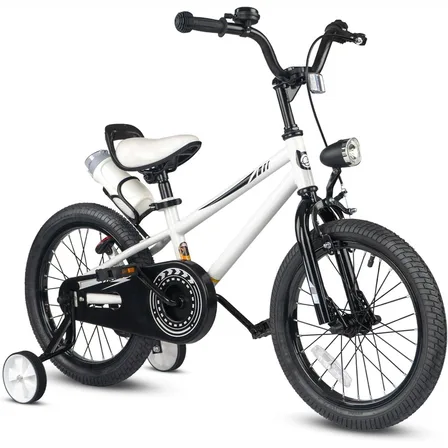
XJD Kids' Training Wheel Bike for Boys & Girls, 12/14/16 Inch – White
The XJD kids' training wheel bike in White is made for riders ages 3–8 (roughly …$169
$199 -

Blue XJD Girls Bike with Training Wheels – 12/14/16 Inch
If you're shopping for a first pedal bike for a daughter roughly 3 to 8 years ol…$149
$169