

What age for 24 inch bike
A 24-inch bike usually suits ages 10–14 and riders 54–64 inches (137–163 cm) tall. Measure the child and confirm the individual fit before buying.
Age is only the starting point
The XBikes age range answers the headline question, but height and actual control matter more than a birthday. Children of the same age can differ substantially in leg length, arm length, coordination and confidence. A shorter 13-year-old may not yet fit a particular 24-inch bicycle, while a tall 9-year-old may be ready to try one.
Do not choose an oversized bicycle merely to leave room for growth. The child should try the exact bicycle whenever possible. Frame shape and adjustment ranges can differ even when two bicycles share the same wheel size.
Measure height and inseam
First, measure the child’s full height without shoes, standing straight against a wall. Compare that measurement with the 24-inch starting range:
| Wheel size | Starting age | Rider height |
|---|---|---|
| 24 Inch | 10–14 | 54–64 in / 137–163 cm |
Next, measure inseam. Have the child stand in socks with feet slightly apart. Place a firm, thin book between the legs and raise it until it meets the body as a bicycle saddle would. Measure from the floor to the top edge of the book. Use that number when checking the stand-over space and saddle adjustment on the exact model; wheel diameter alone cannot establish whether the frame fits.
If the child is below 54 inches (137 cm), compare the fit of a 20-inch bicycle instead of assuming a 24-inch model will work. The XBikes starting range for 20-inch wheels is ages 7–12 and heights 48–60 inches (122–152 cm). If the rider is over 60 inches (153 cm), a 26-inch model can also become a comparison point, but overlap between ranges is a reason to try bicycles—not proof that either size fits.
Check the exact bicycle in person
With the child wearing the shoes used for riding, check whether they can stand over the bicycle without the frame preventing a stable stance. They should be able to mount, start, stop and get a foot down without panic or awkward stretching.
Then look at the upper-body position. The rider should reach the handlebar without locking the elbows, leaning excessively or losing a balanced posture. Ask them to turn the handlebar both ways while remaining in control.
Brake operation is equally important. The child must be able to reach and operate the brake controls reliably from a normal riding position. A bicycle that meets the age and height chart is still unsuitable if the controls are beyond comfortable reach. Current confidence also matters: a rider who cannot start, steer or stop predictably may need a smaller or more familiar bicycle while developing those skills.
How the supplied catalog option helps
The supplied catalog listing, 26-Inch XJD Beach Cruiser Bike for Girls – Purple, V-Brake, includes SKU labels for Mint Green / 24 Inch and Pink / 24 Inch, as well as 20-inch and 26-inch options. Those labels make it useful for comparing the requested 24-inch size with adjacent wheel sizes, but its 26-inch product title must not be treated as evidence that every listed configuration has the same wheel size or fit.

Select the exact SKU label carefully. The Purple option supplied here is labeled only as 26 Inch, so it is not a 24-inch substitute. The Mint Green and Pink labels include 24 Inch, but color and wheel-size wording do not confirm frame clearance, saddle range, reach or brake control. Verify the chosen configuration and have the child complete the same individual fit check.
Confirm setup and riding readiness
Before riding, follow the manual for the exact product and configuration. The supplied catalog information does not provide assembly procedures, adjustment limits, compatibility details, load limits or torque values. Do not guess at any of them; if the manual is unclear or the setup cannot be confirmed, use a qualified bicycle mechanic.
A bicycle helmet must fit properly, sit level on the head and have its straps used according to the helmet manufacturer’s instructions. Choose a controlled area away from traffic for the first fit check and ride. Confirm that the child can repeatedly start, steer, brake and stop before moving to a more demanding setting.
Make the 24-inch decision
Choose a 24-inch bike only when the child is near the 54–64 inch (137–163 cm) starting range and the exact bicycle passes the inseam, stand-over, reach, brake-control and confidence checks. If any check fails, do not size up for future growth: compare a 20-inch option or another frame now, and reconsider 24 inches after the rider grows or gains control.
Bikes for your next adventure
-

26-Inch XJD Beach Cruiser Bike for Girls – Purple, V-Brake
This XJD 26-inch purple beach cruiser is sized for big kids and teens — suggeste…$218.49
$229.99 -
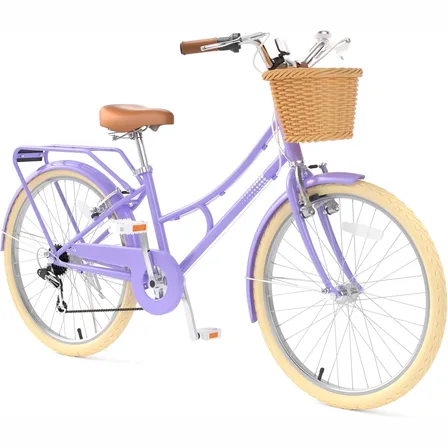
24-Inch Purple XJD Beach Cruiser Bike with U-Brake
The XJD 24-Inch Purple Beach Cruiser is built for girls and young women roughly …$159.99
-
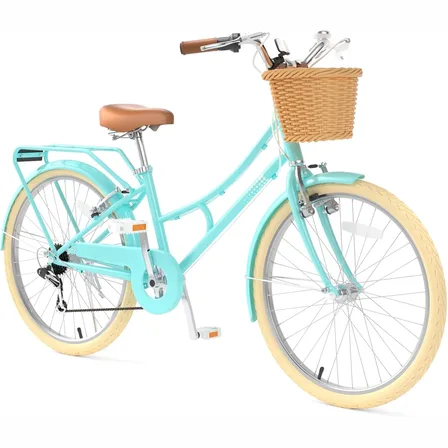
XJD 24-Inch Green Beach Cruiser Bike with U-Brake
This XJD 24-inch beach cruiser in green is made for riders about 4'8" to 5'4" ta…$159.99
$199.99