

How tall for a 24 inch bike
A 24-inch bike is an XBikes starting point for a rider 54–64 inches (137–163 cm) tall, usually ages 10–14. Measure the child first, then confirm stand-over clearance, reach, brake control and confidence on the actual bicycle.
Measure height and inseam before choosing
Have the child stand without shoes against a wall, looking straight ahead. Measure from the floor to the top of the head for total height. Compare that result with the 54–64 inch (137–163 cm) starting range for a 24-inch wheel bike.
Next, measure inseam. With the child standing naturally, place a firm, thin book between the legs to represent the saddle area, then measure from the floor to the top edge of the book. The supplied wheel-size standard does not give a numerical inseam requirement, so use this measurement only when checking the geometry and stand-over guidance for the exact bicycle.
Age is secondary. Although 24-inch bikes are generally associated with ages 10–14, children of the same age can differ substantially in height, leg length, arm length and riding ability.
Compare the rider with the XBikes starting points
| Wheel size | Rider-height starting point | What the comparison suggests |
|---|---|---|
| 20 Inch | 48–60 in / 122–152 cm | Worth comparing if the rider is below, or near the lower end of, the 24-inch range. |
| 24 Inch | 54–64 in / 137–163 cm | The requested starting range, subject to an individual fit check. |
| 26 Inch | Over 60 in / 153 cm | A separate larger-wheel category; it is not automatically suitable at 60 inches. |
The ranges overlap, so height alone does not settle every borderline case. A rider between 54 and 60 inches may fit either a 20-inch or 24-inch design differently, while someone over 60 inches may still have better control on a particular 24-inch bike than on a particular 26-inch bike. Compare actual fit rather than treating the chart as a guarantee.
Perform the fit check on the actual bike
Ask the child to try the bicycle instead of buying an oversized model for future growth. Check these points before deciding:
- Stand-over: The child should be able to straddle the bicycle without the frame preventing a stable stance. Use the exact product manual for model-specific fit guidance.
- Reach: With hands on the controls, the rider should not need to stretch, lock the elbows or slide forward simply to reach the handlebar.
- Brake control: The rider must be able to reach and operate the fitted brakes deliberately while maintaining a secure grip.
- Starting and stopping: In a controlled area, confirm that the child can start, steer, stop and put a foot down without panic or loss of balance.
- Confidence: Hesitation caused by the bike feeling tall, long or difficult to control is a reason to compare a smaller option, even when height falls within the chart.
How the supplied 24-inch options help
The catalog includes two bicycles explicitly titled as 24-inch models and another product with 20-, 24- and 26-inch SKU labels. They provide relevant wheel-size and brake-label comparisons, but their titles and variants cannot replace checking the individual rider on the exact selected configuration.
 24-Inch Purple XJD Beach Cruiser Bike with U-Brake
A directly relevant 24-inch catalog option whose exact title specifies purple and a U-brake. Its only available SKU label is Default, so confirm individual stand-over, reach and control.
 26-Inch XJD Beach Cruiser Bike for Girls – Purple, V-Brake
The title specifies 26 inches, but the catalog includes mint green and pink 24-inch SKU labels alongside 20- and 26-inch variants. Confirm the exact selected size rather than relying on the title.
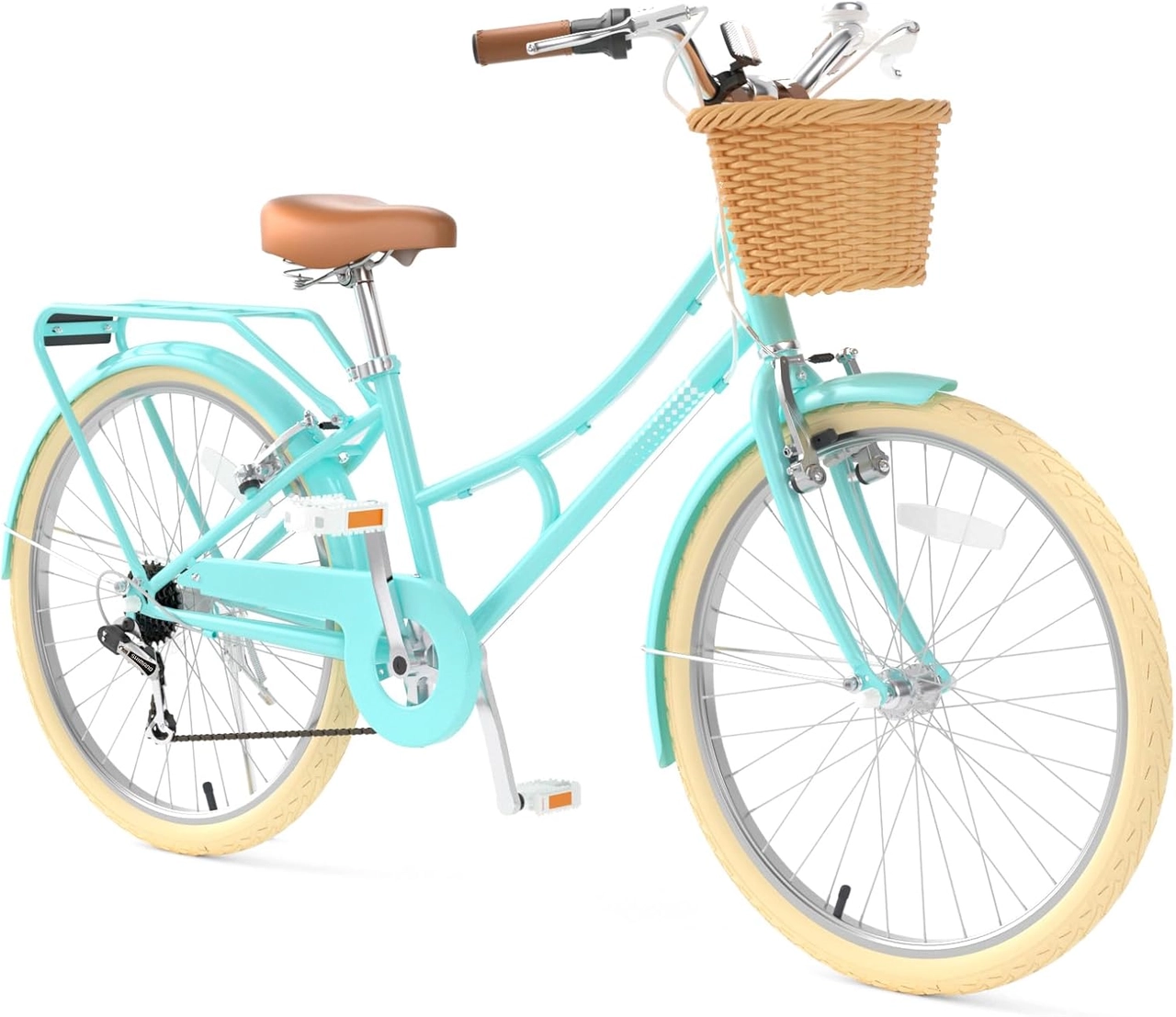 XJD 24-Inch Green Beach Cruiser Bike with U-Brake
A directly relevant 24-inch U-brake model with Green / 24 Inch and Pink / 24 Inch variants. The catalog also lists Pink / 26 Inch, so verify the selected SKU.
The 24-Inch Purple XJD Beach Cruiser Bike with U-Brake is directly relevant because its exact title specifies a 24-inch wheel size and U-brake; its available SKU label is Default.
The XJD 24-Inch Green Beach Cruiser Bike with U-Brake also directly matches the requested wheel size. Its listed variants are Green / 24 Inch, Pink / 24 Inch and Pink / 26 Inch, so verify that the selected SKU is one of the 24-inch variants.
The 26-Inch XJD Beach Cruiser Bike for Girls – Purple, V-Brake has 20-, 24- and 26-inch SKU labels in mint green and pink, plus Purple / 26 Inch. Despite the 26-inch wording in its product title, its catalog includes 24-inch variants. Treat that title as a catalog label and confirm the exact size and color selection rather than assuming every variant is 26 inches.
Know when a 24-inch bike is not the right choice
Do not choose a 24-inch bike merely because the child will grow into it. Compare a 20-inch bicycle when the rider is below the 24-inch height starting point or cannot stand over, reach, brake, start and stop confidently. Consider the separate 26-inch category only for a rider over 60 inches (153 cm), followed by the same hands-on checks.
Before riding, use a properly fitting bicycle helmet. It should sit level, with its straps adjusted according to the helmet manufacturer’s instructions. Follow the exact bicycle manual or ask a qualified bicycle mechanic for assembly, maintenance, compatibility, load-limit and torque information.
Decision: If the rider measures 54–64 inches and comfortably passes every fit and control check on the chosen 24-inch configuration, it is a reasonable size to consider; otherwise, compare the adjacent wheel size that gives the child better control now.
Bikes for your next adventure
-
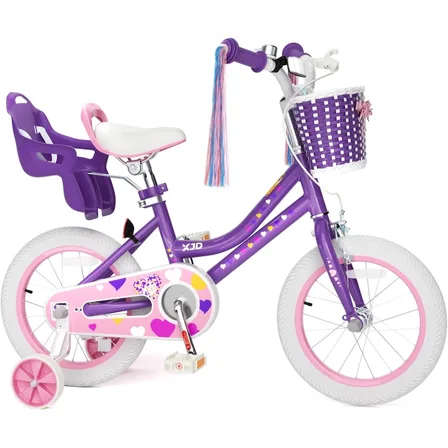
Purple XJD Girls' Bike with Doll Seat & Basket
For girls 71–122 cm tall (about ages 3–7), this XJD girls' bike in Purple pairs …$75.99
$99.99 -

Blue XJD Girls Bike with Training Wheels – 12/14/16 Inch
If you're shopping for a first pedal bike for a daughter roughly 3 to 8 years ol…$149
$169 -

XJD Boys 12/14/16" Training Wheel Bike – Blue
The XJD Boys Bike in Blue is a training wheel bike for riders 71–122 cm tall—rou…$169
$199