

What age is 24 inch bike suitable for
A 24-inch bike is generally suitable for ages 10–14 and riders 54–64 inches (137–163 cm) tall, but the child’s individual fit matters more than age.
Start with height, not the birthday
The age range is a starting point, not a guarantee. Measure the child’s height without shoes, standing straight against a wall. If the result falls within 54–64 inches (137–163 cm), a 24-inch bike is a reasonable size to try.
Children of the same age can have different proportions, strength and riding experience. A taller 9-year-old might be ready to try this wheel size, while a shorter or less confident 12-year-old might control a 20-inch bike more comfortably. The deciding evidence comes from an actual fit check.
Measure inseam before comparing bikes
To measure inseam, have the child stand in socks with their back against a wall and feet slightly apart. Place a firm book between the legs, bringing it up gently to simulate the position of a saddle. Measure from the floor to the top edge of the book.
Compare that measurement with the stand-over clearance and sizing information for the exact bicycle. Geometry varies even when two bikes share a 24-inch wheel label, so wheel diameter alone cannot establish whether the frame fits. Use the product manual or ask a qualified bicycle mechanic if the required measurements are unclear.
What to check during a test fit
The American Academy of Pediatrics recommends having a child try the bicycle and avoiding an oversized bike bought merely for future growth. During the trial, check all of the following:
- Stand-over: The child can straddle the bicycle as directed by its manufacturer without the frame preventing a stable stance.
- Starting and stopping: The rider can get on, begin riding and stop without struggling to manage the bicycle.
- Reach: The handlebars are reachable without excessive stretching, locked elbows or loss of steering control.
- Brake control: The child can reach and operate the fitted brakes confidently while keeping control of the handlebars.
- Confidence: The wheel size and frame do not make the rider hesitant, unstable or dependent on an adult to hold the bike.
If any of these checks fail, do not assume the child will quickly grow into the bicycle. Compare another frame or wheel size.
When to compare 20-, 24- and 26-inch options
| Wheel size | XBikes starting point | How to use it |
|---|---|---|
| 20 Inch | Ages 7–12; 48–60 in / 122–152 cm | Compare when the rider is shorter, overlaps both ranges or lacks confidence on a 24-inch bike. |
| 24 Inch | Ages 10–14; 54–64 in / 137–163 cm | Try when measured height is in range, then verify inseam, reach, braking and control. |
| 26 Inch | Youth and adults over 60 in / 153 cm | Consider only when height supports it and the individual fit check confirms comfortable control. |
The overlapping height bands are useful comparison points, not instructions to size up. A rider over 60 inches may still fit a particular 24-inch bicycle better than a 26-inch model because frame geometry and body proportions differ.
How the supplied catalog options help
All three supplied bicycles offer a 24 Inch SKU, so they are directly relevant for comparing the requested wheel size. Two also provide 20 Inch and 26 Inch labels, which can help families compare adjacent sizes while completing a real fit check.
 Pink XJD Beach Cruiser Bike, 24"/26", U-Brake
Available in 24 Inch and 26 Inch labels, this beach cruiser is relevant for comparing the requested size with a larger option. Its title specifies a U-Brake; verify the child’s reach, operation and control individually.
 XJD Kids Beach Cruiser Bicycle, Rear Rack & V-Brakes, Mint Green
Its 20 Inch, 24 Inch and 26 Inch labels make it useful for comparing the target wheel size with adjacent choices. The title identifies a rear rack and V-brakes, but neither establishes fit.
 XJD Pink Beach Cruiser for Girls – Rear Rack & V-Brake
This model offers 20 Inch, 24 Inch and 26 Inch labels for direct size comparison. Its catalog title mentions a rear rack and V-Brake; an individual stand-over, reach, braking and confidence check remains necessary.
The Pink XJD Beach Cruiser Bike, 24"/26", U-Brake is offered in 24 Inch and 26 Inch labels. It is relevant when comparing the requested size with the larger starting point; its catalog title identifies a U-Brake, but fit still depends on the child’s ability to reach and operate it.
The XJD Kids Beach Cruiser Bicycle, Rear Rack & V-Brakes, Mint Green has 20 Inch, 24 Inch and 26 Inch labels. Those choices allow comparison on both sides of 24 inches. Its title identifies a rear rack and V-brakes, neither of which proves rider fit.
The XJD Pink Beach Cruiser for Girls – Rear Rack & V-Brake likewise has 20 Inch, 24 Inch and 26 Inch labels. Treat the wording in its title as catalog identification, not evidence that it fits a particular child. Confirm reach and brake operation on the selected size.
Make the final 24-inch decision
Choose a 24-inch bike only when the child’s measured height supports the 54–64-inch range and a hands-on check confirms suitable stand-over, reach, braking and confident control. Follow the exact product manual or use a qualified bicycle mechanic for assembly, adjustment, maintenance, compatibility or torque questions.
Before riding, add a properly fitting bicycle helmet. The U.S. Consumer Product Safety Commission advises that it sit level and that its straps be used according to the helmet manufacturer’s instructions. If the child cannot control the 24-inch bike comfortably today, compare a 20-inch option instead of buying room to grow.
Bikes for your next adventure
-

26-Inch XJD Beach Cruiser Bike for Girls – Purple, V-Brake
This XJD 26-inch purple beach cruiser is sized for big kids and teens — suggeste…$218.49
$229.99 -
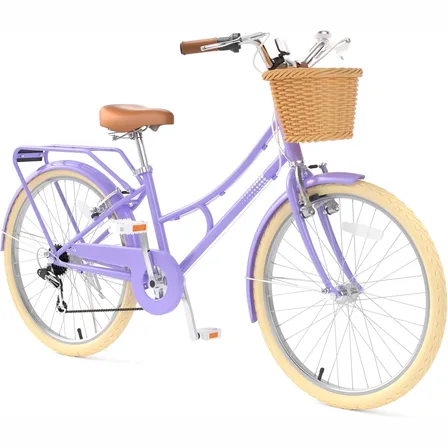
24-Inch Purple XJD Beach Cruiser Bike with U-Brake
The XJD 24-Inch Purple Beach Cruiser is built for girls and young women roughly …$159.99
-

XJD 24-Inch Green Beach Cruiser Bike with U-Brake
This XJD 24-inch beach cruiser in green is made for riders about 4'8" to 5'4" ta…$159.99
$199.99