

What age is a 16 inch wheel bike for
A 16 inch wheel bike is a starting point for ages 4–7 and riders 40–48 in (102–122 cm) tall, but your child must pass an individual fit check.
Use height before age
Age gives you a quick place to begin, not a final size. Children of the same age can differ substantially in height, leg length, reach and confidence. Measure your child rather than choosing from a birthday alone.
Have the child stand straight without shoes against a wall. Measure from the floor to the top of the head for height. Then measure inseam from the floor to the crotch, using a book held level between the legs to represent the saddle area. Compare measured height with the XBikes starting range, then use inseam during the physical fit check.
| Wheel size | Starting age | Rider height |
|---|---|---|
| 14 Inch | 3–6 | 37–45 in / 94–114 cm |
| 16 Inch | 4–7 | 40–48 in / 102–122 cm |
| 18 Inch | 5–9 | 43–52 in / 109–132 cm |
The overlapping ranges are intentional starting points. A rider within the overlap might fit more than one nominal wheel size, so the bicycle itself must settle the decision.
Check a 16 inch bike in person
Have your child try the exact bicycle, wearing the shoes normally used for riding. Confirm these points before accepting the size:
- Stand-over: the child can straddle the bicycle without being pressed against the frame.
- Starting and stopping: the rider can get on, set off and put a foot down without panic or excessive leaning.
- Reach: the handlebars can be held with relaxed arms while the child remains balanced and able to steer.
- Brake control: the child can reach and operate the fitted braking controls confidently.
- Overall control: turning, stopping and dismounting look deliberate rather than stretched or unstable.
Exact clearances and adjustment procedures vary by bicycle. Follow its product manual, and use a qualified bicycle mechanic if assembly or fit adjustments are uncertain.
When 16 inches is the wrong choice
A 16 inch wheel bike is probably too large if the child cannot comfortably straddle it, reach its controls, steer without stretching or stop securely. Do not buy an oversized bicycle merely to leave room for growth. A bike that may fit later does not provide suitable control now.
It may be too small if the rider appears cramped, cannot achieve an appropriate riding position within the permitted adjustments, or has clearly moved beyond its height range. A child taller than 48 in (122 cm) reaches the 20 inch starting range of ages 7–12 and 48–60 in (122–152 cm), but that is still only a prompt to try the next size—not proof of fit.
If your child is near a boundary, compare the actual bikes side by side. Confidence matters: a newer rider may control one fit more comfortably, while an experienced rider may handle another, provided stand-over, reach and braking remain appropriate.
How the supplied bike helps with comparison
The Black XJD Kids Bike for Boys – 12, 14 & 16 Inch Sizes is listed in the Training Wheel Bikes category and has 12 Inch, 14 Inch and 16 Inch SKU labels. Its 16 Inch option directly matches the wheel size in question, while its smaller labeled options can help a parent compare nearby sizes when the child is below the 16 inch range or cannot control that size comfortably. The name is a catalog title, not evidence of fit; select by the individual rider’s measurements and trial.

No supplied facts establish its frame dimensions, brake type, adjustment range, assembly method, load limit or compatibility. Check the exact product manual or ask a qualified bicycle mechanic about those details before riding.
Complete the safety check
Wheel size alone does not make a bicycle ready to ride. Make sure the bicycle is assembled and adjusted according to its manual, and verify that the rider can use its controls in a quiet, traffic-free practice area with close adult supervision.
Use a bicycle helmet that fits properly. It should sit level and be secured with its straps according to the helmet manufacturer’s instructions. Recheck the fit rather than relying only on the helmet’s printed size.
Your next decision
- Measure your child’s height and inseam without shoes.
- Use 40–48 in (102–122 cm) and ages 4–7 only as the 16 inch starting point.
- Have the child try the exact 16 inch bicycle and check stand-over, reach, braking, starting and stopping.
- If control is strained or uncertain, compare the adjacent appropriate size instead of buying for future growth.
Choose the 16 inch bike only if your child’s current measurements and real-world control both support it today.
Bikes for your next adventure
-
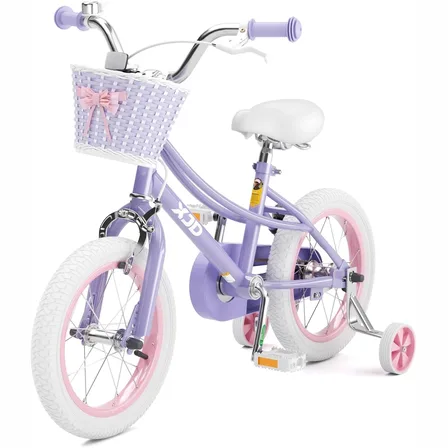
Girls' Training Wheel Bike by XJD with Basket – Purple
If you're shopping for a first bike for a girl roughly 3 to 12 years old (91–152…$75.99
-

XJD Girls Bike for Kids Ages 3-8, 12/14/16 Inch with Training Wheels – Purple
The XJD Girls Bike in Purple is a training-wheel bicycle for kids ages 3 to 8, f…$149
$169 -

Blue XJD Girls Bike with Training Wheels – 12/14/16 Inch
If you're shopping for a first pedal bike for a daughter roughly 3 to 8 years ol…$149
$169