

What age is an 18 inch bike frame for
An 18-inch bike is generally for children ages 5–9 who are 43–52 inches (109–132 cm) tall, but the rider’s measurements and control matter more than age.
Start with height, not the birthday
The age range is only a starting point because children of the same age can differ greatly in height, leg length and confidence. Measure your child’s height without shoes, standing upright against a wall. Then compare it with the 18-inch starting range of 43–52 inches (109–132 cm).
Also measure inseam: with shoes off, have the child stand with feet slightly apart and measure from the floor to the crotch. There is no single inseam number in the XBikes standard for an 18-inch bike, so use that measurement when checking the bicycle’s stated stand-over and saddle-adjustment information. Follow the exact bike manual where those specifications are provided.
What “18 inch” means
In children’s bicycles, 18 inches normally describes the wheel size, not the frame measurement. If a listing literally says “18-inch frame,” confirm whether it means the frame or wheels before choosing. An 18-inch adult-style frame and an 18-inch children’s wheel size are not equivalent.
For the wheel-size meaning used here, the XBikes starting points around this size are:
| Wheel size | Starting age | Rider height |
|---|---|---|
| 16 Inch | 4–7 | 40–48 in / 102–122 cm |
| 18 Inch | 5–9 | 43–52 in / 109–132 cm |
| 20 Inch | 7–12 | 48–60 in / 122–152 cm |
The ranges overlap deliberately. A child near a boundary may fit either neighboring size on paper, but only an individual fit check can show which bicycle allows easier, more confident control.
Check the child on the actual bicycle
Have the child try the bicycle rather than selecting solely from a chart. The American Academy of Pediatrics advises against buying an oversized bicycle for a child to grow into. On a correctly sized option, check that the rider can:
- Stand over the bicycle with comfortable clearance rather than being pressed against it.
- Mount, start, steer and stop without struggling to manage the bicycle’s size.
- Reach the handlebars without an excessive stretch or locked elbows.
- Operate the brakes comfortably and reliably, if hand brakes are fitted.
- Place their feet as directed by the bicycle manufacturer while learning or stopping.
Current confidence matters too. A hesitant beginner may control a smaller option more successfully than a larger bicycle that technically falls within the height range. Do not move up merely to extend the time before the next purchase.
How the supplied XBikes options relate
Neither supplied product has an 18-inch SKU. The Light Pink XJD Girls' Bicycle with Basket & Training Wheels and the Girls' Training Wheel Bike by XJD, 12–20 Inch Wheels – Blue are both cataloged as training-wheel bikes with 12-, 14-, 16- and 20-inch options. They therefore provide nearest-size comparison points—16 inches below and 20 inches above—but are not substitutes for an 18-inch bicycle.
 Light Pink XJD Girls' Bicycle with Basket & Training Wheels
Available in 12-, 14-, 16- and 20-inch SKUs. Its 16- and 20-inch versions can serve as neighboring-size fit comparisons, but neither is an 18-inch substitute.
 Girls' Training Wheel Bike by XJD, 12–20 Inch Wheels – Blue
This training-wheel bike has 12-, 14-, 16- and 20-inch SKU labels. The 16- and 20-inch choices are comparison points around 18 inches, subject to an individual fit check.
For a child who measures 43–48 inches, comparing an available 16-inch version with a true 18-inch bicycle may help clarify stand-over, reach and control. For a child who measures 48–52 inches, an available 20-inch version can be another comparison, but the 20-inch starting standard is ages 7–12 and 48–60 inches tall. Being tall enough to enter that range does not prove the larger bike fits.
Choose between these catalog options only after the child tries the relevant available size. Their training-wheel category does not establish fit, brake reach or confidence for an individual rider. For assembly, adjustment, compatibility, maintenance or limits, follow the exact product manual or consult a qualified bicycle mechanic.
Make the final 18-inch decision
- Confirm that “18 inch” refers to wheel size rather than frame size.
- Measure standing height and inseam without shoes.
- Use ages 5–9 and 43–52 inches (109–132 cm) only as starting guidance.
- Arrange an actual fit check for stand-over clearance, reach, steering and braking.
- Reject any bicycle the child cannot start, control and stop confidently, even if the chart appears to match.
Add a properly fitted bicycle helmet for every ride. U.S. Consumer Product Safety Commission guidance says the helmet should sit level and its straps should be adjusted according to the manufacturer’s instructions.
If the child falls within the 18-inch height range and controls a true 18-inch bicycle comfortably, that size is a reasonable choice. If not, compare the neighboring size that matches the child’s measured height and demonstrated control—never size up only for growth.
Bikes for your next adventure
-
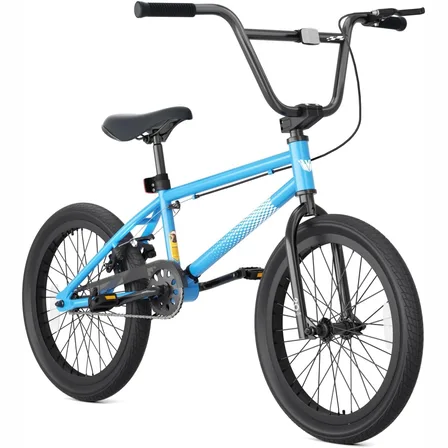
Blue XJD Freestyle BMX Bike, 20-Inch – No Pegs
The XJD 20-Inch Blue Freestyle BMX is an entry-level BMX bike for boys and girls…$189.99
-

26-Inch XJD Beach Cruiser Bike for Girls – Purple, V-Brake
This XJD 26-inch purple beach cruiser is sized for big kids and teens — suggeste…$218.49
$229.99 -
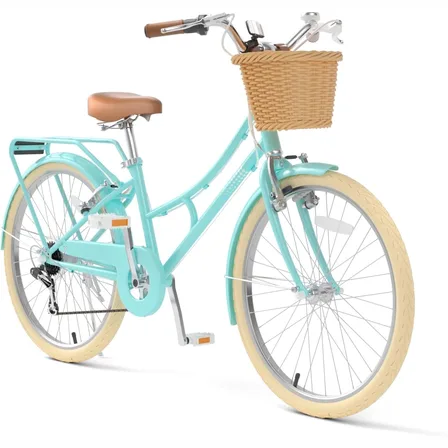
XJD Kids Beach Cruiser Bicycle, Rear Rack & V-Brakes, Mint Green
The XJD Beach Cruiser in Mint Green is a geared, multi-speed cruiser bike for ol…$179.99
$209.99