

What age rides a 16 inch bike
A 16 inch bike usually suits children ages 4–7 who are 40–48 inches (102–122 cm) tall, but measured fit and control matter more than age.
Start with height, not the birthday
The age range is a useful starting point, not a guarantee. Children of the same age can differ greatly in height, leg length, reach and confidence. Measure the child’s height without shoes, standing straight against a wall. Then compare that measurement with the XBikes 16 Inch starting range of 40–48 inches (102–122 cm).
If the child falls outside that height range, compare the neighboring wheel sizes rather than forcing the age recommendation to fit. A child near a boundary should try the actual bicycle because frame shapes and riding positions can differ even when wheel diameters match.
| Wheel size | Starting age | Rider height |
|---|---|---|
| 14 Inch | 3–6 | 37–45 in / 94–114 cm |
| 16 Inch | 4–7 | 40–48 in / 102–122 cm |
| 18 Inch | 5–9 | 43–52 in / 109–132 cm |
| 20 Inch | 7–12 | 48–60 in / 122–152 cm |
Measure inseam and check stand-over clearance
Height narrows the choice, but inseam helps reveal whether the child can manage the frame. Measure from the floor to the crotch while the child stands in socks with feet slightly apart. Record the result and compare it with the bicycle manufacturer’s fit information rather than assuming every 16 inch model has identical dimensions.
Have the child straddle the bicycle with both feet flat on the ground. There should be usable clearance between the child and the top tube, and mounting or stepping off should feel controlled. Do not buy an oversized bicycle merely to allow room for growth. If the child cannot stand over it comfortably, the bike is not an appropriate current fit.
Confirm reach, brakes and confidence
Seat the child on the bicycle and watch the whole riding position. The child should reach the handlebar without stretching, twisting forward or locking the elbows. They must be able to steer through turns while remaining balanced.
Check brake control on the exact model. The child should reach and operate the controls confidently with their hands in a stable riding position. If reaching the brakes pulls the hands away from secure control, do not rely on age or wheel size to approve the fit.
Current confidence matters too. In a safe, traffic-free fitting area with close adult supervision, ask the child to start, steer, stop and get off. A 16 inch bicycle is relevant only when those actions are manageable. Follow the exact product manual for assembly, adjustment and maintenance, or use a qualified bicycle mechanic.
How the supplied 16 inch options compare
The three catalog options are relevant because each offers a labeled 16 Inch SKU, as well as nearby labeled sizes for comparison, and each is categorized as a training wheel bike. This makes them useful candidates to inspect after measurements indicate that 16 Inch is the right starting point; their catalog labels do not replace an individual fit check.
 Girls' Training Wheel Bike by XJD, 12–20 Inch Wheels – Blue
This blue XJD training wheel bike includes a labeled 16 Inch SKU, plus 12 Inch, 14 Inch and 20 Inch options for size comparison. The label is a starting point; confirm the child’s individual fit and control.
 XJD Girls' Bike with Training Wheels, 12/14/16/20 Inch – Purple
This purple XJD training wheel bike is offered in labeled 12 Inch, 14 Inch, 16 Inch and 20 Inch SKUs. Its 16 Inch option is relevant when measurements support that size, subject to an exact fit check.
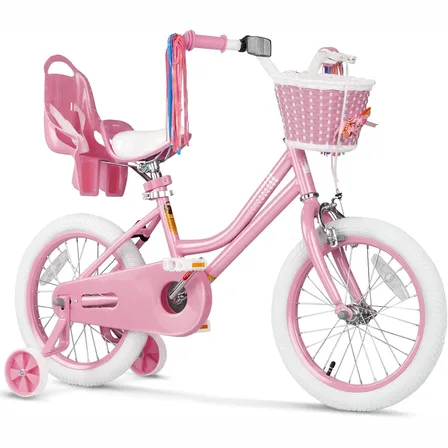
 XJD Kids Bike for Girls – Pink, 12/14/16/20 Inch with Training Wheels
This pink XJD kids training wheel bike lists 12 Inch, 14 Inch, 16 Inch and 20 Inch options. Consider its 16 Inch SKU only after checking rider height, stand-over clearance, reach, brake control and confidence.
Girls' Training Wheel Bike by XJD, 12–20 Inch Wheels – Blue lists 12 Inch, 14 Inch, 16 Inch and 20 Inch SKUs. XJD Girls' Bike with Training Wheels, 12/14/16/20 Inch – Purple lists the same four size labels. XJD Kids Bike for Girls – Pink, 12/14/16/20 Inch with Training Wheels also lists 12 Inch, 14 Inch, 16 Inch and 20 Inch options.
Because the supplied facts distinguish these products only by exact title, color wording and the same available wheel-size labels, they cannot establish which will fit a particular child better. Select the 16 Inch SKU only after checking the exact bicycle in person or against its product manual. Do not treat a 14 Inch or 20 Inch version as equivalent to a 16 Inch bicycle.
Make the final 16 inch decision
- Consider 16 Inch: the child is 40–48 inches (102–122 cm) tall and can comfortably stand over, reach, steer and operate the brakes on the exact bicycle.
- Compare another size: the measured height falls outside that range, or the child struggles with clearance, reach or control.
- Wait or seek fitting help: no available setup allows confident starting, steering, stopping and dismounting.
Finish with a properly fitting bicycle helmet. It should sit level, fit securely and use its straps according to the helmet manufacturer’s instructions. The practical answer is therefore not simply “ages 4–7”: measure the child, compare the 40–48 inch height range, and approve a 16 inch bike only after the child demonstrates comfortable control of that exact model.
Bikes for your next adventure
-

XJD Pink Beach Cruiser for Girls – Rear Rack & V-Brake
The XJD Pink Beach Cruiser for girls is the step-up bike for riders who've outgr…$179.99
$209.99 -

Flower Pink XJD Girls Bike with Doll Seat & Basket
The XJD Flower Pink girls' bike is made for riders 71–122 cm tall (roughly ages …$69.99
-
XJD Pink Girls' Bike – Kids 12/14/16 Inch Training Wheel Bicycle
The XJD Pink Girls' Bike is a training-wheel bicycle for girls ages 3 to 8 (ride…$149
$169