

What age should kids be able to ride a bike
Most children can begin riding a bike around ages 3–4, but age is only a starting point. Measure height, check inseam clearance, and confirm the child can reach, steer and brake confidently before choosing a bike.
What age should a child ride a bike?
There is no single correct age. Under the XBikes starting points, a 12-inch bike commonly suits ages 3–4, while a 14-inch bike spans ages 3–6 and a 16-inch bike spans ages 4–7. These ranges overlap because children of the same age can differ greatly in height, proportions, coordination and confidence.
Readiness matters as much as the calendar. A child should be able to sit in a controlled position, hold the handlebar without stretching, steer deliberately and operate the brakes they will use. They should also understand simple instructions such as stopping and looking ahead. If those actions are not yet manageable, wait or use a more suitable learning setup rather than forcing progress.
Measure before comparing wheel sizes
Measure the child’s height without shoes. Then measure the inseam from the floor to the crotch while the child stands upright. Compare height with the table, but use the inseam during an actual fit check to judge stand-over clearance and the ability to place feet down securely.
| Wheel size | Starting age | Rider height |
|---|---|---|
| 12 Inch | 3–4 | 34–40 in / 86–102 cm |
| 14 Inch | 3–6 | 37–45 in / 94–114 cm |
| 16 Inch | 4–7 | 40–48 in / 102–122 cm |
| 18 Inch | 5–9 | 43–52 in / 109–132 cm |
| 20 Inch | 7–12 | 48–60 in / 122–152 cm |
| 24 Inch | 10–14 | 54–64 in / 137–163 cm |
| 26 Inch | Youth and adults | Over 60 in / 153 cm |
These figures narrow the search; they do not establish fit. When a child falls into two overlapping ranges, compare both sizes in person where possible. Do not choose the larger one merely to leave room for growth.
Use this fit check before saying yes
- Stand-over: Have the child straddle the bike and check that the frame does not prevent comfortable, stable standing.
- Seated position: Confirm that the child can get on and off without being caught by the saddle or frame.
- Reach: Their hands should meet the handlebar naturally, without locked arms, leaning or excessive stretching.
- Steering: Ask them to turn the handlebar both ways while remaining balanced and in control.
- Braking: Make sure they can reach and operate the available brake controls reliably.
- Confidence: Watch for calm starts, planned stops and attention to the riding path. A visibly intimidated child may need more practice or a different fit.
The American Academy of Pediatrics advises having the child try the bicycle and avoiding an oversized purchase for future growth. Stand-over position, overall control and brake reach should decide between otherwise plausible sizes.
Where the supplied bikes are relevant
The two catalog options are useful when the measured child is comparing 12-, 14- or 16-inch training-wheel bikes. The Girls 12/14/16 Inch Kids Bike by XJD with Training Wheels – Peach is supplied in 12 Inch, 14 Inch and 16 Inch labels. The XJD Light Purple Girls Bike with Basket, Training Wheels, 12/14/16/20 Inch has supplied available SKU labels of 12 Inch, 14 Inch and 16 Inch; despite “20 Inch” appearing in its catalog title, a 20-inch available SKU is not included in the facts provided here.
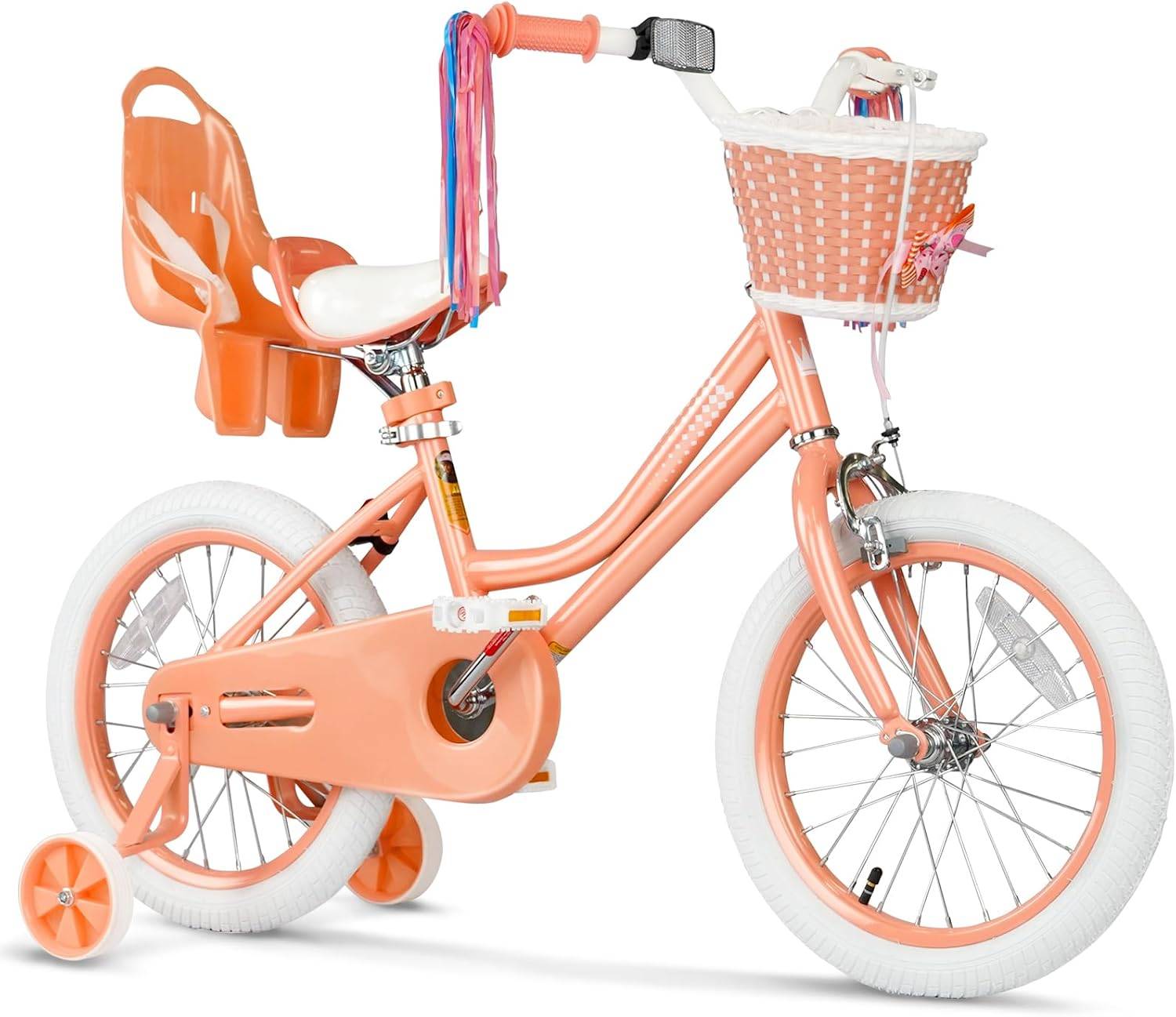 Girls 12/14/16 Inch Kids Bike by XJD with Training Wheels – Peach
A training-wheel bike offered in supplied 12 Inch, 14 Inch and 16 Inch labels, relevant when the child’s measured height and individual fit check point to one of those sizes.
 XJD Light Purple Girls Bike with Basket, Training Wheels, 12/14/16/20 Inch
A basket-equipped training-wheel bike with supplied available labels of 12 Inch, 14 Inch and 16 Inch. Its title mentions 20 Inch, but that size is not included in the supplied available SKU facts.
Use these products only after the child’s measurement points to one of their supplied sizes and an individual fit check succeeds. They are not relevant substitutes when the rider needs an 18-, 20-, 24- or 26-inch bike. Training wheels can provide support, but their presence does not correct poor reach, inadequate clearance or an oversized frame.
Do not skip the helmet and setup
Use a bicycle helmet that fits properly, sits level and has straps adjusted according to its manufacturer’s instructions. A helmet that is tipped back, loose or incorrectly strapped is not a satisfactory fit.
Before riding, follow the exact bicycle manual for assembly, adjustment, maintenance, compatibility, load limits and torque requirements. If instructions are missing, unclear or beyond your experience, use a qualified bicycle mechanic. Do not guess at safety-critical setup.
Make the age decision now
Start with the child’s measured height, shortlist the corresponding wheel size, and then test inseam clearance, reach, steering, braking and confidence. If every check works, the child is ready for that correctly fitted bike; if any essential check fails, try another size or wait and practise before riding.
Bikes for your next adventure
-

Pink 12/14/16/20" XJD Girls Bike with Training Wheels & Basket
The Pink XJD Girls Bike with Training Wheels & Basket is a first-bike pick f…$65.99
$75.99 -

XJD Girls Bike for Kids Ages 3-8, 12/14/16 Inch with Training Wheels – Purple
The XJD Girls Bike in Purple is a training-wheel bicycle for kids ages 3 to 8, f…$149
$169 -

XJD Kids Bike for Girls – Pink, 12/14/16/20 Inch with Training Wheels
The XJD Kids Bike for Girls in Pink is a training-wheel bike built to carry your…$139
$159