

What age should kids know how to ride a bike
There is no single age by which every child should know how to ride a bike. Use readiness and fit—not a birthday—to decide when to teach and what to try next.
Age is a starting point, not a deadline
Children develop balance, coordination, judgment and confidence at different rates. A child is ready to practise when they can follow simple instructions, steer with purpose, stop when asked and remain interested without becoming overwhelmed. Being later than a sibling or friend does not by itself signal a problem.
The useful question is not “Should my child already know?” but “Can my child control a correctly fitted bicycle in a suitable practice area?” Age can narrow the wheel-size search, but it cannot confirm fit or readiness.
Measure before choosing a bicycle
Measure the child’s standing height without shoes. Also measure inseam from the floor to the crotch while the child stands straight. Then have the child try the actual bicycle. They should be able to stand over it, reach the handlebar without an uncomfortable stretch, steer without fighting the bicycle and operate the brakes confidently.
Do not buy an oversized bicycle merely to allow room for growth. If the child cannot manage stand-over clearance, reach or braking now, the bicycle is not an appropriate current fit even when its age label appears suitable.
XBikes wheel-size starting points
| Wheel size | Age starting point | Rider height |
|---|---|---|
| 12 Inch | 3–4 | 34–40 in / 86–102 cm |
| 14 Inch | 3–6 | 37–45 in / 94–114 cm |
| 16 Inch | 4–7 | 40–48 in / 102–122 cm |
| 18 Inch | 5–9 | 43–52 in / 109–132 cm |
| 20 Inch | 7–12 | 48–60 in / 122–152 cm |
| 24 Inch | 10–14 | 54–64 in / 137–163 cm |
| 26 Inch | Youth and adults | Over 60 in / 153 cm |
Overlapping ranges are normal. Prioritize measured height, inseam, reach, brake control and current confidence over age alone. If two sizes appear possible, compare both with the child present rather than choosing from the table alone.
How the supplied bicycles help with the comparison
The three catalog options span several relevant wheel-size labels, so they can help a family compare age-based starting points with the child’s actual fit. They do not replace an individual try-on, and an available size should never be treated as equivalent to a different size.
 XJD Light Purple Girls Bike with Basket, Training Wheels, 12/14/16/20 Inch
Available in supplied 12 Inch, 14 Inch and 16 Inch SKU labels, this training-wheel model is relevant for comparing smaller early-learning sizes after measuring the rider and completing an individual fit check.
 XJD Kids Beach Cruiser Bicycle, Rear Rack & V-Brakes, Mint Green
Its supplied 20 Inch, 24 Inch and 26 Inch SKU labels make this beach cruiser relevant for taller children and youth whose measurements reach those starting ranges; it is not a substitute for a smaller size.
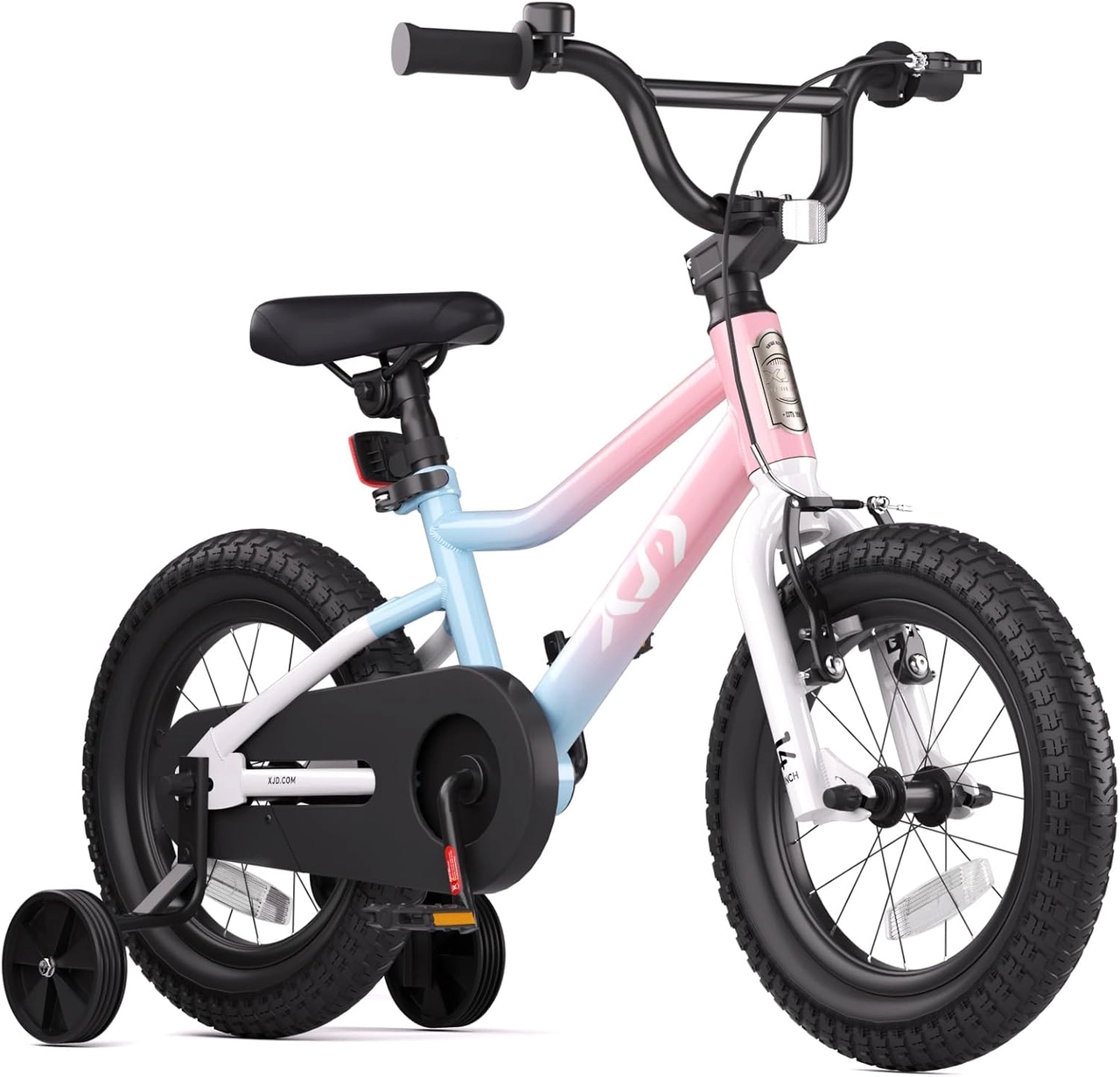 XJD Girls BMX Bike 12/14/16 Inch with Training Wheels – Pink Blue
This kids’ BMX model has supplied 12 Inch, 14 Inch and 16 Inch SKU labels plus training wheels, making it useful for comparing smaller sizes while still prioritizing reach, brake control and confidence.
The XJD Light Purple Girls Bike with Basket, Training Wheels, 12/14/16/20 Inch currently has supplied SKU labels for 12 Inch, 14 Inch and 16 Inch. Those labels cover several early-learning starting points in the table and make it relevant when comparing smaller sizes.
The XJD Girls BMX Bike 12/14/16 Inch with Training Wheels – Pink Blue likewise has supplied 12 Inch, 14 Inch and 16 Inch SKU labels. Compare the child’s measurements and control on each relevant size; the wording in the product title is not independent evidence of fit.
The XJD Kids Beach Cruiser Bicycle, Rear Rack & V-Brakes, Mint Green has supplied SKU labels for 20 Inch, 24 Inch and 26 Inch. It is relevant for taller children or youth whose measurements reach those starting ranges, not as a substitute for a smaller learning bicycle.
What to do during a fit check
- Match measured height to the table and shortlist the plausible wheel sizes.
- Have the child stand over and sit on each candidate bicycle.
- Check that the handlebar is comfortably reachable and the child can steer without excessive stretching.
- Confirm that the child can reach and operate the brakes with control.
- Choose the size the child can manage now, then practise in a flat area away from traffic and obstacles.
A properly fitting bicycle helmet is essential. It should sit level, fit properly and use its straps according to the helmet manufacturer’s instructions. An adult should supervise practice and stop the session if fatigue or frustration reduces control.
When to continue, pause or get help
Continue when the child can start with assistance, look ahead, steer a planned line and stop predictably. Keep sessions short enough that control and attention remain steady. Training wheels may support early familiarity on catalog models that include them, but their presence does not prove that the bicycle fits.
Pause and recheck fit if the child must lean or stretch markedly to reach the ground, handlebar or brakes, cannot control direction, or becomes frightened. Follow the exact product manual for assembly, maintenance, compatibility and adjustments not stated here; use a qualified bicycle mechanic when those instructions are unclear.
Decision: do not set a birthday deadline. Measure the child now, shortlist the matching wheel sizes, test stand-over, reach and braking, and begin only with the bicycle they can control confidently today.
Bikes for your next adventure
-

Kids Bike Helmet by XJD for Boys & Girls – Black, Blue, Green, Pink, Purple
The XJD Kids Bike Helmet covers a wide 2-to-8-year age range thanks to two head-…$59.99
-

Kids Bike Helmet by XJD for Girls – Pink
The XJD Kids Bike Helmet in Pink is a lightweight multi-sport helmet for girls r…$59.99
$99 -

XJD Kids Bike for Girls – Pink, 12/14/16/20 Inch with Training Wheels
The XJD Kids Bike for Girls in Pink is a training-wheel bike built to carry your…$139
$159