

What age would a 20 inch bike be for
A 20 inch bike is generally for ages 7–12 and riders 48–60 inches (122–152 cm) tall, but measured fit and control matter more than age.
Start with height, not the birthday
The age range is a useful starting point, not a guarantee. Children of the same age can differ greatly in height, leg length, reach and riding confidence. Measure the child without shoes, standing straight against a wall, and compare that height with the XBikes 20 inch starting range of 48–60 inches (122–152 cm).
If the child falls outside that range, do not assume a 20 inch bike will work. The neighboring XBikes starting points are 18 inch wheels for ages 5–9 and heights of 43–52 inches (109–132 cm), and 24 inch wheels for ages 10–14 and heights of 54–64 inches (137–163 cm). These ranges overlap because an individual fit check must settle the decision.
Measure the rider before choosing
Record the child’s standing height and inseam. For the inseam, have the child stand naturally and measure from the floor to the crotch. Compare both measurements with the bicycle maker’s exact sizing information, because wheel diameter alone does not reveal the frame’s stand-over height, seat range or reach.
Then consider present ability. A confident rider may manage a different riding position from a beginner of identical height, but confidence never makes an oversized frame fit. The American Academy of Pediatrics advises having the child try the bicycle and avoiding an oversized bike bought merely for future growth.
What to check during a 20 inch bike trial
A useful trial checks more than whether the child can touch a pedal. Have the child wear the shoes normally used for riding and verify these points:
- Stand-over: The child must be able to straddle the bicycle with appropriate clearance rather than being pressed against the frame.
- Starting and stopping: The rider should mount, begin moving and stop without losing control or needing an adult to hold the bicycle.
- Reach: The handlebars should be reachable without an exaggerated stretch, locked elbows or an awkwardly bent posture.
- Brake control: The child must be able to reach and operate the bicycle’s brakes confidently. Check the controls on the actual bicycle rather than assuming all 20 inch models feel alike.
- Pedaling and steering: Knees, hands and handlebars should move freely, and the rider should steer at low speed without wobbling caused by excessive reach.
If any of these checks fail, adjust only within the manufacturer’s instructions. Otherwise, try a different frame or wheel-size starting point. Do not rely on a promise that the child will “grow into it.”
How the supplied 20 inch options relate
The supplied catalog choices are relevant because each is a training-wheel bike offered with a specific 20 Inch SKU, alongside 12, 14 and 16 Inch SKUs. They let you identify the requested wheel-size variant while comparing two catalog options, but their titles and SKU labels do not replace an individual fit trial.
 Girls' Training Wheel Bike by XJD, 12–20 Inch Wheels – Blue
A relevant training-wheel bike with available 12, 14, 16 and 20 Inch SKU labels. Choose its 20 Inch variant only after confirming the child’s measurements, reach, brake control and confidence.
 XJD Girls' Bike with Training Wheels, 12/14/16/20 Inch – Purple
This purple training-wheel bike includes available 12, 14, 16 and 20 Inch SKU labels. Its 20 Inch option is relevant to the query, but the catalog label does not replace an individual fit check.
Blue option
Girls' Training Wheel Bike by XJD, 12–20 Inch Wheels – Blue is categorized and listed under Training Wheel Bikes. Its available SKU labels are 12 Inch, 14 Inch, 16 Inch and 20 Inch. Select the 20 Inch SKU only if the rider’s measurements, reach, brake control and confidence support that size.
Purple option
XJD Girls' Bike with Training Wheels, 12/14/16/20 Inch – Purple is also categorized and listed under Training Wheel Bikes, with 12 Inch, 14 Inch, 16 Inch and 20 Inch SKU labels. The supplied facts distinguish its title and purple description, but do not establish different geometry, components or fit.
Because both products include the requested 20 Inch label, they are relevant candidates rather than nearest-size substitutes. Confirm that the selected variant actually says 20 Inch; a smaller SKU from the same listing is not equivalent to the requested wheel size.
Finish the setup safely
Follow the exact product manual for assembly, adjustment, maintenance, compatibility, load limits and torque. Where the manual is unclear or the bicycle cannot be set up correctly, use a qualified bicycle mechanic rather than inventing an adjustment or tightening value.
A bicycle helmet is also essential, but its label alone does not prove fit. The U.S. Consumer Product Safety Commission advises that the helmet fit properly, sit level on the head and have its straps used according to the manufacturer’s instructions. Recheck helmet position each time the child rides.
Make the 20 inch decision
Choose a 20 inch bike when the child is near the 48–60 inch (122–152 cm) starting range and can comfortably straddle, reach, steer, pedal and operate the brakes on the actual bicycle. If those checks do not pass, try the appropriate neighboring size instead of buying 20 inches based on age or room to grow.
Bikes for your next adventure
-

XJD 24-Inch Green Beach Cruiser Bike with U-Brake
This XJD 24-inch beach cruiser in green is made for riders about 4'8" to 5'4" ta…$159.99
$199.99 -
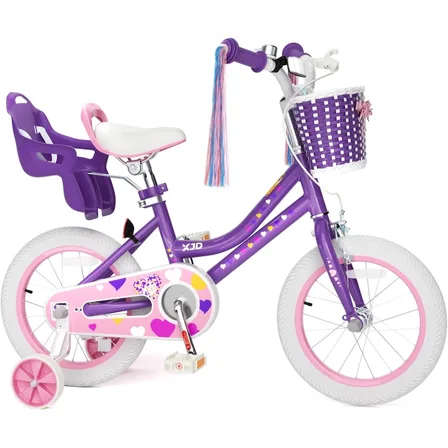
Purple XJD Girls' Bike with Doll Seat & Basket
For girls 71–122 cm tall (about ages 3–7), this XJD girls' bike in Purple pairs …$75.99
$99.99 -

Kids Bike Helmet by XJD for Boys & Girls – Black, Blue, Green, Pink, Purple
The XJD Kids Bike Helmet covers a wide 2-to-8-year age range thanks to two head-…$59.99