

What are the best kids bikes
The best kids bikes fit the rider now: match measured height to wheel size, then confirm stand-over clearance, reach, brake control and confidence.
Choose fit before features
Start by measuring the child’s height without shoes. Use the XBikes wheel-size ranges below to identify likely options, but treat them only as starting points. Age overlaps heavily between sizes, so height and an in-person fit check matter more than a birthday.
Have the child try the bicycle whenever possible. A suitable bike lets the rider get on and off comfortably, stand over it without being crowded by the frame, reach the controls without stretching, and steer and brake with confidence. Do not choose an oversized bicycle simply to leave room for growth; a bike that is difficult to control now is not the best choice.
XBikes wheel-size starting points
| Wheel size | Age starting point | Rider height |
|---|---|---|
| 12 Inch | 3–4 | 34–40 in / 86–102 cm |
| 14 Inch | 3–6 | 37–45 in / 94–114 cm |
| 16 Inch | 4–7 | 40–48 in / 102–122 cm |
| 18 Inch | 5–9 | 43–52 in / 109–132 cm |
| 20 Inch | 7–12 | 48–60 in / 122–152 cm |
| 24 Inch | 10–14 | 54–64 in / 137–163 cm |
| 26 Inch | Youth and adults | Over 60 in / 153 cm |
If the child falls within overlapping ranges, compare both plausible sizes in person rather than automatically choosing the larger one. The better option is the one the rider can mount, balance, steer and stop more comfortably. Measure inseam as well, then use the bicycle’s actual geometry and adjustment instructions to check fit; wheel diameter alone cannot establish stand-over clearance.
Run a practical fit check
- Check stand-over: Ask the child to straddle the bicycle with both feet planted. There should be comfortable clearance rather than pressure or an awkward lean.
- Check seated reach: The rider should hold the handlebar naturally without locking the elbows, hunching forward or sliding into an unstable position.
- Check brake control: Confirm the child can reach and operate the brake controls while maintaining a secure grip. A brake label alone does not prove that the controls fit a particular hand.
- Check handling: In a suitable traffic-free area, confirm that the rider can start, steer, look around, slow down and stop without panic or loss of control.
- Check confidence: If the rider appears tense or cannot repeat these actions reliably, reconsider the size or setup even when the height table suggests a match.
What to compare between suitable bikes
Only compare features after narrowing the choice to bicycles that fit. Focus on whether each candidate supports the child’s current riding: comfortable body position, manageable steering, reachable controls and predictable stopping. The best choice is not necessarily the model with the largest wheel or the most room to grow.
Also consider where the child will actually ride. A catalog category can help identify the intended style, but it does not replace fit or confirm suitability for every route. For assembly, adjustments, maintenance, load limits, component compatibility and torque settings, follow the exact product manual or use a qualified bicycle mechanic.
When the supplied 24-inch cruiser is relevant
The supplied catalog contains one relevant option rather than a complete size-by-size comparison: the 24-Inch Purple XJD Beach Cruiser Bike with U-Brake. Its 24-inch size makes it reasonable to consider for a rider near the XBikes 24-inch starting range of 54–64 in / 137–163 cm, commonly ages 10–14, provided an individual fit check confirms control. Its Beach Cruiser Bikes category also helps families specifically comparing that riding style.

This product is not relevant merely because the child is 10–14. It should be set aside if the rider’s measured height points to another wheel-size range, if stand-over or reach is unsuitable, or if the child cannot comfortably operate its controls. The exact title identifies a U-Brake, but that fact does not establish brake reach, performance or suitability for a particular rider; verify operation during the fit check and consult the manual or a qualified bicycle mechanic where needed.
Helmet fit belongs in the decision
Choose a bicycle helmet that fits the child properly. It should sit level and be secured with its straps according to the helmet manufacturer’s instructions. Recheck the fit rather than assuming a familiar helmet still fits, especially after growth or adjustment.
Your next step is simple: measure the rider’s height and inseam, shortlist the matching wheel sizes, and have the child try them. Select the bike the child can stand over, reach, steer and brake confidently today; consider the supplied 24-inch cruiser only if it passes every one of those checks.
Bikes for your next adventure
-

Flower Pink XJD Girls Bike with Doll Seat & Basket
The XJD Flower Pink girls' bike is made for riders 71–122 cm tall (roughly ages …$69.99
-

XJD Pink Beach Cruiser for Girls – Rear Rack & V-Brake
The XJD Pink Beach Cruiser for girls is the step-up bike for riders who've outgr…$179.99
$209.99 -
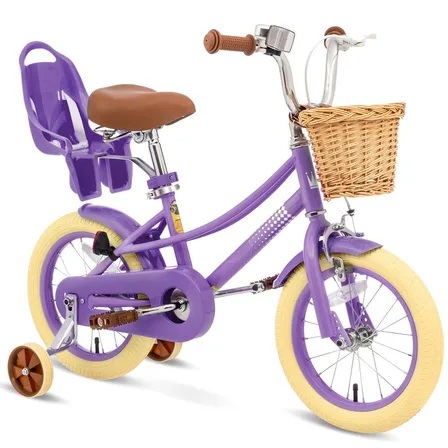
XJD Girls' Bike with Training Wheels, 12/14/16/20 Inch – Purple
The XJD girls' bike with training wheels in Purple is built to grow with your ri…$139
$159