

What does 20 in bike mean
“20” on a bike usually means a nominal 20-inch wheel size, not the frame size or the child’s height. It is a size category used to compare bicycles, but it does not guarantee that every 20-inch bike will fit or feel the same.
What the 20-inch label tells you
The label identifies the bicycle’s wheel-size class. It is useful for narrowing the search, yet wheel size alone cannot confirm fit. Frame shape, saddle position, handlebar reach and the child’s ability to operate the controls can change how two bicycles of the same wheel size feel.
For XBikes, a 20-inch wheel is a starting point for riders ages 7–12 and 48–60 inches (122–152 cm) tall. Treat age as a rough reference. The rider’s measured height, inseam, reach, brake control and current confidence matter more.
What to measure before choosing
- Height: Measure the child without shoes, standing straight against a wall. Compare the result with the 48–60 inch (122–152 cm) starting range.
- Inseam: Measure from the floor to the crotch while the child stands naturally. Use that measurement when checking whether the child can stand over the actual bicycle comfortably.
- Reach: On the bicycle, check that the child can hold the handlebars without locking the elbows, stretching forward excessively or losing a balanced riding position.
- Brake control: The child must be able to reach and operate the fitted brakes confidently while keeping control of the handlebars.
Have the child try the bicycle whenever possible. Do not choose an oversized model merely to leave room for growth. A bike that the child cannot mount, stop or steer confidently is not made suitable by an age recommendation.
Compare 20 inches with nearby sizes
| Wheel size | XBikes age starting point | Rider-height starting point |
|---|---|---|
| 16 Inch | Ages 4–7 | 40–48 in / 102–122 cm |
| 18 Inch | Ages 5–9 | 43–52 in / 109–132 cm |
| 20 Inch | Ages 7–12 | 48–60 in / 122–152 cm |
| 24 Inch | Ages 10–14 | 54–64 in / 137–163 cm |
These ranges overlap because children with similar ages can have different proportions and skill levels. Do not treat an 18-inch or 24-inch bicycle as equivalent to a 20-inch model. Use the table to identify candidates, then check the individual bicycle and rider together.
How the supplied XBikes options relate
These catalog options clarify the meaning of “20” by showing both multi-size models and a model that begins at 20 inches. They help you compare the requested wheel-size label with adjacent choices, but their titles and SKU labels still do not replace an individual fit check.
 XJD Kids Bike for Girls – Pink, 12/14/16/20 Inch with Training Wheels
Directly relevant because its supplied SKU labels include 20 Inch, alongside 12, 14 and 16 Inch comparison options in the Training Wheel Bikes category.
 XJD Light Purple Girls Bike with Basket, Training Wheels, 12/14/16/20 Inch
Useful only as a smaller-size comparison: despite 20 Inch appearing in the exact title, the supplied available SKU labels are 12, 14 and 16 Inch.
 XJD Kids Beach Cruiser Bicycle, Rear Rack & V-Brakes, Mint Green
Directly relevant as a Beach Cruiser Bikes option with supplied 20, 24 and 26 Inch SKU labels, allowing comparison between the requested size and larger wheel categories.
XJD Kids Bike for Girls – Pink, 12/14/16/20 Inch with Training Wheels is listed in Training Wheel Bikes and has 12 Inch, 14 Inch, 16 Inch and 20 Inch SKU labels. Its 20 Inch option is directly relevant if the rider’s measurements and control support that size.
XJD Light Purple Girls Bike with Basket, Training Wheels, 12/14/16/20 Inch is also listed in Training Wheel Bikes. Although “20 Inch” appears in its exact catalog title, the supplied available SKU labels are only 12 Inch, 14 Inch and 16 Inch. Therefore, it should be used as a smaller-size comparison here, not treated as an available 20-inch option.
XJD Kids Beach Cruiser Bicycle, Rear Rack & V-Brakes, Mint Green is listed in Beach Cruiser Bikes with 20 Inch, 24 Inch and 26 Inch SKU labels. It offers a direct comparison between the requested 20 Inch size and larger labeled sizes. The supplied facts identify its rear rack and V-brakes, but the child must still demonstrate suitable reach and brake control on the exact bicycle.
Do this fit check next
- Start with the measured height and use 20 inches as a candidate when the rider is within 48–60 inches (122–152 cm).
- Have the child mount and stand over the exact bicycle; check that the position allows comfortable clearance and control.
- Confirm that starting, steering, stopping and getting off are manageable at the child’s current confidence level.
- Check handlebar and brake reach rather than assuming that a matching age or wheel label proves fit.
For assembly, adjustment, maintenance, load limits, compatibility and torque requirements, follow the exact product manual or consult a qualified bicycle mechanic. Do not guess settings from wheel size.
Remember the helmet
A properly fitting bicycle helmet should sit level and be secured with its straps according to the helmet manufacturer’s instructions. Helmet fit is separate from bicycle sizing, so check both every time equipment or the child’s measurements change.
The practical decision is simple: read “20” as a 20-inch wheel category, measure the rider, compare the 48–60 inch starting range, and choose that size only after the child can stand over, reach, steer and brake on the exact bike with confidence.
Bikes for your next adventure
-

XJD 24-Inch Green Beach Cruiser Bike with U-Brake
This XJD 24-inch beach cruiser in green is made for riders about 4'8" to 5'4" ta…$159.99
$199.99 -

Kids Bike Helmet by XJD for Girls – Pink
The XJD Kids Bike Helmet in Pink is a lightweight multi-sport helmet for girls r…$59.99
$99 -
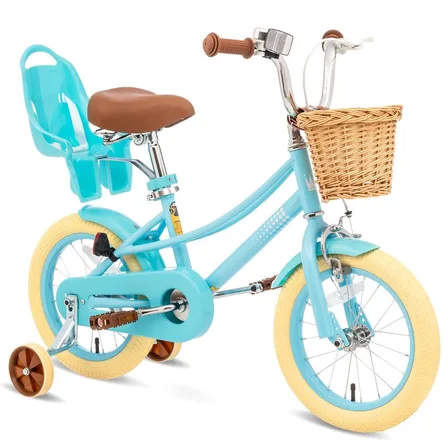
Girls' Training Wheel Bike by XJD, 12–20 Inch Wheels – Blue
This XJD girls' training wheel bike in Blue covers one of the widest fit ranges …$139
$159