

What height is a 24 inch bike good for
A 24-inch bike is a starting fit for riders 54–64 inches (137–163 cm) tall, often ages 10–14, but the child must try it before you buy.
Use height first, not age
Measure the rider without shoes, standing straight against a wall with heels on the floor. Compare that measured height with the XBikes 24-inch starting range of 54–64 inches (137–163 cm). Age 10–14 is only a secondary reference because children of the same age can have very different proportions, reach and riding ability.
If the rider is shorter than 54 inches, begin the comparison with a 20-inch bike, whose starting range is 48–60 inches (122–152 cm). If the rider is over 60 inches (153 cm), a 26-inch model may also warrant a fit check. These ranges overlap intentionally: wheel diameter alone cannot determine whether a particular frame fits.
Measure inseam before comparing a bike
Height narrows the search; inseam helps reveal whether the child can stand over and mount a particular bicycle comfortably. Have the rider stand in socks with feet slightly apart. Place a straight, firm book between the legs and raise it gently to simulate the saddle contact point. Measure from the floor to the top edge of the book.
Do not turn that measurement into a universal frame-size formula. Frame shapes differ, and no product-specific stand-over dimensions are supplied here. Take the inseam measurement to the exact product listing, manual or an in-person fitting, then compare it with that bicycle’s stated geometry.
Make these checks on the actual 24-inch bike
A 24-inch label describes wheel size, not complete fit. Following the American Academy of Pediatrics guidance, let the child try the bicycle and avoid buying an oversized model merely to leave growing room. During the trial, check that the rider can:
- Stand over the bicycle with comfortable clearance rather than being pressed against the frame.
- Mount, start, stop and get a foot down without panic or an awkward lean.
- Reach the handlebars without locking the elbows or stretching the torso excessively.
- Turn the bars while remaining balanced and looking ahead.
- Reach and operate the brakes confidently with the hands in a normal riding position.
Current confidence matters. A rider who falls within the height range but cannot start, steer or stop under control is not ready for that particular 24-inch bike. Compare a smaller option rather than assuming practice will correct an obviously oversized fit.
How the supplied XBikes options help
The catalog includes two relevant beach-cruiser comparisons. The XJD Pink Beach Cruiser for Girls – Rear Rack & V-Brake lists 20 Inch, 24 Inch and 26 Inch SKU labels, so its three labeled sizes can help a family compare the overlapping starting ranges around a 24-inch choice. Select the 24 Inch SKU when evaluating the size addressed here; do not assume every SKU has identical fit.
The 24-Inch Purple XJD Beach Cruiser Bike with U-Brake is another directly relevant 24-inch wheel option. Its available SKU label is Default, so confirm on the exact product page that the selected configuration is the intended item rather than expecting a separate size selector.
These particular catalog options help answer the title because both provide a 24-inch comparison, while the first also supplies adjacent 20-inch and 26-inch SKU labels for riders near an overlapping height boundary. They do not replace an individual stand-over, reach and brake-control check.
 XJD Pink Beach Cruiser for Girls – Rear Rack & V-Brake
Offers 20 Inch, 24 Inch and 26 Inch SKU labels, making this beach cruiser useful for comparing the requested 24-inch option with adjacent labeled wheel sizes before an individual fit check.
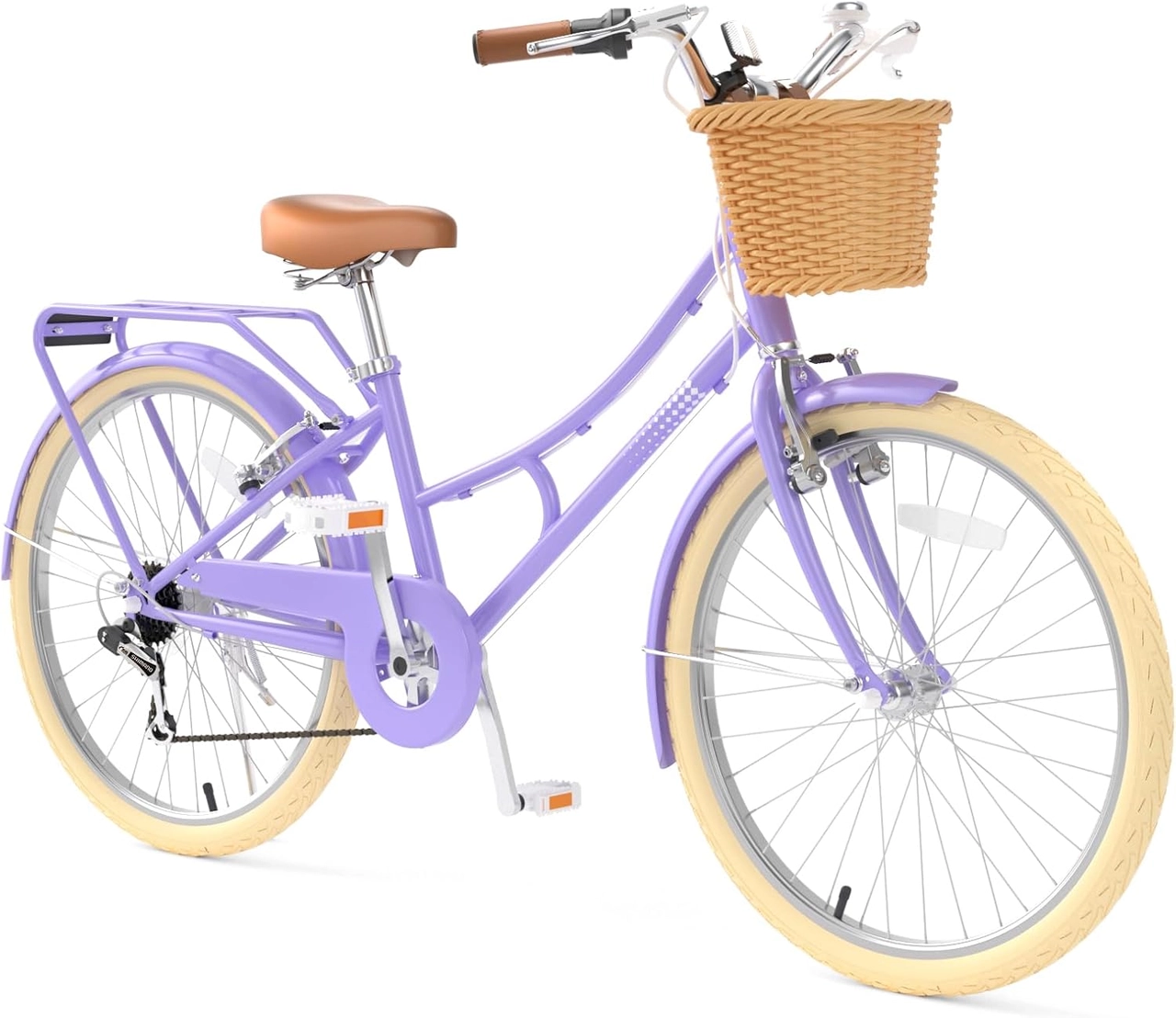 24-Inch Purple XJD Beach Cruiser Bike with U-Brake
A directly relevant 24-inch beach cruiser with a U-Brake and a Default SKU label; confirm the intended configuration and check the rider’s stand-over, reach, brake access and control.
Know when a supplied product is not relevant
Neither 24-inch option should be chosen solely because the rider is 10–14 years old. It may be unsuitable if the measured height is outside the starting range, the stand-over position is cramped, the rider must stretch to steer, or the brakes cannot be reached and operated reliably.
For a rider near the lower boundary, compare the actual fit with a 20-inch bicycle. Near or above the upper boundary, compare it with a 26-inch bicycle. A neighboring size is a comparison point, not an automatic answer, and the exact frame still needs to be tried.
Use the exact product manual or a qualified bicycle mechanic for assembly, adjustment, maintenance, compatibility, load limits and torque information that is not supplied in the catalog facts.
Make the final 24-inch decision
Record the child’s height and inseam, shortlist the correct 24-inch configuration, and arrange a real fit check. Choose it only if the rider has comfortable stand-over clearance, relaxed reach, dependable brake access and confident control. Add a properly fitting bicycle helmet that sits level, with straps adjusted according to its manufacturer’s instructions. If any fit or control check fails, compare the adjacent wheel size instead of buying the 24-inch bike for future growth.
Bikes for your next adventure
-

Light Pink XJD Girls' Bicycle with Basket & Training Wheels
The Light Pink XJD Girls' Bicycle with Basket & Training Wheels is a retro-style…$109.99
$129.99 -

Blue XJD Kids Bike Helmet for Boys & Girls
The Blue XJD Kids Bike Helmet is a lightweight, adjustable multi-sport helmet fo…$59.99
$99 -

Kids Bike Helmet by XJD for Girls – Pink
The XJD Kids Bike Helmet in Pink is a lightweight multi-sport helmet for girls r…$59.99
$99