

What inch bike for a 14 year old
For a 14-year-old, start with a 24-inch bike at 54–64 in (137–163 cm), or compare a 26-inch bike if the rider is over 60 in (153 cm). Height narrows the choice; an individual fit check decides it.
Measure before choosing the wheel size
Measure the teenager barefoot, standing straight against a wall. Record total height. Then measure inseam from the floor to the crotch while the rider stands naturally. The XBikes height ranges below are starting points; inseam must be compared with the actual bicycle’s stand-over clearance and adjustment range.
| Wheel size | XBikes starting point | How it applies at age 14 |
|---|---|---|
| 20 Inch | 48–60 in / 122–152 cm; ages 7–12 | Consider only if the measured rider fits the bicycle despite being older than the age guide. |
| 24 Inch | 54–64 in / 137–163 cm; ages 10–14 | The normal first comparison for a 14-year-old in this height range. |
| 26 Inch | Youth and adults over 60 in / 153 cm | Compare when the rider is over 60 inches, then verify control and reach. |
The 24-inch and 26-inch ranges overlap above 60 inches. That does not make the sizes equivalent: frame shape, stand-over height, reach and adjustment can make one clearly more manageable than the other.
Use a real fit check to settle the answer
Have the rider try the exact bicycle rather than relying on age, height or a wheel label alone. While straddling it, the rider should have practical clearance over the bicycle and should not be pressed against the frame. Follow the product manual when checking or changing the seat position.
Next, have the rider sit in a normal riding position and hold the handlebar. They should be able to steer without an excessive stretch, turn their head to look around, and reach and operate the brake controls confidently. A rider who feels unstable, cannot control the brakes, or has to strain for the handlebar has not passed the fit check.
Do not select an oversized 26-inch bicycle merely to leave room for growth. A manageable 24-inch bicycle is the better size decision when the larger option compromises stand-over clearance, reach, braking or confidence.
How the supplied bicycles help with comparison
These catalog options are relevant because each offers a 24-inch and a 26-inch SKU label, allowing the two likely sizes for many 14-year-olds to be compared. Two also list a 20-inch option for a shorter rider whose measurements warrant checking it. Their listed categories are Beach Cruiser Bikes, so suitability still depends on the intended riding and an exact-bike fit check.
 Pink XJD Beach Cruiser Bike, 24"/26", U-Brake
Available in 24 Inch and 26 Inch labels, this beach cruiser provides the two main comparison sizes for many 14-year-olds; its supplied facts also list a U-brake.
 XJD Kids Beach Cruiser Bicycle, Rear Rack & V-Brakes, Mint Green
Its 20 Inch, 24 Inch and 26 Inch labels allow adjacent-size comparison, while the supplied catalog facts identify a rear rack and V-brakes.
 XJD Pink Beach Cruiser for Girls – Rear Rack & V-Brake
This beach cruiser lists 20 Inch, 24 Inch and 26 Inch options plus a rear rack and V-brake; fit must still be checked on the exact bicycle.
Compare the three catalog options
Pink XJD Beach Cruiser Bike, 24"/26", U-Brake is available with 24 Inch and 26 Inch SKU labels and lists a U-brake. It is relevant when the rider’s height points to either of those wheel sizes.
XJD Kids Beach Cruiser Bicycle, Rear Rack & V-Brakes, Mint Green is available with 20 Inch, 24 Inch and 26 Inch SKU labels. Its supplied details list a rear rack and V-brakes. The three labels make it useful for comparing adjacent size candidates, but the word “Kids” is a catalog label rather than proof of fit.
XJD Pink Beach Cruiser for Girls – Rear Rack & V-Brake also has 20 Inch, 24 Inch and 26 Inch SKU labels, with a rear rack and V-brake in the supplied facts. “for Girls” describes the catalog title; it does not establish sizing or who can ride it.
Do not infer frame dimensions, component compatibility, load capacity or adjustment limits from a wheel-size label. Check the manual for the exact SKU, or ask a qualified bicycle mechanic when those details are unavailable.
Check control before committing
- Confirm measured height against the 24-inch and 26-inch starting points.
- Compare inseam with the exact bicycle’s stand-over clearance.
- Check seated reach, steering freedom and access to every brake control.
- Let the rider start, stop, turn and dismount in a controlled area.
- Reject the larger size if it reduces control or confidence.
Assembly, adjustments, maintenance and any torque requirements should follow the manual for the exact product. If correct setup is uncertain, use a qualified bicycle mechanic.
Complete the 14-year-old’s size decision
Choose 24 Inch when the rider measures 54–64 inches and controls that exact bike comfortably. Compare 26 Inch once the rider is over 60 inches, but select it only if stand-over, reach, braking and confidence remain sound. If the rider is 60 inches or shorter, do not move to 26 Inch on age alone. Finish by fitting a bicycle helmet so it sits level and its straps are adjusted according to the helmet manufacturer’s instructions.
Bikes for your next adventure
-

XJD Girls Bike for Kids Ages 3-8, 12/14/16 Inch with Training Wheels – Purple
The XJD Girls Bike in Purple is a training-wheel bicycle for kids ages 3 to 8, f…$149
$169 -

Pink Girls' 12/14/16" Bike by XJD – Basket & Doll Seat
The XJD Pink Girls' Bike with Basket & Doll Seat is made for riders 71–122 cm ta…$75.99
$99.99 -
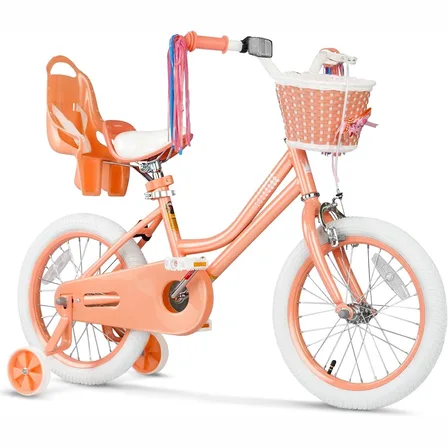
Girls 12/14/16 Inch Kids Bike by XJD with Training Wheels – Peach
The XJD Girls Bike in Peach is a training-wheel bike built for girls roughly 3 t…$149
$169