

What inch bike for child
Choose the bike inch size from your child’s measured height first, then confirm inseam clearance, reach, brake control and confidence on the actual bike.
Which inch bike fits your child?
Measure your child without shoes and compare the result with the XBikes starting points below. Age can narrow the search, but children of the same age can differ considerably in height, proportions and riding ability.
| Wheel size | Starting age | Rider height |
|---|---|---|
| 12 Inch | 3–4 | 34–40 in / 86–102 cm |
| 14 Inch | 3–6 | 37–45 in / 94–114 cm |
| 16 Inch | 4–7 | 40–48 in / 102–122 cm |
| 18 Inch | 5–9 | 43–52 in / 109–132 cm |
| 20 Inch | 7–12 | 48–60 in / 122–152 cm |
| 24 Inch | 10–14 | 54–64 in / 137–163 cm |
| 26 Inch | Youth and adults | Over 60 in / 153 cm |
Where height bands overlap, do not automatically choose the larger wheel. Compare both candidate sizes in person and select the bike on which the child can start, stop, steer and use the brakes comfortably.
Measure height and inseam before shopping
- Height: Have the child stand straight against a wall without shoes. Keep the head level, mark the top of the head and measure from the floor.
- Inseam: With feet slightly apart, place a firm, book-like object between the legs to represent the saddle contact point. Measure vertically from the floor to its top edge.
- Record both measurements: Use height to identify likely wheel sizes, then use inseam during the actual stand-over and saddle check.
Wheel diameter does not determine every frame dimension. Two bikes with the same wheel label may feel different because fit also depends on the individual bicycle’s frame and adjustment range. That is why the inch chart is a shortlist, not a final verdict.
Check the child on the actual bicycle
Have the child try the bicycle rather than buying from age or wheel size alone. With the child straddling the frame, confirm there is comfortable stand-over clearance and that getting on and off does not require awkward stretching or leaning.
Next, watch the riding position. The child should reach the handlebar without being pulled far forward, turn it without losing balance, and operate the brakes with controlled hand movement. They should also be able to start and stop predictably at their current skill level.
Reject a bike that is clearly oversized even if the child may grow into it. A larger bike can make mounting, steering, stopping and brake reach harder now. If neither overlapping size gives secure control, keep looking for a different frame fit rather than forcing the choice.
How the available 12, 14 and 16 Inch bikes compare
The supplied catalog options are useful when your child’s measurement points to 12, 14 or 16 Inch wheels: all three models offer those exact SKU labels, so you can compare adjacent starting sizes while keeping the model choice within its stated category.
 Flower Pink XJD Girls Bike with Doll Seat & Basket
A Training Wheel Bike offered in 12 Inch, 14 Inch and 16 Inch labels; relevant when the child’s measured height suggests one of those sizes and an individual fit check confirms control.
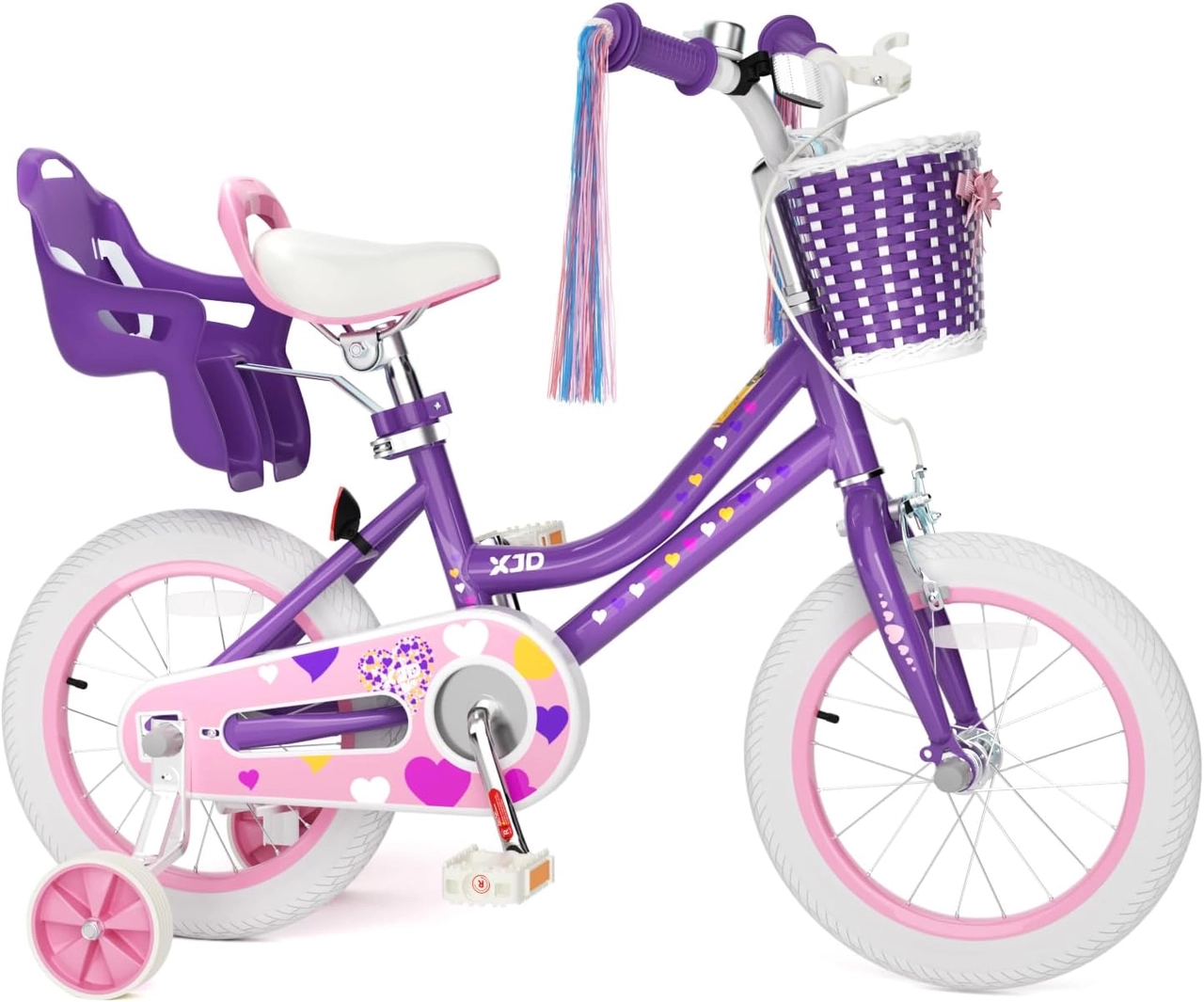 Purple XJD Girls' Bike with Doll Seat & Basket
This Training Wheel Bike has 12 Inch, 14 Inch and 16 Inch SKU labels, making it relevant for comparing those starting sizes after measuring the child’s height and inseam.
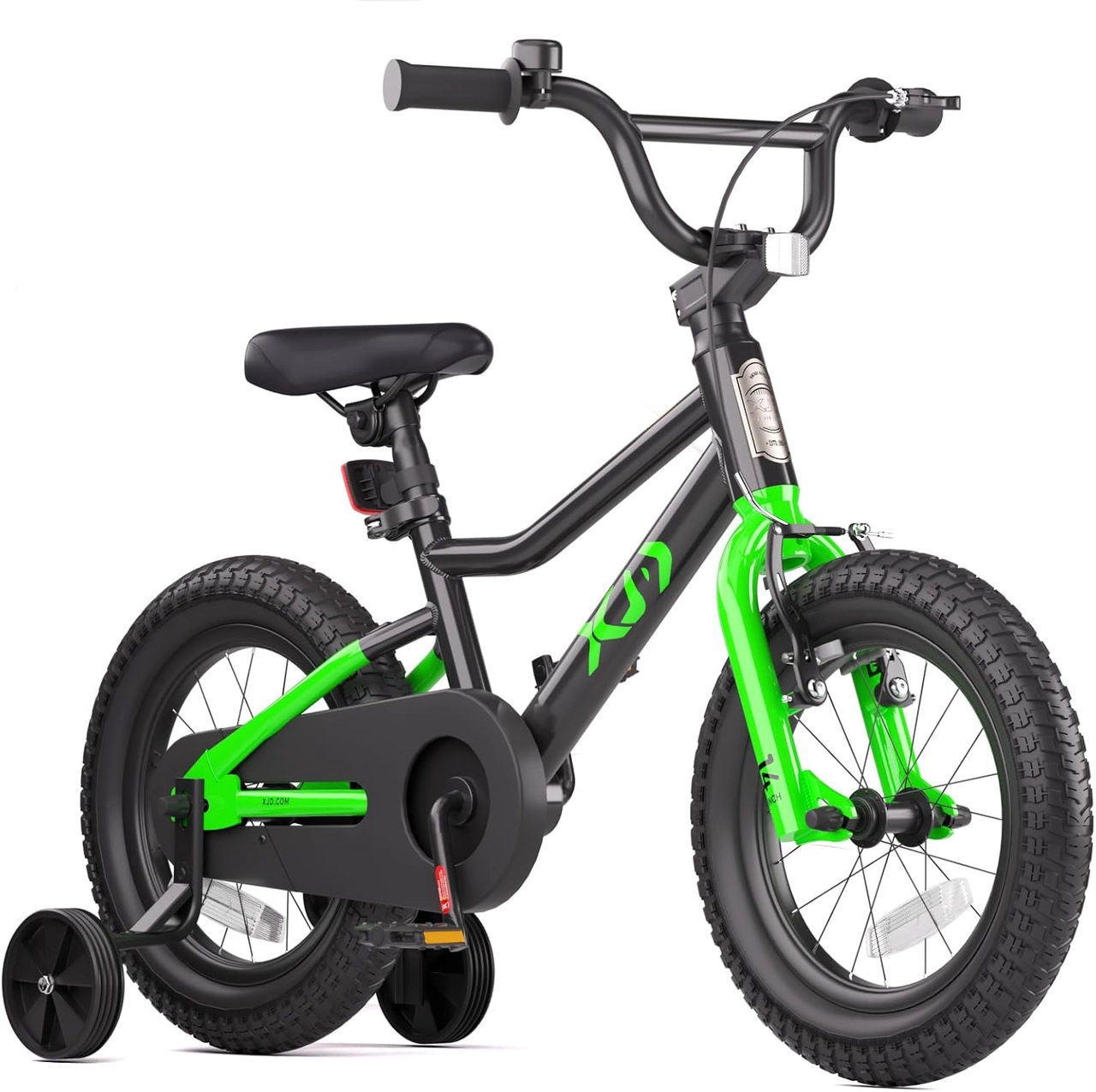 Black XJD Kids' BMX Bicycle with Training Wheels
A Kids' BMX Bike with 12 Inch, 14 Inch and 16 Inch labels; consider it only when the height chart and an actual check of stand-over, reach, braking and confidence agree.
Flower Pink XJD Girls Bike with Doll Seat & Basket and Purple XJD Girls' Bike with Doll Seat & Basket are cataloged as Training Wheel Bikes. Each is available in 12 Inch, 14 Inch and 16 Inch labels.
Black XJD Kids' BMX Bicycle with Training Wheels is cataloged as a Kids' BMX Bike and is likewise available in 12 Inch, 14 Inch and 16 Inch labels. Its category differs, but the supplied facts do not establish differences in frame geometry, brakes, weight or components. Compare those details only on the verified product page and in the exact product manual.
These three products are relevant only when a 12, 14 or 16 Inch starting point matches the child and the actual fit check succeeds. For a child whose measurement points to 18, 20, 24 or 26 Inch, they are smaller-wheel comparison points, not substitutes for the indicated size.
Make the final size decision
- Start with measured height, using age only as a secondary reference.
- Use inseam to check stand-over and saddle access on the actual bicycle.
- Confirm comfortable reach, steering, brake operation, starting and stopping.
- Choose for present control and confidence, not extra growth room.
- If the child is between sizes, try both rather than deciding from the label.
A properly fitting bicycle helmet is also essential. It should sit level, fit properly and have its straps adjusted according to the helmet manufacturer’s instructions. For bicycle assembly, maintenance, compatibility, load limits or torque settings, follow the exact product manual or ask a qualified bicycle mechanic.
Your next step is simple: measure the child’s height and inseam, shortlist the matching inch size from the table, and approve the bike only after the child demonstrates comfortable stand-over, reach, braking and control.
Bikes for your next adventure
-
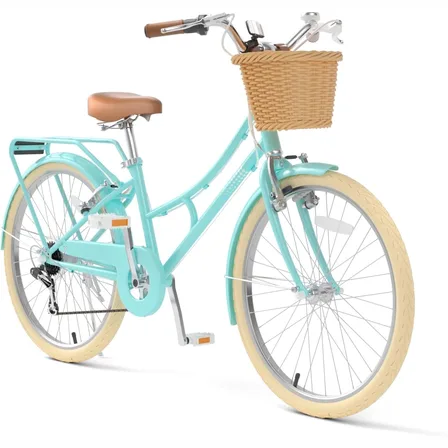
XJD Kids Beach Cruiser Bicycle, Rear Rack & V-Brakes, Mint Green
The XJD Beach Cruiser in Mint Green is a geared, multi-speed cruiser bike for ol…$179.99
$209.99 -

XJD Girls Bike for Kids Ages 3-8, 12/14/16 Inch with Training Wheels – Purple
The XJD Girls Bike in Purple is a training-wheel bicycle for kids ages 3 to 8, f…$149
$169 -

Blue XJD Girls Bike with Training Wheels – 12/14/16 Inch
If you're shopping for a first pedal bike for a daughter roughly 3 to 8 years ol…$149
$169