

What inch bike would a 7 year old need
Most 7-year-olds need a 16-, 18-, or 20-inch bike. Measure the child’s height first: 16-inch suits 40–48 in, 18-inch 43–52 in, and 20-inch 48–60 in, followed by an individual fit check.
Choose the starting size by measured height
Age alone cannot determine the right wheel size. At seven, children can fall within several overlapping height bands, so measure the rider without shoes and compare that result with the XBikes starting points below.
| Wheel size | XBikes age starting point | Rider-height starting point |
|---|---|---|
| 16 Inch | Ages 4–7 | 40–48 in / 102–122 cm |
| 18 Inch | Ages 5–9 | 43–52 in / 109–132 cm |
| 20 Inch | Ages 7–12 | 48–60 in / 122–152 cm |
These ranges overlap deliberately because two children of the same height may differ in leg length, reach, coordination, and confidence. A child near a boundary should try both adjacent sizes rather than automatically moving up.
Measure height and inseam before comparing bikes
For height, have the child stand straight against a wall without shoes, with feet flat and looking forward. Mark the top of the head and measure vertically from the floor.
For inseam, place a firm, thin book between the child’s legs and raise it gently to simulate the bicycle saddle. With the child standing naturally, measure from the floor to the top edge of the book. Record both measurements in inches or centimetres.
Height identifies a useful wheel-size starting point. Inseam then helps assess whether the child can stand over the particular bicycle comfortably. Geometry can vary between bikes with the same wheel size, so wheel diameter does not prove that the frame fits.
Check the actual bike with the child
Have the child try the exact bicycle rather than relying only on its label. The American Academy of Pediatrics advises against buying an oversized bicycle merely so a child can grow into it. During the fit check, look for all of the following:
- The child can stand over the bicycle with comfortable clearance and without leaning it sharply.
- The child can get on and off in a controlled way.
- From the riding position, the handlebar is reachable without an extreme stretch or cramped posture.
- The child can operate the available brake controls confidently and without shifting the hands into an unstable position.
- Starting, steering, stopping, and putting a foot down feel manageable at the child’s present skill level.
If one of these checks fails, do not treat an age or height match as approval. Compare another frame or the adjacent wheel size. Follow the exact product manual for adjustment, assembly, maintenance, load limits, compatibility, and torque information, or ask a qualified bicycle mechanic.
When the supplied 16-inch option is relevant
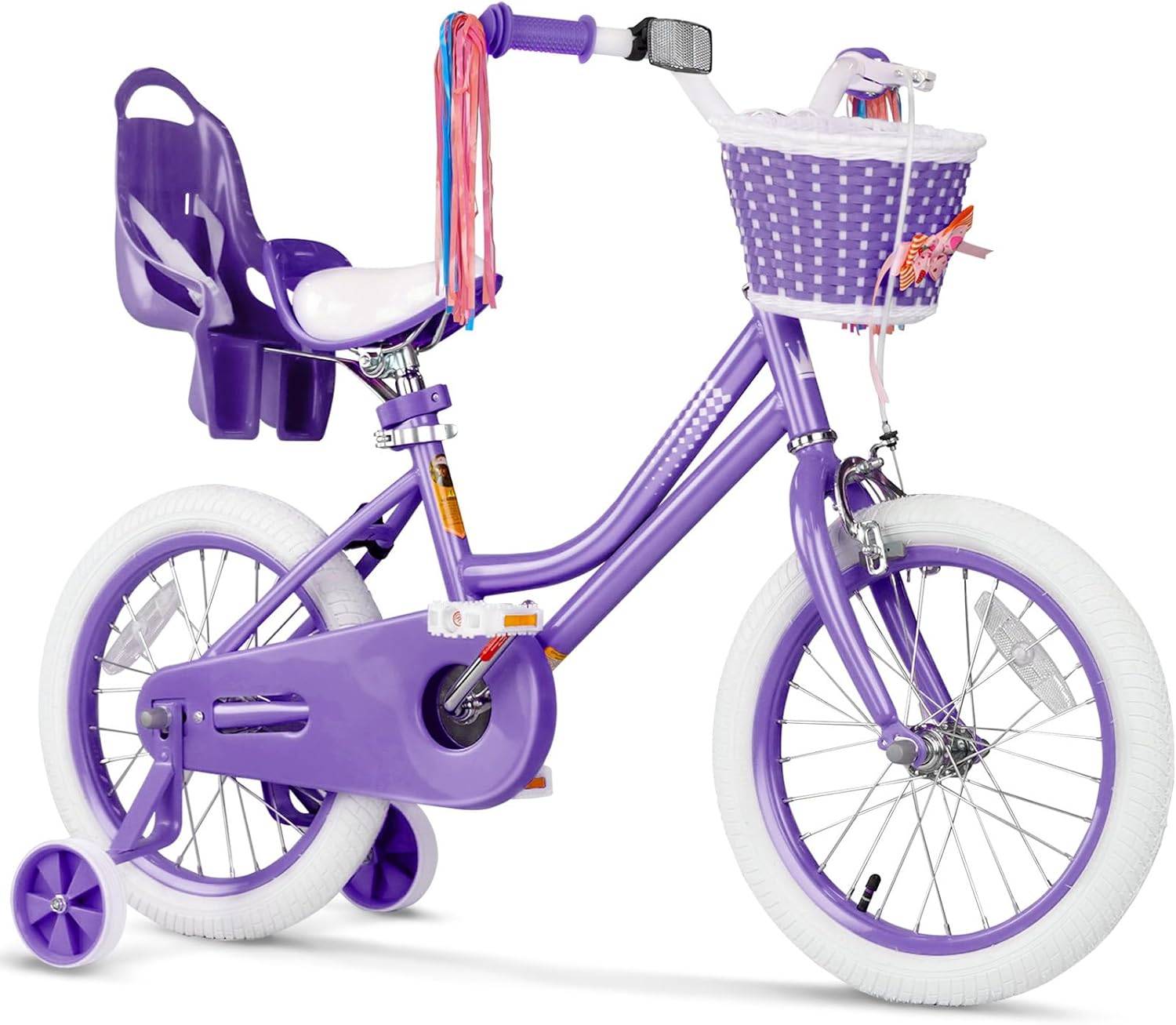
The supplied catalog option is the XJD Girls Bike for Kids Ages 3-8, 12/14/16 Inch with Training Wheels – Purple. It is listed under Training Wheel Bikes and has 12 Inch, 14 Inch, and 16 Inch SKU labels. For this question, only its 16 Inch version is a plausible comparison, and only when the child’s measured height falls within the 40–48 in / 102–122 cm starting range and the individual fit checks succeed.
The “Ages 3-8” wording is part of the exact catalog title, not evidence that every seven-year-old fits it. Its 12 Inch and 14 Inch versions have XBikes starting ranges of ages 3–4 at 34–40 in / 86–102 cm and ages 3–6 at 37–45 in / 94–114 cm. Those are generally smaller starting points and should not be chosen simply because they share the same product listing.
This catalog option helps a parent compare the available 16-inch training-wheel configuration with the size suggested by the child’s measurements. It does not supply an 18- or 20-inch choice, so for a child who measures into either of those ranges, it is a nearest-size comparison point rather than a substitute.
Decide among 16, 18, and 20 inches
If the child is 40–48 in / 102–122 cm tall, begin with a 16-inch trial. If the child is 43–52 in / 109–132 cm, include an 18-inch bike in the comparison. At 48–60 in / 122–152 cm, begin with a 20-inch trial. In an overlap, favor the bicycle the child can control now; do not select the larger one solely for future growth.
Current confidence matters as well. Training wheels are relevant only if that configuration suits the rider’s present learning needs. A wheel-size match does not by itself decide whether training wheels are appropriate, nor does the presence of training wheels correct a frame that is too large.
Complete the seven-year-old’s fit check
Before riding, add a properly fitting bicycle helmet. U.S. Consumer Product Safety Commission guidance says the helmet should sit level and its straps should be used according to the helmet manufacturer’s instructions.
The practical next step is simple: measure height and inseam, shortlist the matching 16-, 18-, or 20-inch range, and have the seven-year-old try the exact bicycle. Choose only when stand-over clearance, reach, brake control, mounting, starting, steering, and stopping all work confidently today.
Bikes for your next adventure
-
Purple XJD Girls' Bike with Doll Seat & Basket
For girls 71–122 cm tall (about ages 3–7), this XJD girls' bike in Purple pairs …$75.99
$99.99 -

XJD 24-Inch Green Beach Cruiser Bike with U-Brake
This XJD 24-inch beach cruiser in green is made for riders about 4'8" to 5'4" ta…$159.99
$199.99 -

Kids Bike Helmet by XJD for Boys & Girls – Black, Blue, Green, Pink, Purple
The XJD Kids Bike Helmet covers a wide 2-to-8-year age range thanks to two head-…$59.99