

What is the best child bike trailer
The best child bike trailer is one that fits your children, matches the towing bicycle and hitch, and stays within every limit in both product manuals.
Choose by fit and compatibility first
There is no single trailer that is best for every family. Begin with the number of children you need to carry, their current measurements and the space required for helmets and clothing. The occupants should fit without being cramped against the frame or cover, and every supplied restraint should adjust correctly for each child.
Next, identify the exact make and model of the towing bicycle, including its axle and any surrounding rack, fender or brake hardware. Compare those details with the trailer manufacturer’s compatibility instructions. Do not assume that a hitch fits merely because it can be attached. If either manual is unclear, ask the manufacturer or a qualified bicycle mechanic to inspect the proposed combination.
Compare the features that affect daily use
A useful comparison starts with the intended journeys rather than the longest feature list. Check each candidate for:
- Occupant fit: adequate seated room and restraints that adjust as the manual describes.
- Rated limits: the permitted occupant, cargo and total loads stated by the manufacturer.
- Hitch system: documented compatibility with the towing bicycle and any required backup retention device.
- Protection and visibility: the supplied enclosure, wheel guards, reflectors and visibility equipment.
- Braking and handling: whether the bicycle’s manual permits trailer use and whether the adult can control the complete loaded combination.
- Practicality: folded dimensions, storage space, entry method and cleaning instructions that suit your routine.
Do not infer load capacity, assembly steps, compatibility or fastener torque from appearance. Follow the exact trailer and bicycle manuals. Have a qualified bicycle mechanic handle uncertain installation or compatibility questions.
Measure before making a decision
Record each child’s seated height, shoulder width and the space occupied while wearing a properly fitted bicycle helmet. Then compare those measurements with the trailer maker’s occupant-space instructions and limits. Also measure the storage doorway, vehicle cargo area or other tight space through which the folded trailer must pass.
For the towing setup, note the bicycle model and axle details rather than measuring and guessing at the hitch. A child’s helmet should fit properly, sit level and have its straps adjusted according to its manufacturer’s instructions, consistent with U.S. Consumer Product Safety Commission guidance.
Test the complete setup before carrying a child
- Read both manuals and confirm that trailer use and the exact hitch arrangement are permitted.
- Assemble and attach the equipment exactly as instructed, using a mechanic if any step is uncertain.
- Check that restraints, enclosure, wheels, hitch and retention components operate as their manuals describe.
- Practice with the trailer empty in a traffic-free area, noticing its width, turning path, stopping distance and effect on balance.
- Add only manufacturer-permitted test load before carrying a child, then reassess control and braking.
If the bicycle feels difficult to start, steer or stop, do not carry a child. Recheck the installation, reduce the permitted load if appropriate, or choose another compatible setup.
How the supplied XBikes options relate
The supplied catalog contains children’s bicycles, not child bike trailers or confirmed towing bicycles. They therefore cannot answer hitch, passenger capacity or trailer compatibility questions. They are useful only as comparison points if your real decision is whether a child should ride independently instead of traveling as a trailer passenger.
 XJD Boys & Girls BMX Bike with Training Wheels, 12/14/16" – Blue
A children’s BMX bicycle offered in 12 Inch, 14 Inch and 16 Inch options. It is relevant only when comparing independent riding with trailer transport; supplied facts do not establish trailer compatibility.
 XJD Pink Beach Cruiser for Girls – Rear Rack & V-Brake
A beach cruiser offered in 20 Inch, 24 Inch and 26 Inch options. It is an independent-riding comparison point, not a child trailer, and the supplied catalog facts do not confirm towing compatibility.
 Girls' Training Wheel Bike by XJD with Basket – Purple
A training-wheel bicycle offered in 14 Inch, 16 Inch and 20 Inch options. Consider it only as an independent-riding alternative after an individual fit check; it does not answer child-trailer compatibility questions.
The XJD Boys & Girls BMX Bike with Training Wheels, 12/14/16" – Blue offers 12 Inch, 14 Inch and 16 Inch labels. Girls' Training Wheel Bike by XJD with Basket – Purple offers 14 Inch, 16 Inch and 20 Inch labels. XJD Pink Beach Cruiser for Girls – Rear Rack & V-Brake offers 20 Inch, 24 Inch and 26 Inch labels. Those are bicycle wheel-size choices only; none is a child trailer, and no supplied fact establishes trailer compatibility.
If independent riding is the alternative
Use XBikes wheel-size ranges only as starting points: 12 Inch corresponds to 34–40 in (86–102 cm), 14 Inch to 37–45 in (94–114 cm), 16 Inch to 40–48 in (102–122 cm), 20 Inch to 48–60 in (122–152 cm), 24 Inch to 54–64 in (137–163 cm), and 26 Inch to riders over 60 in (153 cm). Age ranges exist, but measured fit matters more than age alone.
Have the child try the bicycle. Check stand-over clearance, inseam, reach, brake control and present confidence; do not buy an oversized bicycle merely for growth. This follows American Academy of Pediatrics guidance to prioritize an individual fit check.
Your next decision is specific: choose a trailer only after confirming occupant fit, documented bicycle-and-hitch compatibility, manual limits and confident loaded control. If independent riding is being considered instead, fit the child to the appropriate bicycle in person.
Bikes for your next adventure
-

Kids Bike Helmet by XJD for Girls – Pink
The XJD Kids Bike Helmet in Pink is a lightweight multi-sport helmet for girls r…$59.99
$99 -

Blue XJD Kids Bike Helmet for Boys & Girls
The Blue XJD Kids Bike Helmet is a lightweight, adjustable multi-sport helmet fo…$59.99
$99 -
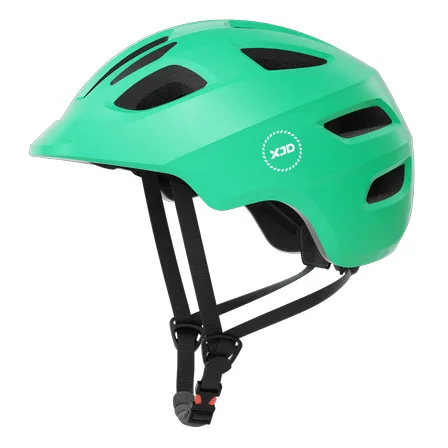
Green XJD Kids Bike Helmet for Boys & Girls
The Green XJD Kids Bike Helmet is a lightweight multi-sport helmet for toddlers …$59.99
$99