

What is the right size bike for a toddler
The right size bike for a toddler is the smallest wheel size that matches the child’s measured height and lets them stand over, reach, steer and brake comfortably. Under the XBikes guide, 12 Inch starts at age 3 and 34–40 in (86–102 cm); a smaller or younger toddler may not yet fit any listed size.
Measure the child before comparing bikes
Begin with current measurements, not clothing size, a birthday or hoped-for growth. Measure the child’s height without shoes, standing straight against a wall. Then measure inseam from the floor to the crotch while the child stands naturally.
Height identifies a sensible wheel-size starting point. Inseam helps you judge stand-over clearance and whether the child can get on, off and stabilize comfortably. Bike geometry varies, so an inseam measurement should be compared with the actual bicycle or its exact sizing information rather than converted through an invented formula.
Write down both measurements. If the child is near the boundary between sizes, do not automatically choose the larger one: current control matters more than extra growing room.
Use the XBikes size ranges as starting points
| Wheel size | Age starting point | Rider height | Toddler relevance |
|---|---|---|---|
| 12 Inch | 3–4 | 34–40 in / 86–102 cm | The first listed size to check for a child who meets the range. |
| 14 Inch | 3–6 | 37–45 in / 94–114 cm | Worth comparing for a taller child, subject to a complete fit check. |
| 16 Inch | 4–7 | 40–48 in / 102–122 cm | Usually outside the toddler question unless the rider is older and fits the measurements. |
The remaining XBikes starting points are 18 Inch for ages 5–9 and 43–52 in (109–132 cm), 20 Inch for ages 7–12 and 48–60 in (122–152 cm), 24 Inch for ages 10–14 and 54–64 in (137–163 cm), and 26 Inch for youth and adults over 60 in (153 cm). These are not typical toddler starting points.
Overlapping height ranges are intentional: wheel diameter alone cannot determine fit. Prioritize measured height, inseam, reach, brake control and current confidence over age.
Check the fit on the actual bicycle
Have the child try the bicycle. The American Academy of Pediatrics’ guidance supports choosing a bike the child can control now rather than buying an oversized model for growth.
- Stand-over: Ask the child to straddle the bicycle with feet on the ground. There should be comfortable clearance rather than contact or a forced stance.
- Starting and stopping: Confirm the child can get into position, put feet down promptly and remain balanced without stretching.
- Reach and steering: With hands in the riding position, the child should not need to lunge forward, lock the arms or lose easy steering control.
- Brake control: If the bicycle has hand controls, verify that the child can reach and operate them confidently. Follow the exact product manual for the bicycle’s controls.
- Confidence: Watch for hesitation caused by the bicycle feeling tall, long or difficult to manage. A size chart cannot override what the child can safely control.
If any of these checks fail, try a smaller option or wait until the child grows. Do not solve a poor fit by assuming training wheels make an oversized bicycle appropriate.
How the supplied training-wheel bikes compare
These particular catalog options help answer the sizing question because their available wheel labels include the 12 Inch, 14 Inch and 16 Inch starting points that may overlap with children at the upper end of toddlerhood. Their listed accessories and colors can distinguish models only after fit has been established.
 Girls' Training Wheel Bike by XJD with Basket – Purple
Available in 14 Inch, 16 Inch and 20 Inch. For this toddler-sizing question, its 14 Inch option is relevant only when the rider fits the supplied height range and passes an individual fit check; no 12 Inch option is listed.
 Flower Pink XJD Girls Bike with Doll Seat & Basket
Available in 12 Inch, 14 Inch and 16 Inch, giving two potentially relevant toddler starting points. Select between them using measured height, inseam, reach, brake control and current confidence rather than age or growing room alone.
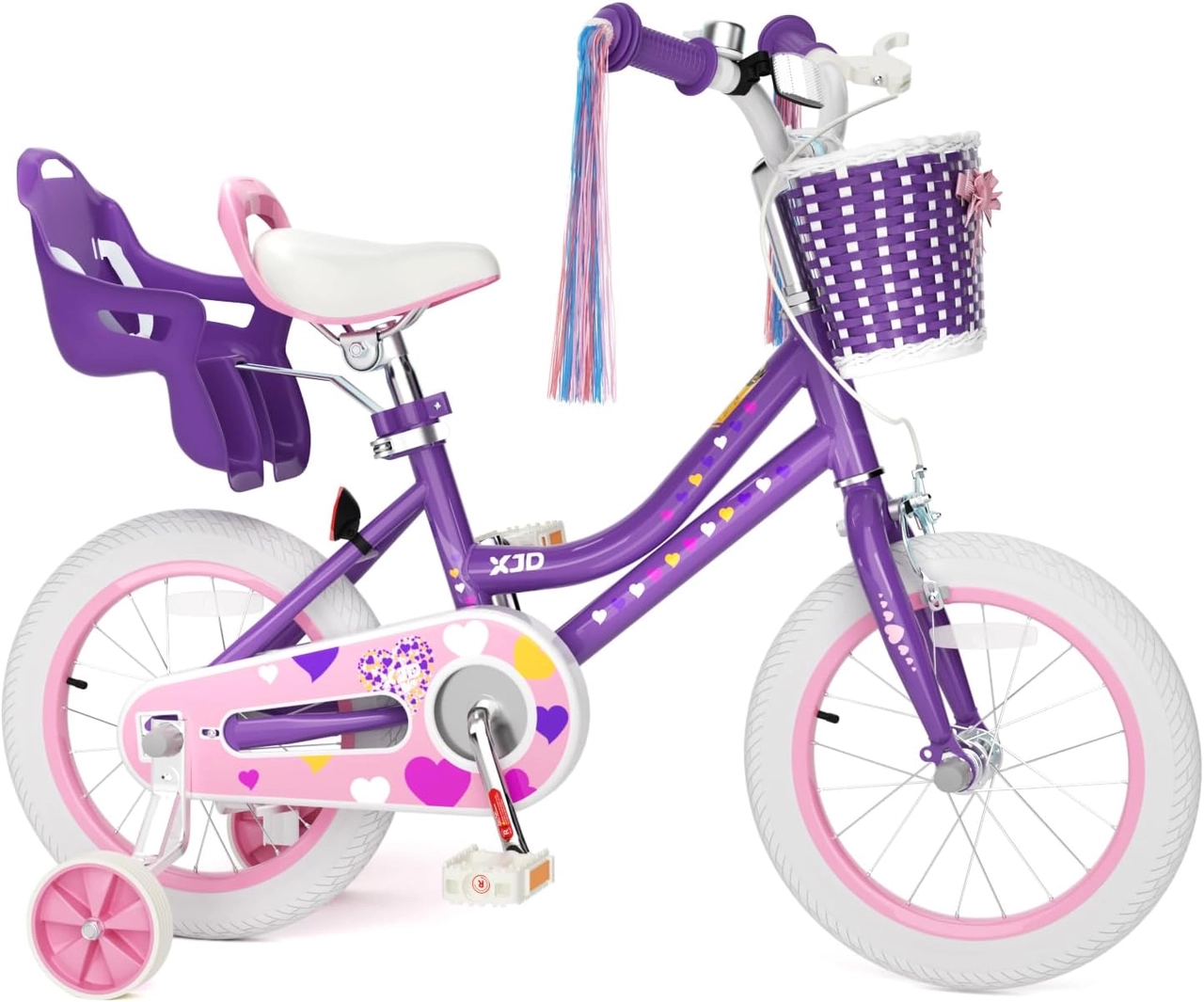 Purple XJD Girls' Bike with Doll Seat & Basket
Its listed 12 Inch, 14 Inch and 16 Inch options allow comparison at the smaller supplied sizes. Relevance depends on the child’s measurements and actual control; the doll seat and basket do not establish fit.
The Flower Pink XJD Girls Bike with Doll Seat & Basket and Purple XJD Girls' Bike with Doll Seat & Basket are each listed in 12 Inch, 14 Inch and 16 Inch sizes. That makes both relevant when a measured child fits either the 12 Inch or 14 Inch starting range and passes the individual checks.
The Girls' Training Wheel Bike by XJD with Basket – Purple is listed in 14 Inch, 16 Inch and 20 Inch. It has no supplied 12 Inch option, so it is not relevant for a child who needs 12 Inch. Its 14 Inch label may be considered for a child measuring 37–45 in (94–114 cm), but only after checking stand-over, reach, braking and control on the actual bicycle.
Nothing in the supplied catalog facts establishes frame measurements, brake type, weight, load limit or compatibility. Consult the exact product manual or a qualified bicycle mechanic for those details and for assembly, adjustment, maintenance and torque requirements.
Do not size up for future growth
An oversized bike can make mounting, stopping, steering and reaching controls harder. When 12 Inch and 14 Inch height ranges overlap, compare both only if the child can try them; choose according to present control and confidence, not the amount of time the larger bike might last.
If the child is under 34 in (86 cm), is younger than the listed starting age of 3, or cannot complete the fit checks on a 12 Inch bicycle, none of these supplied products is established as an appropriate fit yet. Waiting is a valid outcome.
Make the final decision
Choose a wheel-size candidate from measured height, verify inseam clearance on the actual frame, and observe reach, stopping, steering, brake use and confidence. Add a properly fitting bicycle helmet that sits level, with its straps secured according to the helmet manufacturer’s instructions. Buy for the toddler who is riding now: if the child cannot comfortably control the smallest suitable candidate, do not move up a size—pause and recheck later.
Bikes for your next adventure
-

Light Purple XJD Toddler Bike Helmet, Adjustable, Size XS (46–51 cm)
This Light Purple XJD toddler bike helmet is made for the smallest riders — the …$20.39
-

Black XJD Toddler Bike Helmet, Adjustable – Kids' Protective Helmet
The XJD Toddler Bike Helmet in black is an adjustable protective helmet for kids…$20.39
-

Blue XJD Girls Bike with Training Wheels – 12/14/16 Inch
If you're shopping for a first pedal bike for a daughter roughly 3 to 8 years ol…$149
$169