

What kind of bike for 6 year old
For most 6-year-olds, start by comparing 16-inch and 18-inch bikes, then choose by measured height, inseam, reach, brake control and confidence—not age alone.
Which wheel size should you check first?
Measure your child’s height without shoes and use it to identify the sizes worth trying. At age six, three ranges may be relevant: a 14-inch bike covers riders 37–45 in (94–114 cm), a 16-inch bike covers 40–48 in (102–122 cm), and an 18-inch bike covers 43–52 in (109–132 cm).
That overlap is useful, but it does not make the sizes interchangeable. A shorter six-year-old may still fit a 14-inch bike, while a taller child may need an 18-inch model. A 20-inch bike starts at 48 in (122 cm), but its age starting point is seven; consider it only when the child’s measurements and an individual fit check support it. Never buy an oversized bicycle merely to leave room for growth.
| Wheel size | XBikes starting age | Rider height | Relevance at age 6 |
|---|---|---|---|
| 14 Inch | 3–6 | 37–45 in / 94–114 cm | Check for a shorter rider |
| 16 Inch | 4–7 | 40–48 in / 102–122 cm | Common starting comparison |
| 18 Inch | 5–9 | 43–52 in / 109–132 cm | Check for a taller rider |
| 20 Inch | 7–12 | 48–60 in / 122–152 cm | Only if measurements and control support it |
Measure before comparing bikes
Record standing height first. Then measure inseam so you can compare the child’s leg length with the actual bicycle rather than relying on the wheel label. Because frame shapes and adjustment ranges can differ, wheel size alone cannot confirm fit.
Have the child try each candidate bicycle. Check that there is appropriate clearance when standing over it and that getting on and off feels controlled. Seated, the rider should be able to reach the handlebar naturally without an uncomfortable stretch or cramped posture.
Ask the child to operate the brakes during the fit check. They need to reach and control them reliably with their hands in a normal riding position. If reach, stand-over clearance or brake operation is doubtful, reject that bike even when the age and height chart appears to match.
Compare the overlapping sizes in person
When two sizes match the measured height, compare them side by side. Do not automatically choose the larger one. Let the child mount, start, steer, stop and dismount under close adult supervision in a suitable traffic-free area.
- Choose the smaller candidate when the larger bike compromises stand-over clearance, reach, braking or confidence.
- Choose the larger candidate only when the child retains comfortable clearance, easy reach, dependable brake control and calm handling.
- Choose neither when adjustments cannot produce a controlled fit; try another size or bicycle design.
How the supplied XBikes option fits this decision
The supplied catalog option, Pink Girls' 12/14/16" Bike by XJD – Basket & Doll Seat, is a training-wheel bike offered with 12 Inch, 14 Inch and 16 Inch SKU labels. For a six-year-old, its 14-inch and 16-inch versions are the relevant comparisons when the rider falls within the corresponding XBikes height ranges. The 12-inch version starts at ages 3–4 and 34–40 in (86–102 cm), so it generally falls outside the age starting point for this question and should not be chosen without a confirming individual fit check.

This product does not provide an 18-inch or 20-inch option in the supplied catalog facts. If the child measures above the 16-inch range, or cannot achieve suitable stand-over clearance, reach and control on its available sizes, compare a correctly sized bicycle elsewhere in the catalog. The basket and doll seat are included in the exact product title, but they do not determine bicycle fit.
Decide whether training wheels suit the rider
Training wheels may be relevant when the child currently needs that style of support, and the supplied product belongs to the Training Wheel Bikes category. Still, category and wheel label cannot replace a riding check. Consider the child’s present balance, starting and stopping ability, steering control and confidence.
For assembly, adjustments, training-wheel setup, maintenance, load limits, compatibility and torque, follow the exact product manual or use a qualified bicycle mechanic. Do not improvise settings or assume that instructions from another bicycle apply.
Complete the fit and helmet checks
Before choosing, repeat the mount, stand-over, reach, brake and controlled-riding checks with the bicycle adjusted according to its manual. A properly fitting bicycle helmet is also essential: it should fit the child, sit level and have its straps positioned according to the helmet manufacturer’s instructions.
Your next step is simple: measure the six-year-old’s height and inseam, shortlist the matching 14-, 16- or 18-inch range, and buy only after the child demonstrates comfortable clearance, reach, braking and control on that exact bicycle.
Bikes for your next adventure
-

Flower Pink XJD Girls Bike with Doll Seat & Basket
The XJD Flower Pink girls' bike is made for riders 71–122 cm tall (roughly ages …$69.99
-
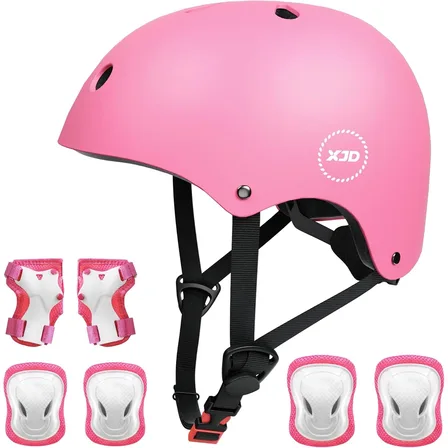
XJD Kids Helmet & Protective Gear Set for Girls, Pink
The XJD Kids Helmet & Protective Gear Set in Pink is a complete safety kit for g…$24.64
-

Kids Bike Helmet by XJD for Boys & Girls – Black, Blue, Green, Pink, Purple
The XJD Kids Bike Helmet covers a wide 2-to-8-year age range thanks to two head-…$59.99