

What should be the bike size for 6 year old
For most 6-year-olds, start by comparing 14-, 16-, and 18-inch bikes—but choose by measured height and an individual fit check, not age alone.
Which wheel size should you check first?
Measure the child’s height without shoes, then use the XBikes starting points below. A 6-year-old may fall into several overlapping ranges, so age cannot identify one correct wheel size.
| Wheel size | XBikes age starting point | Rider height |
|---|---|---|
| 14 Inch | Ages 3–6 | 37–45 in / 94–114 cm |
| 16 Inch | Ages 4–7 | 40–48 in / 102–122 cm |
| 18 Inch | Ages 5–9 | 43–52 in / 109–132 cm |
If the child is 41 inches tall, for example, both the 14- and 16-inch starting ranges include that measurement. If the child is 47 inches tall, compare 16- and 18-inch options. Overlap means the next step is trying the bikes; it does not mean the sizes fit identically.
Measure height, inseam, and reach
Record standing height first. Then measure inseam: with shoes off, have the child stand upright with feet slightly apart and measure from the floor to the top of the inner leg. Do not turn that number into a wheel size through a separate formula; compare it with the actual bicycle’s stand-over clearance and saddle adjustment.
During the fit check, look at three practical points:
- Stand-over: The child should be able to straddle the bicycle without the frame preventing stable contact with the ground.
- Reach: The child should hold the handlebar and steer without stretching, locking the elbows, or shifting forward just to reach.
- Brake control: If the bicycle has hand controls, the child must be able to reach and operate them reliably while maintaining control.
Exact geometry and adjustment limits vary by bicycle. Follow the specific product manual for setup, compatibility, assembly, maintenance, load limits, and torque information, or use a qualified bicycle mechanic.
Have the child try the bike
HealthyChildren guidance from the American Academy of Pediatrics supports having the child try the bicycle, checking stand-over, control, and brake reach, and avoiding an oversized bike bought only for future growth. The correct choice is the bike the child can manage now.
Set the bicycle up according to its manual, then ask the child to mount, start, steer, stop, and dismount in a controlled area. Watch whether these actions look deliberate rather than strained. Current confidence matters: two children with the same height may be more comfortable on different sizes because their proportions, reach, and control differ.
Reject a candidate if the child cannot stand over it appropriately, reach its controls, steer predictably, or stop with control. A wheel-size chart narrows the search; this observation makes the decision.
How the supplied XBikes option helps
The Blue XJD Girls Bike with Training Wheels – 12/14/16 Inch is listed in the Training Wheel Bikes category and has 12 Inch, 14 Inch, and 16 Inch SKU labels. For this title, its 14- and 16-inch versions provide relevant comparison points for many 6-year-olds whose measured heights fall within those XBikes ranges. The 12-inch version starts at ages 3–4 and 34–40 in / 86–102 cm, so it is generally a smaller starting point and still requires the same individual check.
These particular catalog options help you compare adjacent smaller wheel sizes and determine whether a training-wheel model matches the child’s present control and confidence. The product name and SKU labels alone do not establish fit.

This product does not include an 18-inch SKU in the supplied catalog facts. If the child measures within the 18-inch starting range, treat the listed 14- and 16-inch choices only as comparison points—not substitutes for an 18-inch bike. Likewise, do not infer brakes, materials, weight, certification, or other specifications that were not supplied; confirm needed details in the exact product information and manual.
Make the final size decision
- Measure the child’s standing height and inseam without shoes.
- Use measured height to shortlist 14, 16, or 18 inches from the table.
- Have the child try each realistic candidate rather than choosing the largest one for growth.
- Compare stand-over, handlebar reach, brake access, starting, steering, stopping, and dismounting.
- Choose only the size the child can control confidently now.
Add a properly fitted bicycle helmet before riding. U.S. Consumer Product Safety Commission guidance says the helmet should sit level and its straps should be used according to the helmet manufacturer’s instructions.
For a 6-year-old, measure first, shortlist the overlapping 14-, 16-, or 18-inch range, and buy only after the child demonstrates comfortable reach, clearance, braking, and control on the exact bike.
Bikes for your next adventure
-

XJD Girls Bike for Kids Ages 3-8, 12/14/16 Inch with Training Wheels – Purple
The XJD Girls Bike in Purple is a training-wheel bicycle for kids ages 3 to 8, f…$149
$169 -

Pink Girls' 12/14/16" Bike by XJD – Basket & Doll Seat
The XJD Pink Girls' Bike with Basket & Doll Seat is made for riders 71–122 cm ta…$75.99
$99.99 -
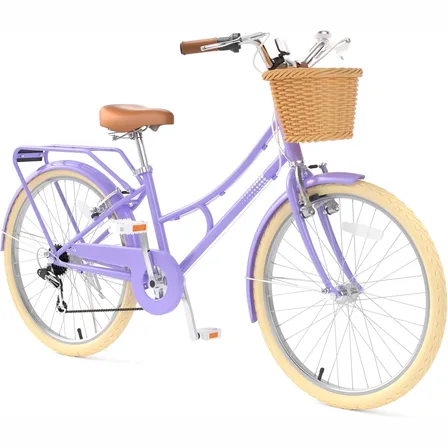
24-Inch Purple XJD Beach Cruiser Bike with U-Brake
The XJD 24-Inch Purple Beach Cruiser is built for girls and young women roughly …$159.99