

What size bike do i need for my teenager
Most teenagers need a 24 Inch or 26 Inch bike, but height alone does not confirm fit. Measure your teenager’s height and inseam, then check stand-over clearance, reach, brake control and confidence on the actual bike.
Start with measured height, not age
Have your teenager stand barefoot against a wall and measure from the floor to the top of the head. For inseam, measure from the floor to the crotch while the rider stands straight with feet slightly apart. Record both measurements in inches or centimetres.
Compare measured height with these XBikes starting points. Age can narrow the search, but overlapping ranges mean it cannot select the bike by itself.
| Wheel size | Starting age | Rider height |
|---|---|---|
| 12 Inch | 3–4 | 34–40 in / 86–102 cm |
| 14 Inch | 3–6 | 37–45 in / 94–114 cm |
| 16 Inch | 4–7 | 40–48 in / 102–122 cm |
| 18 Inch | 5–9 | 43–52 in / 109–132 cm |
| 20 Inch | 7–12 | 48–60 in / 122–152 cm |
| 24 Inch | 10–14 | 54–64 in / 137–163 cm |
| 26 Inch | Youth and adults | Over 60 in / 153 cm |
A teenager measuring 54–60 inches may appear in both the 20 Inch and 24 Inch height ranges. Likewise, a rider over 60 inches may fall within both the upper 24 Inch range and the 26 Inch starting point. In either overlap, compare both candidates in person rather than treating the larger wheel as the automatic choice.
Use inseam to check stand-over clearance
Wheel size is only a category; frame shapes and proportions can differ. With the teenager standing over the bicycle, there should be usable clearance between the body and the top tube. The rider must be able to stop and dismount without being trapped or forced onto tiptoes.
Do not turn the inseam measurement into a universal frame-size formula. Instead, use it when trying the exact bicycle. If clearance is doubtful, consult that product’s manual or ask a qualified bicycle mechanic to assess the fit.
Check reach, brakes and control
Seat the rider in a normal riding position and ask them to hold the grips. Their posture should allow comfortable steering without an extreme forward stretch. They must be able to reach and operate the brake controls reliably while keeping control of the handlebar.
Then perform a supervised, low-speed fit check in a traffic-free area. Ask the teenager to:
- Mount and dismount without help.
- Start, steer and stop predictably.
- Look ahead while maintaining balance.
- Use the brakes without shifting into an unstable position.
Current confidence matters. A bicycle at the upper edge of a height range can still be unsuitable if the rider cannot manage its reach, balance or controls. The American Academy of Pediatrics advises having the child try the bicycle and not buying an oversized model merely to allow room for growth.
When the supplied products are relevant
The three supplied catalog options are available only in 12 Inch, 14 Inch and 16 Inch sizes. They help show the smaller end of the wheel-size scale: Flower Pink XJD Girls Bike with Doll Seat & Basket and Purple XJD Girls' Bike with Doll Seat & Basket are categorized as Training Wheel Bikes, while Black XJD Kids' BMX Bicycle with Training Wheels is categorized as a Kids' BMX Bike. Their shared size labels make them useful comparison points for a substantially smaller rider.
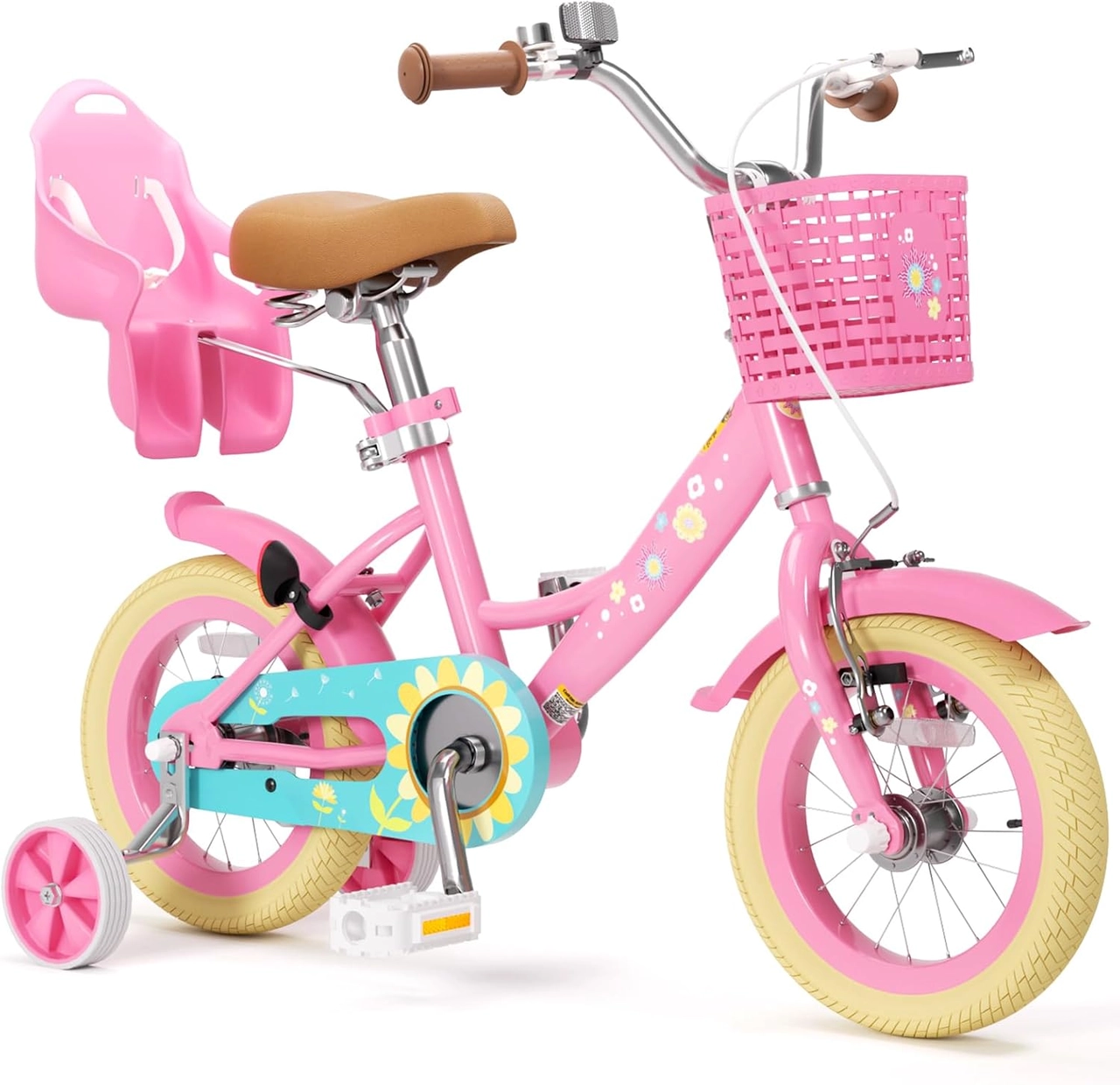 Flower Pink XJD Girls Bike with Doll Seat & Basket
Available in 12 Inch, 14 Inch and 16 Inch sizes, this Training Wheel Bike is relevant only for a teenager whose measured height and individual fit support one of those smaller sizes.
 Purple XJD Girls' Bike with Doll Seat & Basket
This Training Wheel Bike offers 12 Inch, 14 Inch and 16 Inch labels. It is a comparison option for unusually small teenage riders, not a substitute for a needed larger wheel size.
 Black XJD Kids' BMX Bicycle with Training Wheels
Categorized as a Kids' BMX Bike and offered in 12 Inch, 14 Inch and 16 Inch sizes, this model is relevant only when the rider fits that smaller range and controls it confidently.
For most teenagers, these products are not substitutes for a correctly fitted 20 Inch, 24 Inch or 26 Inch bicycle. They may be relevant only if the individual rider’s measured height falls within the supplied 12–16 Inch ranges and the exact bicycle passes the complete fit check. A diagnosis, disability or unusual body proportion may warrant guidance from an appropriate clinician and a qualified bicycle mechanic.
Avoid buying extra size for growth
An oversized bike can make mounting, stopping, steering and brake operation harder now. Choose the bike the teenager can control today. Seat or component adjustments must remain within the limits in the exact product manual; do not improvise beyond marked limits or assume parts are compatible.
If assembly, maintenance, load limits, compatibility or torque information is needed, follow the exact product manual or use a qualified bicycle mechanic. Those details cannot be inferred from wheel size.
Complete the decision
Measure height and inseam first, shortlist the matching wheel sizes, and arrange an individual fit check of each candidate. Reject any bike that compromises stand-over clearance, comfortable reach, reliable brake use or confident control—even when the age or height table appears to match.
Before riding, add a properly fitted bicycle helmet. U.S. Consumer Product Safety Commission guidance says it should sit level and its straps should be used according to the helmet manufacturer’s instructions. Your final choice is the size your teenager can mount, steer, brake and stop confidently now, not the size they may grow into later.
Bikes for your next adventure
-

Kids Bike Helmet by XJD for Boys & Girls – Black, Blue, Green, Pink, Purple
The XJD Kids Bike Helmet covers a wide 2-to-8-year age range thanks to two head-…$59.99
-

Kids Bike Helmet by XJD for Girls – Pink
The XJD Kids Bike Helmet in Pink is a lightweight multi-sport helmet for girls r…$59.99
$99 -

XJD Kids Bike for Girls – Pink, 12/14/16/20 Inch with Training Wheels
The XJD Kids Bike for Girls in Pink is a training-wheel bike built to carry your…$139
$159