

What size bike does my teenager need
Most teenagers need a 24 Inch or 26 Inch bike, but height and fit decide: measure your teen’s height and inseam, then check control in person.
Start with measured height, not age
Measure your teenager barefoot, standing straight against a wall. Record total height from the floor to the top of the head. Then measure inseam from the floor to the crotch while the rider stands naturally. Inseam is essential for checking clearance over the bicycle, even though the XBikes starting points below use rider height.
Compare the measured height with this chart. Treat age only as a rough starting point because teenagers of the same age can differ substantially in proportions, confidence and coordination.
| Wheel size | Starting age | Rider height |
|---|---|---|
| 12 Inch | 3–4 | 34–40 in / 86–102 cm |
| 14 Inch | 3–6 | 37–45 in / 94–114 cm |
| 16 Inch | 4–7 | 40–48 in / 102–122 cm |
| 18 Inch | 5–9 | 43–52 in / 109–132 cm |
| 20 Inch | 7–12 | 48–60 in / 122–152 cm |
| 24 Inch | 10–14 | 54–64 in / 137–163 cm |
| 26 Inch | Youth and adults | Over 60 in / 153 cm |
The ranges overlap. A teenager measuring 60–64 inches, for example, appears in both the 24 Inch range and the 26 Inch starting point. That overlap means the next step is an individual fit comparison, not an automatic choice based on the chart.
Check stand-over clearance
Have your teen try the complete bicycle while wearing the shoes normally used for riding. Ask them to straddle the frame with both feet planted securely on the ground. There should be clear space between the rider and the top tube; the bike should not press into the body.
Do not choose an oversized bicycle simply because your teenager may grow into it. If they cannot stand over it comfortably or must lean sharply to one side when stopping, move to a smaller or differently shaped frame. Wheel size is a label, while usable clearance depends on the complete bicycle’s frame geometry.
Test reach, steering and brakes
With the saddle adjusted to an appropriate position according to the exact product manual, have the rider sit normally and hold the handlebar. Their posture should allow them to look ahead, steer smoothly and turn the handlebar without feeling stretched or cramped.
Ask the rider to operate each brake control from a normal hand position. They must be able to reach and use the controls confidently without releasing their grip or straining. Also check that they can start, stop, turn and place a foot down under control. Current confidence matters: a size that feels manageable is preferable to a larger bike that makes these actions hesitant.
If you cannot establish suitable saddle adjustment, brake reach or control, consult a qualified bicycle mechanic. Follow the exact bicycle manual for assembly, adjustments, compatibility, load limits, maintenance and torque requirements rather than relying on a general procedure.
How the supplied kids’ bikes relate
The supplied catalog choices help show the smaller end of the wheel-size scale. Black XJD Kids' BMX Bicycle with Training Wheels is offered in 12 Inch, 14 Inch and 16 Inch labels. Pink Girls' 12/14/16" Bike by XJD – Basket & Doll Seat is also offered in 12 Inch, 14 Inch and 16 Inch labels.
These particular catalog options make the size distinction concrete because their available sizes can be compared directly with the teenager-oriented chart. They are nearest-size comparison points, not substitutes for a 24 Inch or 26 Inch bike when your teen’s measurement and fit check indicate one of those larger sizes.
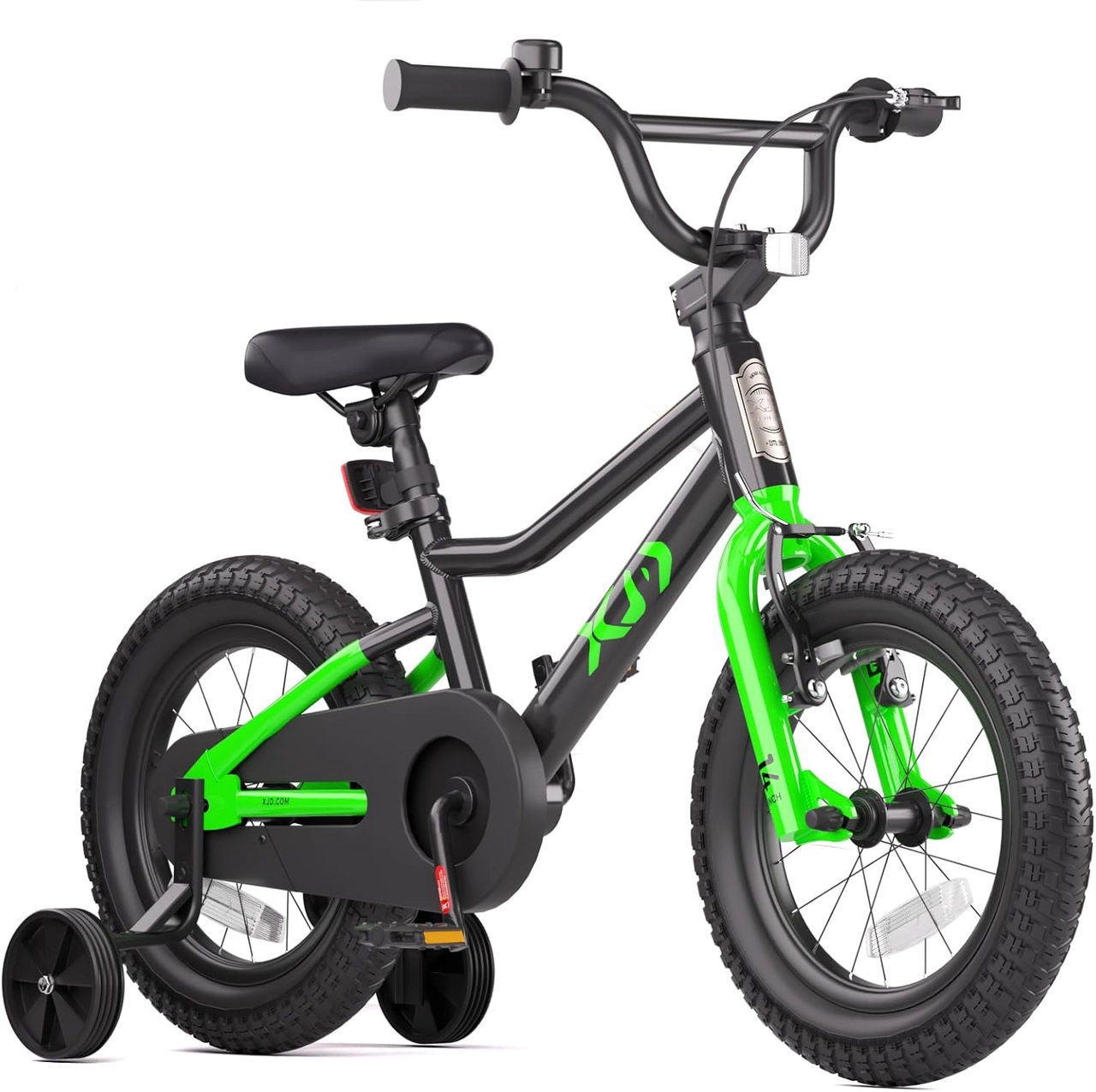 Black XJD Kids' BMX Bicycle with Training Wheels
Available only in 12 Inch, 14 Inch and 16 Inch labels, this kids’ BMX bike is a smaller-size comparison point rather than a substitute when a teenager fits a 24 Inch or 26 Inch bike.
 Pink Girls' 12/14/16" Bike by XJD – Basket & Doll Seat
This training-wheel bike has 12 Inch, 14 Inch and 16 Inch options. Compare those labels with the height chart, but do not treat them as equivalent to the larger size indicated by a teenager’s fit check.
Under the XBikes starting points, 12 Inch through 16 Inch covers heights from 34 to 48 inches across overlapping ranges and is associated with younger children. Unless your teenager’s measured height genuinely falls within the relevant range and the complete bike passes every physical control check, neither supplied product should be treated as a teenage fit merely because it is available.
Resolve an overlap by trying both sizes
If height falls in an overlapping range, compare the candidate bicycles in person. Use the same shoes and repeat the same sequence on each one:
- Straddle the frame and confirm comfortable clearance.
- Sit in a properly adjusted riding position.
- Check that the handlebar is within easy reach.
- Operate the brake controls without shifting the hands awkwardly.
- Start, steer, stop and put a foot down with confidence.
Reject any option that fails one of these checks, even if its age band appears suitable. If both fit, favor the one your teenager controls more naturally now—not the larger one chosen solely for future growth.
Complete the fit with a helmet
A correctly sized bicycle still requires a properly fitting bicycle helmet. The helmet should sit level and its straps should be used according to the helmet manufacturer’s instructions. Recheck the fit rather than assuming an existing helmet still fits a growing teenager.
Your next decision is therefore specific: measure height and inseam today, shortlist 24 Inch or 26 Inch from the height chart when applicable, and buy only after your teenager passes the stand-over, reach, brake-control and confidence checks on the actual bicycle.
Bikes for your next adventure
-

Kids Bike Helmet by XJD for Boys & Girls – Black, Blue, Green, Pink, Purple
The XJD Kids Bike Helmet covers a wide 2-to-8-year age range thanks to two head-…$59.99
-

Kids Bike Helmet by XJD for Girls – Pink
The XJD Kids Bike Helmet in Pink is a lightweight multi-sport helmet for girls r…$59.99
$99 -

XJD Kids Bike for Girls – Pink, 12/14/16/20 Inch with Training Wheels
The XJD Kids Bike for Girls in Pink is a training-wheel bike built to carry your…$139
$159