

What size bike for 10 years old
Most 10-year-olds should start by comparing 20-inch and 24-inch bikes: use 20 inches for a measured height of 48–60 in (122–152 cm), and 24 inches for 54–64 in (137–163 cm). Where those ranges overlap, choose by actual fit, reach, brake control and confidence—not age alone.
Measure before choosing a wheel size
Measure your child’s height without shoes, standing straight against a wall. Also measure inseam from the floor to the crotch while the child stands with feet slightly apart. Height identifies the XBikes starting range; inseam helps you assess clearance when the child tries the actual bicycle.
Do not estimate from clothing size or assume every 10-year-old needs the same bike. Body proportions, arm reach and riding experience differ, even among children of equal height.
| Wheel size | XBikes age starting point | Rider height starting point |
|---|---|---|
| 20 Inch | Ages 7–12 | 48–60 in / 122–152 cm |
| 24 Inch | Ages 10–14 | 54–64 in / 137–163 cm |
| 26 Inch | Youth and adults | Over 60 in / 153 cm |
These ranges are starting points, not proof of fit. A child near a boundary needs an especially careful comparison of the two relevant sizes.
How to decide between 20 and 24 inches
If the rider is under 54 in (137 cm), the XBikes chart points to a 20-inch bike. From 54 to 60 in (137–152 cm), both chart ranges apply, so age and height alone cannot settle the choice. From above 60 through 64 in (over 152–163 cm), the chart points to 24 inches; once the rider is over 60 in (153 cm), 26-inch bicycles also enter the XBikes starting range and must be assessed individually.
In an overlap, favor the bicycle the child can control now. Do not buy an oversized model merely to leave growing room. A bike that is awkward to mount, steer or stop is not made suitable by the expectation that the rider will grow into it.
Perform an individual fit check
Have the child try the complete bicycle. Check that the rider can stand over it with practical clearance rather than being pressed against the frame. Because frame shapes vary, inseam should be compared with the actual bike rather than converted into an invented universal clearance number.
Then check the riding position and controls:
- The child can reach the handlebar without stretching, locking the elbows or losing a stable posture.
- The child can turn the handlebar and look ahead while remaining balanced.
- Hands can reach and operate the brakes confidently with normal control.
- Starting, stopping, mounting and dismounting feel controlled at low speed.
- The size matches the rider’s current confidence, especially if the larger option feels cumbersome.
If either size prevents reliable control, it is not the right fit even when the age or height chart includes the rider.
How the supplied bikes help with the comparison
The two catalog options represent the two main wheel sizes a parent may compare for this question. The Blue XJD Freestyle BMX Bike, 20-Inch – No Pegs is a 20-inch model in Kids' BMX Bikes. The 24-Inch Purple XJD Beach Cruiser Bike with U-Brake is a 24-inch model in Beach Cruiser Bikes. Their different categories also mean wheel diameter alone cannot establish equal geometry, reach or riding position; each bicycle still requires its own fit check.
 24-Inch Purple XJD Beach Cruiser Bike with U-Brake
A 24-inch Beach Cruiser Bikes option relevant for riders whose measured height falls within the 54–64 in (137–163 cm) starting range, subject to an individual fit and control check.
 Blue XJD Freestyle BMX Bike, 20-Inch – No Pegs
A 20-inch Kids' BMX Bikes option relevant for riders within the 48–60 in (122–152 cm) starting range, provided stand-over clearance, reach, braking and current confidence are suitable.
Use these products as relevant size comparison points, not as automatic recommendations for every 10-year-old. The 20-inch option aligns with the 48–60 in (122–152 cm) starting range, while the 24-inch option aligns with 54–64 in (137–163 cm). Compare the child’s measurements and intended bicycle style before deciding which, if either, is relevant.
Check the exact bicycle before riding
Consult the exact product manual for assembly, adjustment, maintenance, load limits, compatibility and torque requirements. If the manual is unavailable, a step is unclear or the bicycle cannot be adjusted for confident control, use a qualified bicycle mechanic rather than guessing.
A properly fitting bicycle helmet is also necessary. It should sit level, fit properly and use its straps according to the helmet manufacturer’s instructions. Recheck helmet fit whenever its adjustment changes.
Your next decision
- Measure height and inseam without shoes.
- Use height to shortlist 20, 24 or—when over 60 in (153 cm)—possibly 26 inches.
- Have the 10-year-old try each shortlisted bicycle and compare stand-over clearance, reach, braking and low-speed control.
- Choose only the size the child can operate confidently today.
For a 10-year-old, the practical answer is therefore 20 or 24 inches in most cases, with the final choice determined by measured height and a successful hands-on fit check.
Bikes for your next adventure
-
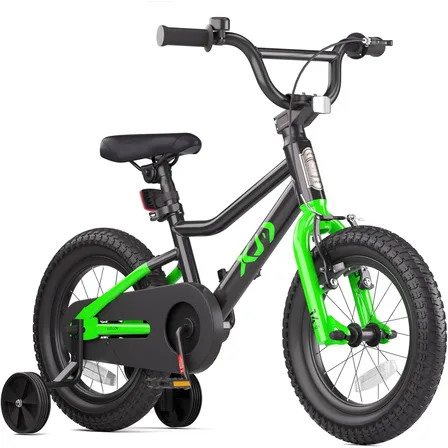
Black XJD Kids' BMX Bicycle with Training Wheels
The XJD Kids' BMX Bicycle with Training Wheels is built for children roughly 3 t…$99.99
$119.99 -

Light Purple XJD Toddler Bike Helmet, Adjustable, Size XS (46–51 cm)
This Light Purple XJD toddler bike helmet is made for the smallest riders — the …$20.39
-

Black XJD Kids Bike for Boys – 12, 14 & 16 Inch Sizes
For a son between roughly 3 and 8 years old, the XJD Kids Bike in Black covers t…$169
$199