

What size bike for a 9yr old
Most 9-year-olds should start by trying an 18-inch or 20-inch bike. Measure the child first: height, inseam, reach, brake control and confidence determine the correct fit.
Start with measured height, not age
According to the XBikes starting points, an 18-inch bike covers ages 5–9 and heights of 43–52 inches (109–132 cm). A 20-inch bike covers ages 7–12 and heights of 48–60 inches (122–152 cm). Therefore, many 9-year-olds fall into one or both ranges, but age alone cannot settle the choice.
Measure the child's height without shoes, standing upright against a wall. Then measure inseam from the floor to the crotch while the child stands naturally. Inseam helps you assess stand-over clearance, while total height provides the initial wheel-size comparison.
Compare the measurements with these starting points
| Wheel size | XBikes age starting point | XBikes height starting point | Likely relevance at age 9 |
|---|---|---|---|
| 18 Inch | Ages 5–9 | 43–52 in / 109–132 cm | Worth trying for a child within this height range, particularly if a smaller, more manageable fit supports current confidence. |
| 20 Inch | Ages 7–12 | 48–60 in / 122–152 cm | A common starting point for a 9-year-old whose measured height is within this range. |
| 24 Inch | Ages 10–14 | 54–64 in / 137–163 cm | Consider only when the child is already within its height range and can pass every fit and control check. |
If the child is 48–52 inches tall (122–132 cm), both the 18-inch and 20-inch starting ranges overlap. That does not make the sizes equivalent. Try both and choose according to stand-over, reach, control and confidence. If the child is shorter than 48 inches, begin with the 18-inch range; if taller than 52 inches, begin with the 20-inch range.
Perform the fit check on the actual bike
Have the child try the bicycle rather than ordering solely from an age chart. The American Academy of Pediatrics advises against buying an oversized bicycle just to allow room for growth. On the actual model, check that the child can:
- stand over the bicycle with usable clearance rather than being pressed against the frame;
- sit in a stable riding position and reach the handlebar without stretching or locking the arms;
- turn the handlebar while remaining balanced and in control;
- reach and operate the brakes reliably with their hands in a normal position;
- start, stop and steer without the bicycle feeling too large or intimidating.
Wheel diameter is only a starting point because frame shape and cockpit dimensions can differ between bicycles. If either candidate compromises stand-over, reach or braking, reject that bike even when the chart includes the child's age and height.
How the supplied 20-inch bikes help
The supplied catalog options are useful when the child's measurements and fit check point toward a 20-inch bicycle. They also provide two different catalog categories, so they help narrow the type of 20-inch bike to inspect after size has been established.
 Blue XJD Freestyle BMX Bike, 20-Inch – No Pegs
A 20-inch Kids' BMX Bikes option relevant when the rider fits the XBikes 20-inch height range and passes stand-over, reach, brake-control and confidence checks. The exact title confirms that it has no pegs.
 Pink 12/14/16/20" XJD Girls Bike with Training Wheels & Basket
Offers 12-, 14-, 16- and 20-inch SKU labels in the Training Wheel Bikes category. For a 9-year-old, the 20-inch version is relevant only when measurements and an individual fit check support that size.
Blue XJD Freestyle BMX Bike, 20-Inch – No Pegs is a 20-inch option in the Kids' BMX Bikes category. Its supplied SKU label is Default. Consider it only if a 20-inch fit is appropriate and the BMX category matches the intended use; the catalog facts do not establish dimensions beyond wheel size.
Pink 12/14/16/20" XJD Girls Bike with Training Wheels & Basket is listed in the Training Wheel Bikes category, with 12 Inch, 14 Inch, 16 Inch and 20 Inch SKU labels. For a typical 9-year-old comparison, select the 20 Inch label only after confirming that the 20-inch range and the individual fit checks apply. The smaller SKU labels are distinct sizes, not interchangeable fits.
Neither supplied product offers an 18-inch or 24-inch SKU. If measurements point to either of those sizes, these products are comparison points for the nearby 20-inch category, not substitutes for the required size.
Check control, confidence and equipment
Ask the child to demonstrate a controlled start, straight-line ride, turn and stop in a suitable supervised area. A child near the boundary between sizes may be better served by the bike they can confidently control, provided it also passes the physical fit checks.
A bicycle helmet must fit properly, sit level and have its straps adjusted according to the helmet manufacturer's instructions. For bicycle assembly, maintenance, compatibility, load limits or torque requirements, follow the exact product manual or use a qualified bicycle mechanic; those details are not established by the supplied catalog information.
Make the decision for this 9-year-old
Measure height and inseam, compare height with the 18-inch and 20-inch ranges, and arrange an actual fit check. Choose 18 or 20 inches only when the child can stand over, reach, brake, steer and stop comfortably. Consider 24 inches solely if the child already measures at least 54 inches (137 cm) and controls that particular bike without strain—never size up merely for future growth.
Bikes for your next adventure
-

Blue XJD Girls Bike with Training Wheels – 12/14/16 Inch
If you're shopping for a first pedal bike for a daughter roughly 3 to 8 years ol…$149
$169 -
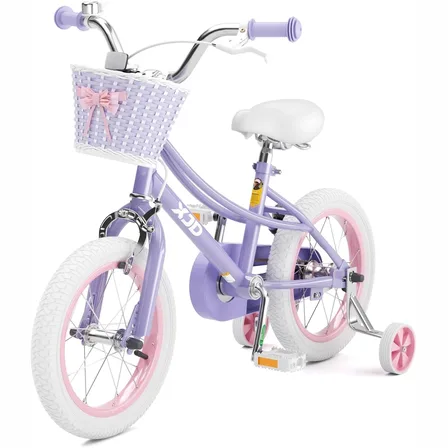
Girls' Training Wheel Bike by XJD with Basket – Purple
If you're shopping for a first bike for a girl roughly 3 to 12 years old (91–152…$75.99
-
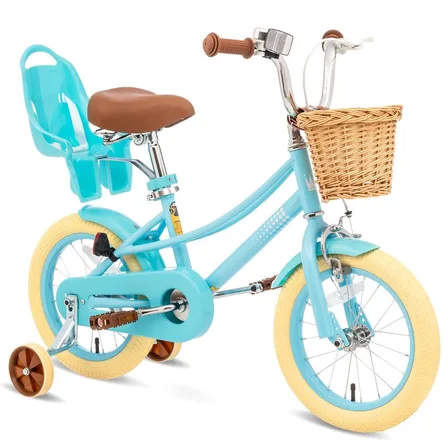
Girls' Training Wheel Bike by XJD, 12–20 Inch Wheels – Blue
This XJD girls' training wheel bike in Blue covers one of the widest fit ranges …$139
$159