

What size bike for teen
Choose a teen’s bike by measured height and individual fit, not age alone. Start with 24-inch wheels at 54–64 in (137–163 cm) and 26-inch wheels above 60 in (153 cm), then check inseam clearance, reach, braking and control on the actual bike.
Measure the teen before choosing
Measure height without shoes, standing straight against a wall. Then measure inseam from the floor to the crotch while the rider stands naturally. Height identifies the most useful wheel-size starting point; inseam helps determine whether the rider can stand over a particular frame comfortably.
Record both measurements rather than relying on clothing size, school year or a recent estimate. Teenagers of the same age can need different bicycles, and proportions such as leg length and arm reach also affect fit.
Compare height with the XBikes starting points
| Wheel size | Age starting point | Rider height starting point |
|---|---|---|
| 20 Inch | 7–12 | 48–60 in / 122–152 cm |
| 24 Inch | 10–14 | 54–64 in / 137–163 cm |
| 26 Inch | Youth and adults | Over 60 in / 153 cm |
For most teenagers, 24-inch and 26-inch wheels are the relevant comparison. A 20-inch bike may still be the appropriate starting point for a shorter teen whose measured height falls within 48–60 in (122–152 cm). Overlapping ranges are a reason to try both nearby sizes, not proof that either will fit.
Use age only as a rough cross-check. A 13-year-old measuring 58 inches, for example, falls within the supplied 24-inch height range even though 20-inch and 24-inch age guidance overlaps. A rider above 60 inches can begin by trying a 26-inch bike, but the frame still has to suit that rider.
Perform an individual fit check
Have the teen try the bicycle. The American Academy of Pediatrics advises against buying an oversized bike merely to allow room for growth. A bike that is too large can make starting, stopping and steering harder now.
- Check stand-over: With feet on the ground and the bicycle upright, confirm that the rider can straddle the frame without uncomfortable contact.
- Check reach: Seated in a normal riding position, the teen should reach the handlebar without stretching, locking the elbows or feeling cramped.
- Check brake control: Confirm that the rider can reach and operate the brake controls confidently while maintaining a secure grip.
- Check handling: In a suitable controlled area, have the rider start, steer, stop and put a foot down without hesitation or loss of balance.
Current confidence matters. If the measurements sit near a boundary, a less confident rider may control one option more comfortably than another. Choose according to demonstrated control rather than the larger wheel-size label.
How the supplied catalog options help
The 26-Inch XJD Beach Cruiser Bike for Girls – Purple, V-Brake provides useful nearby comparison options because its supplied SKU labels include 20-inch, 24-inch and 26-inch sizes in listed colors. These options let a parent compare the wheel-size starting points relevant to many teens, but each SKU still requires its own fit check.

The Purple option is listed only in 26 Inch. Mint Green and Pink have supplied labels in 20 Inch, 24 Inch and 26 Inch. Color does not establish fit, and the exact product title’s 26-inch wording does not make every listed SKU a 26-inch bike. Match the selected SKU label to the intended wheel size.
This beach-cruiser product is relevant only if its available size and individual riding position pass the checks above. The supplied catalog facts do not establish frame geometry, adjustability, load limits, assembly details or component compatibility. Consult the exact product manual or a qualified bicycle mechanic for those points.
Complete the decision safely
Once a candidate fits, confirm the bicycle is assembled and adjusted according to its exact manual. Do not improvise torque, compatibility or maintenance procedures that the supplied information does not specify; use a qualified bicycle mechanic when needed.
Add a properly fitting bicycle helmet. U.S. Consumer Product Safety Commission guidance says the helmet should sit level and its straps should be used according to the manufacturer’s instructions. A helmet is part of the riding setup, but it cannot correct an oversized or poorly controlled bicycle.
The practical decision is simple: measure height and inseam, shortlist 20-, 24- or 26-inch wheels from the stated height ranges, and have the teen demonstrate comfortable stand-over, reach, braking and control. Buy the size that fits now—not a larger bike chosen for future growth.
Bikes for your next adventure
-
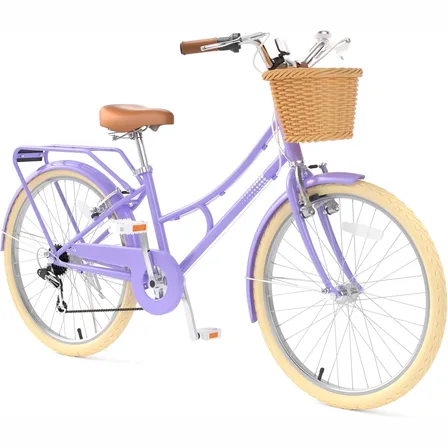
24-Inch Purple XJD Beach Cruiser Bike with U-Brake
The XJD 24-Inch Purple Beach Cruiser is built for girls and young women roughly …$159.99
-
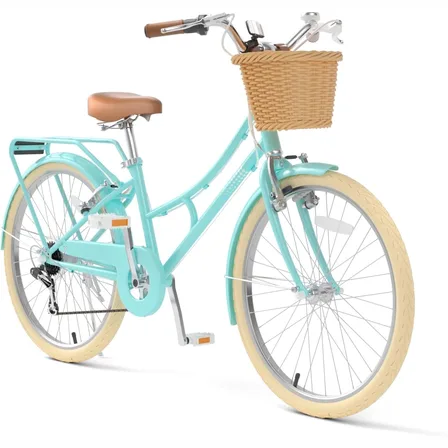
XJD Kids Beach Cruiser Bicycle, Rear Rack & V-Brakes, Mint Green
The XJD Beach Cruiser in Mint Green is a geared, multi-speed cruiser bike for ol…$179.99
$209.99 -
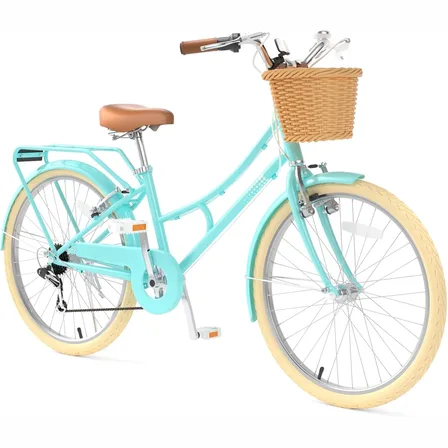
XJD 24-Inch Green Beach Cruiser Bike with U-Brake
This XJD 24-inch beach cruiser in green is made for riders about 4'8" to 5'4" ta…$159.99
$199.99