

What size bike frame for 11 year old
For most 11-year-olds, start by comparing 20-inch and 24-inch bikes: use 20-inch at 48–60 in (122–152 cm) and 24-inch at 54–64 in (137–163 cm), then confirm fit in person.
Choose by measured height, not age alone
There is no single bike frame size that fits every 11-year-old. At this age, the XBikes starting ranges overlap, so the child’s current height is more useful than the birthday on the calendar. Measure the rider without shoes, standing upright against a wall, and compare that result with the ranges below.
| Wheel size | XBikes age starting point | Rider height |
|---|---|---|
| 20 Inch | Ages 7–12 | 48–60 in / 122–152 cm |
| 24 Inch | Ages 10–14 | 54–64 in / 137–163 cm |
| 26 Inch | Youth and adults over 60 in / 153 cm | Over 60 in / 153 cm |
An 11-year-old below 54 in (137 cm) will usually begin with the 20-inch range. From 54 to 60 in (137–152 cm), compare both 20-inch and 24-inch options because the ranges overlap. From 60 to 64 in (153–163 cm), include 24-inch in the fitting process; riders over 60 in (153 cm) may also encounter 26-inch youth or adult bikes. These are starting points, not automatic selections.
Measure height and inseam before shopping
Height identifies which wheel sizes deserve a closer look. Inseam helps determine whether the rider can stand over a particular frame comfortably. To measure it, have the child stand straight without shoes, place a firm book upward between the legs to represent the saddle contact point, and measure from the floor to the top edge of the book.
Do not convert that inseam into a universal frame number. Frame shapes and sizing labels can differ, even when two bicycles use the same wheel size. Compare the measured height and inseam with the sizing information for the exact bicycle, then have the child try it. If the necessary measurements or adjustment instructions are not available, consult the exact product manual or a qualified bicycle mechanic.
Perform an individual fit check
A promising height range still needs a practical check. The child should be able to mount, start, steer, stop and get off without looking stretched, cramped or unstable. Check these points on the actual bicycle:
- Stand-over: With the child standing over the frame, the position should feel comfortable and controlled rather than forcing an awkward stance.
- Reach: The rider should hold the handlebar and steer without excessive stretching, locked arms or a strained upper body.
- Brake control: Confirm that the child can reach and operate the bicycle’s brakes confidently from the normal riding position.
- Current confidence: A size that is technically within a height range can still be unsuitable if starts, turns or stops feel intimidating.
Do not buy an oversized bicycle merely to leave room for growth. A bike that the child cannot control now is not corrected by the expectation that it may fit later.
How the supplied 20-inch BMX compares
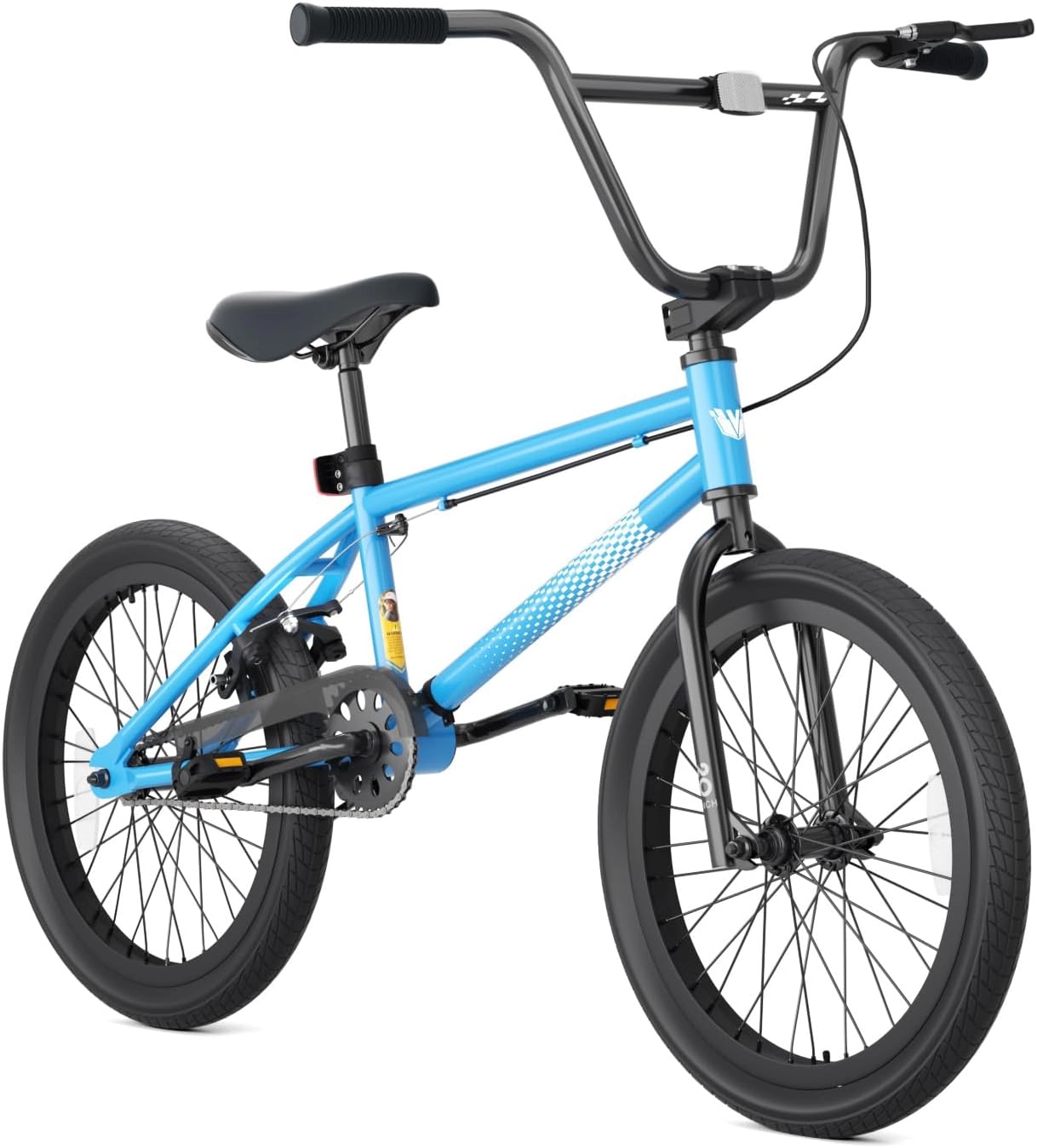
The catalog option here helps parents examine the smaller of the two main starting sizes for an 11-year-old. The Blue XJD Freestyle BMX Bike, 20-Inch – No Pegs is a Kids' BMX Bike with a 20-inch wheel-size label, so it is relevant when the rider measures within the XBikes 20-inch range and wants a BMX-format comparison. Its only available SKU label is Default.
Because this supplied product is 20-inch, it is not a substitute for a 24-inch or 26-inch bicycle when the fit check points to one of those sizes. It should be treated as a specific 20-inch comparison point, with suitability decided by the child’s measured height, inseam, reach, brake control and confidence.
Make the final size decision
- Measure the child’s height without shoes and record the inseam.
- Use the height ranges to shortlist 20-inch, 24-inch or, where relevant, 26-inch bikes.
- Compare the measurements with the exact bicycle’s sizing information rather than relying on wheel size alone.
- Have the child try the bicycle and assess stand-over, reach, steering, stopping and confidence.
- Choose the size the child controls comfortably today, not a larger model intended only for future growth.
Before riding, provide a bicycle helmet that fits properly, sits level and has its straps adjusted according to the helmet manufacturer’s instructions. Follow the exact bicycle manual or use a qualified bicycle mechanic for assembly, maintenance, compatibility, load limits and torque requirements.
For an 11-year-old, the next step is therefore simple: measure first, compare 20-inch and 24-inch wherever the ranges overlap, include 26-inch only when the recorded height supports it, and buy only after the child passes the hands-on fit check.
Bikes for your next adventure
-

XJD Girls Bike for Kids Ages 3-8, 12/14/16 Inch with Training Wheels – Purple
The XJD Girls Bike in Purple is a training-wheel bicycle for kids ages 3 to 8, f…$149
$169 -

Pink Girls' 12/14/16" Bike by XJD – Basket & Doll Seat
The XJD Pink Girls' Bike with Basket & Doll Seat is made for riders 71–122 cm ta…$75.99
$99.99 -

Light Purple XJD Toddler Bike Helmet, Adjustable, Size XS (46–51 cm)
This Light Purple XJD toddler bike helmet is made for the smallest riders — the …$20.39