

What size bike frame for 6 year old
For most 6-year-olds, start by comparing 14-, 16-, and 18-inch bikes. Measure the child first: height usually points to the wheel size, while inseam, reach, brake control, and confidence confirm the frame actually fits.
Choose the starting wheel size by measured height
A child's age is only a rough starting point. At age 6, several wheel sizes overlap, so use current standing height before considering how long the bicycle might last.
| Wheel size | XBikes age starting point | Rider height |
|---|---|---|
| 12 Inch | Ages 3–4 | 34–40 in / 86–102 cm |
| 14 Inch | Ages 3–6 | 37–45 in / 94–114 cm |
| 16 Inch | Ages 4–7 | 40–48 in / 102–122 cm |
| 18 Inch | Ages 5–9 | 43–52 in / 109–132 cm |
| 20 Inch | Ages 7–12 | 48–60 in / 122–152 cm |
This makes 14, 16, and 18 inches the normal comparison range for a 6-year-old, but it does not mean all three are interchangeable. For example, a child measuring 41 inches falls within the 14- and 16-inch starting ranges; the better choice is the one the child can stand over, steer, start, stop, and brake confidently.
Take two measurements before shopping
- Standing height: Have the child stand upright without shoes against a wall. Measure from the floor to the top of the head, then compare the result with the table.
- Inseam: With feet slightly apart, measure from the floor to the crotch. Use this measurement when checking whether the child can comfortably straddle the actual bicycle.
Wheel size labels are not complete frame dimensions. Two bicycles with the same wheel label may feel different because their frame shape, saddle position, and handlebar reach can differ. That is why the final decision must be made on the assembled bicycle rather than from age or wheel size alone.
Check the actual frame fit
Have the child try the bicycle instead of buying an oversized model for future growth. While standing over it, the child should be able to straddle the frame without being forced onto tiptoes or leaning awkwardly. Seated, the child should be able to reach the handlebar naturally without stretching, locking the elbows, or crowding the knees.
Next, check control. Ask the child to steer both directions, place the feet where needed for a controlled start, and stop without losing balance. If the bicycle has hand-operated brake controls, the child must be able to reach and operate them securely while maintaining the riding position. A technically matching height range does not override poor reach or weak brake control.
How confidence affects the decision
A less-confident rider generally benefits from the smaller option among two genuinely suitable fits because easier starts, stops, and handling matter more than extra growing room. A confident rider may be comfortable on the larger overlapping size, but only after passing every stand-over, reach, steering, and braking check.
Do not move up merely because the child's age reaches the edge of a listed range. Likewise, do not keep a child on a smaller bicycle if the riding position is cramped or control is restricted. Recheck fit after growth spurts and whenever the child begins struggling with mounting, steering, or stopping.
How the supplied bikes help with comparison
The catalog options cover useful comparison sizes for this question. Girls' Training Wheel Bike by XJD with Basket – Purple is offered with 14 Inch, 16 Inch, and 20 Inch SKU labels. Flower Pink XJD Girls Bike with Doll Seat & Basket is offered with 12 Inch, 14 Inch, and 16 Inch labels. Their 14- and 16-inch versions sit inside the common comparison range for age 6; neither product has a supplied 18-inch option.
These particular catalog choices therefore help a parent compare 14- and 16-inch possibilities on actual bikes after measuring the rider. Their 12- and 20-inch versions should be considered only when the child's measured height falls within the corresponding XBikes range and the individual fit check succeeds. They are not substitutes for an 18-inch bike when that is the size that fits.
 Girls' Training Wheel Bike by XJD with Basket – Purple
Available in 14 Inch, 16 Inch, and 20 Inch labels. Its 14- and 16-inch options are useful fit comparisons for many 6-year-olds; the 20-inch option requires the corresponding height range and a successful individual fit check.
 Flower Pink XJD Girls Bike with Doll Seat & Basket
Available in 12 Inch, 14 Inch, and 16 Inch labels. Its 14- and 16-inch options cover relevant comparison points, while the 12-inch option is relevant only when the rider's measured height and actual control support that size.
Make the final decision in this order
- Measure standing height and inseam.
- Use height to shortlist the wheel-size range.
- Have the child straddle and sit on each actual bicycle.
- Confirm comfortable reach, steering, starting, stopping, and brake operation.
- Reject any oversized bicycle chosen mainly for growing room.
Before riding, use a bicycle helmet that fits properly, sits level, and has its straps adjusted according to the helmet manufacturer's instructions. Follow the exact bicycle manual for assembly, maintenance, compatibility, load limits, and torque information; if anything is uncertain, use a qualified bicycle mechanic.
For a 6-year-old, measure first, compare 14, 16, and possibly 18 inches by height, then buy only the bicycle the child can confidently stand over, reach, steer, and stop today.
Bikes for your next adventure
-

XJD Girls Bike for Kids Ages 3-8, 12/14/16 Inch with Training Wheels – Purple
The XJD Girls Bike in Purple is a training-wheel bicycle for kids ages 3 to 8, f…$149
$169 -

Pink Girls' 12/14/16" Bike by XJD – Basket & Doll Seat
The XJD Pink Girls' Bike with Basket & Doll Seat is made for riders 71–122 cm ta…$75.99
$99.99 -
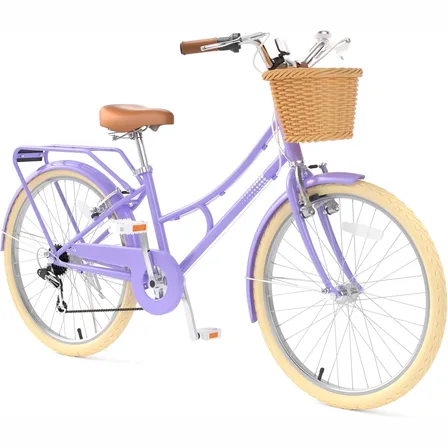
24-Inch Purple XJD Beach Cruiser Bike with U-Brake
The XJD 24-Inch Purple Beach Cruiser is built for girls and young women roughly …$159.99