

What size bike frame for a 6 year old
For a 6-year-old, start by comparing 14-, 16- and 18-inch wheel bikes. Measure the child first: height, inseam, reach and control matter more than age.
The direct size answer
Children’s bikes are commonly compared by wheel size rather than an adult-style frame measurement. Under the XBikes starting points, a 14 Inch bike covers rider heights of 37–45 in (94–114 cm), a 16 Inch bike covers 40–48 in (102–122 cm), and an 18 Inch bike covers 43–52 in (109–132 cm).
That means there is no single correct size for every six-year-old. A child measuring 40–45 in overlaps the 14 Inch and 16 Inch ranges; one measuring 43–48 in overlaps the 16 Inch and 18 Inch ranges. Use the child’s current measurements and an actual fit check to decide between overlapping sizes.
Measure before comparing bikes
- Height: Have the child stand upright without shoes against a wall. Measure from the floor to the top of the head, then compare that figure with the XBikes height ranges.
- Inseam: With feet slightly apart, measure from the floor to the crotch. Use this measurement during the stand-over check rather than trying to convert it into an unsupported frame-size number.
- Reach: On the bicycle, check whether the child can hold the handlebar comfortably without stretching, locking the elbows or leaning excessively.
- Controls: Confirm that the child can operate the brakes and steer while maintaining a stable riding position.
Measure the child as they are now. Do not choose an oversized bicycle merely to leave room for growth.
Use this wheel-size comparison
| Wheel label | XBikes age starting point | Rider height starting point | Relevance at age six |
|---|---|---|---|
| 14 Inch | Ages 3–6 | 37–45 in / 94–114 cm | Compare when the child’s measured height falls within this range. |
| 16 Inch | Ages 4–7 | 40–48 in / 102–122 cm | A common comparison point, but still requires an individual fit check. |
| 18 Inch | Ages 5–9 | 43–52 in / 109–132 cm | Consider only when height and on-bike control support the larger size. |
A 12 Inch bike starts at ages 3–4 and 34–40 in (86–102 cm), so it is generally outside the age starting point for this question. A 20 Inch bike starts at ages 7–12 and 48–60 in (122–152 cm), so age six alone is not a reason to move up to it.
Check the fit on the actual bicycle
Have the child try the exact bicycle where possible. When standing over it, the child should have suitable clearance rather than being pressed against the bike. Seated, they should be able to reach the handlebar and controls comfortably, look ahead, steer predictably and use the brakes without shifting into an unstable position.
Confidence is part of fit. A measured height may place a child in two ranges, but the larger option is not automatically preferable. If the child struggles to start, stop, turn or reach the controls, compare the smaller overlapping size. If neither candidate allows comfortable stand-over, reach and brake operation, keep looking rather than forcing the choice.
How the supplied XBikes options help
The three supplied catalog bicycles each offer 12 Inch, 14 Inch and 16 Inch SKU labels, so their 14 Inch and 16 Inch versions provide relevant comparison points for many six-year-olds. The catalog does not include an 18 Inch version of these products; if the child fits an 18 Inch bike, these options are nearest-size comparison points, not 18 Inch substitutes.
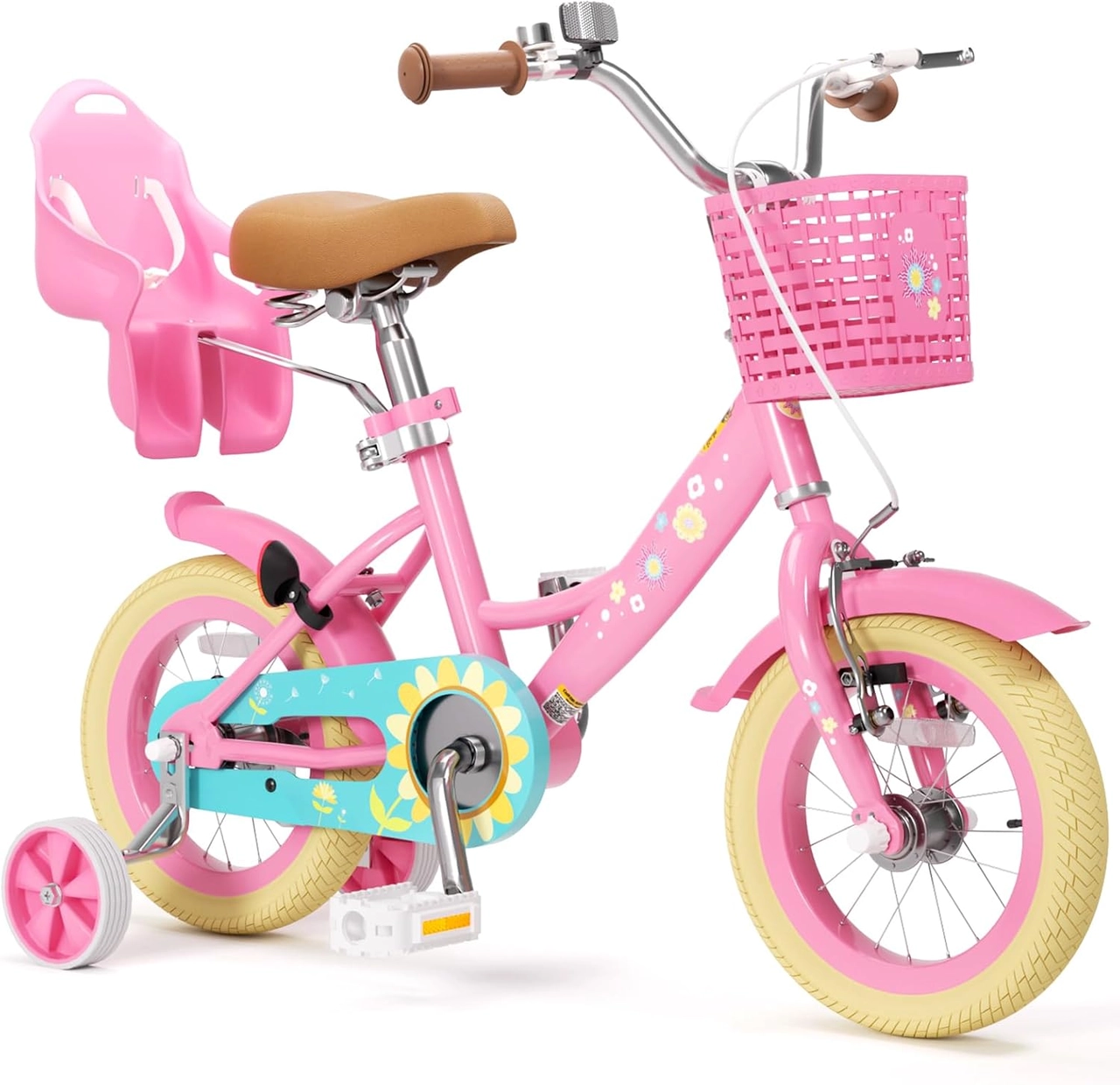 Flower Pink XJD Girls Bike with Doll Seat & Basket
Available in 12 Inch, 14 Inch and 16 Inch labels. Its 14 Inch and 16 Inch versions are useful fit-comparison points for a six-year-old whose measured height falls within the supplied ranges.
 Purple XJD Girls' Bike with Doll Seat & Basket
This Training Wheel Bike lists 12 Inch, 14 Inch and 16 Inch choices. Compare its 14 Inch and 16 Inch versions using the child’s height, stand-over, reach, brake control and confidence.
 Black XJD Kids' BMX Bicycle with Training Wheels
This Kids' BMX Bike with training wheels comes in 12 Inch, 14 Inch and 16 Inch labels. The two larger choices may be relevant comparisons, but neither replaces an 18 Inch bike when that is the appropriate fit.
The Flower Pink XJD Girls Bike with Doll Seat & Basket and Purple XJD Girls' Bike with Doll Seat & Basket are categorized as Training Wheel Bikes. The Black XJD Kids' BMX Bicycle with Training Wheels is categorized as a Kids' BMX Bike. All three list 12 Inch, 14 Inch and 16 Inch choices. Those labels establish the available comparison sizes only; they do not prove that a particular model fits an individual child.
For assembly, adjustment details, maintenance, compatibility, load limits or torque, follow the manual for the exact product or use a qualified bicycle mechanic.
Make the final decision
Put a properly fitting bicycle helmet on the child for every ride. It should sit level and its straps should be adjusted according to the helmet manufacturer’s instructions.
For a six-year-old, first shortlist 14, 16 or 18 Inch according to measured height. Then choose only the bicycle on which the child has appropriate stand-over clearance, comfortable reach, reliable brake control and enough confidence to start, steer and stop. If those checks fail, reject that size even when the age range appears to match.
Bikes for your next adventure
-

XJD Girls Bike for Kids Ages 3-8, 12/14/16 Inch with Training Wheels – Purple
The XJD Girls Bike in Purple is a training-wheel bicycle for kids ages 3 to 8, f…$149
$169 -

Pink Girls' 12/14/16" Bike by XJD – Basket & Doll Seat
The XJD Pink Girls' Bike with Basket & Doll Seat is made for riders 71–122 cm ta…$75.99
$99.99 -

XJD Pink Beach Cruiser for Girls – Rear Rack & V-Brake
The XJD Pink Beach Cruiser for girls is the step-up bike for riders who've outgr…$179.99
$209.99