

What size bike is appropriate for a 6 year old
A 6-year-old will usually compare 14-, 16- and 18-inch bikes, but height and an in-person fit check—not age alone—should decide the size.
Start with measured height
Measure the child without shoes, standing straight against a wall. Compare that result with the XBikes starting points below. The ranges overlap because children of the same age can have different proportions, reach and riding ability.
| Wheel size | Age starting point | Rider height |
|---|---|---|
| 12 Inch | Ages 3–4 | 34–40 in / 86–102 cm |
| 14 Inch | Ages 3–6 | 37–45 in / 94–114 cm |
| 16 Inch | Ages 4–7 | 40–48 in / 102–122 cm |
| 18 Inch | Ages 5–9 | 43–52 in / 109–132 cm |
| 20 Inch | Ages 7–12 | 48–60 in / 122–152 cm |
For many 6-year-olds, the meaningful comparison is between 14, 16 and 18 inches. A child near an overlap should try both sizes rather than automatically taking the larger one. A particularly short or tall child may fall into another height band, so use the measured height rather than forcing the age label to fit.
Measure inseam and check stand-over
Height narrows the options; inseam helps confirm them. With the child barefoot or in thin socks, place a book firmly between the legs as if it were a bicycle saddle. Measure from the floor to the top edge of the book.
Next, have the child stand over the actual bike with both feet flat on the ground. There should be comfortable clearance between the child and the frame. Because frame shapes vary, wheel diameter alone cannot establish stand-over clearance. If the child cannot stand comfortably, reject that bike even when its wheel size matches the height table.
Test reach, braking and control
Seat the child on the bicycle and watch the whole riding position. The child should be able to hold the handlebar without stretching, turn it smoothly, and operate the brakes with their hands in a controlled position. Confirm that the child can start, stop, steer and get off without panic or help.
Current confidence matters. A new or hesitant rider may control the smaller of two genuinely suitable fits more easily, while a confident rider may still use the larger option only if stand-over, reach and braking all work now. Do not buy an oversized bicycle merely to allow room for growth.
How the supplied bikes fit this decision
The Black XJD Kids' BMX Bicycle with Training Wheels and the Pink Girls' 12/14/16" Bike by XJD – Basket & Doll Seat both offer 12 Inch, 14 Inch and 16 Inch SKU labels. They therefore provide concrete 14- and 16-inch comparison points for a 6-year-old whose measured height falls within those XBikes ranges. Their 12-inch versions should be considered only when the child's measurements and individual fit support that smaller size.
These particular catalog options help answer the sizing question because each lets a parent compare the two commonly overlapping supplied sizes—14 and 16 inches—while keeping the product differences limited to verified catalog descriptions and categories.
 Black XJD Kids' BMX Bicycle with Training Wheels
Available in 12 Inch, 14 Inch and 16 Inch labels, this Kids' BMX Bikes option provides relevant 14- and 16-inch fit-check candidates for many 6-year-olds.
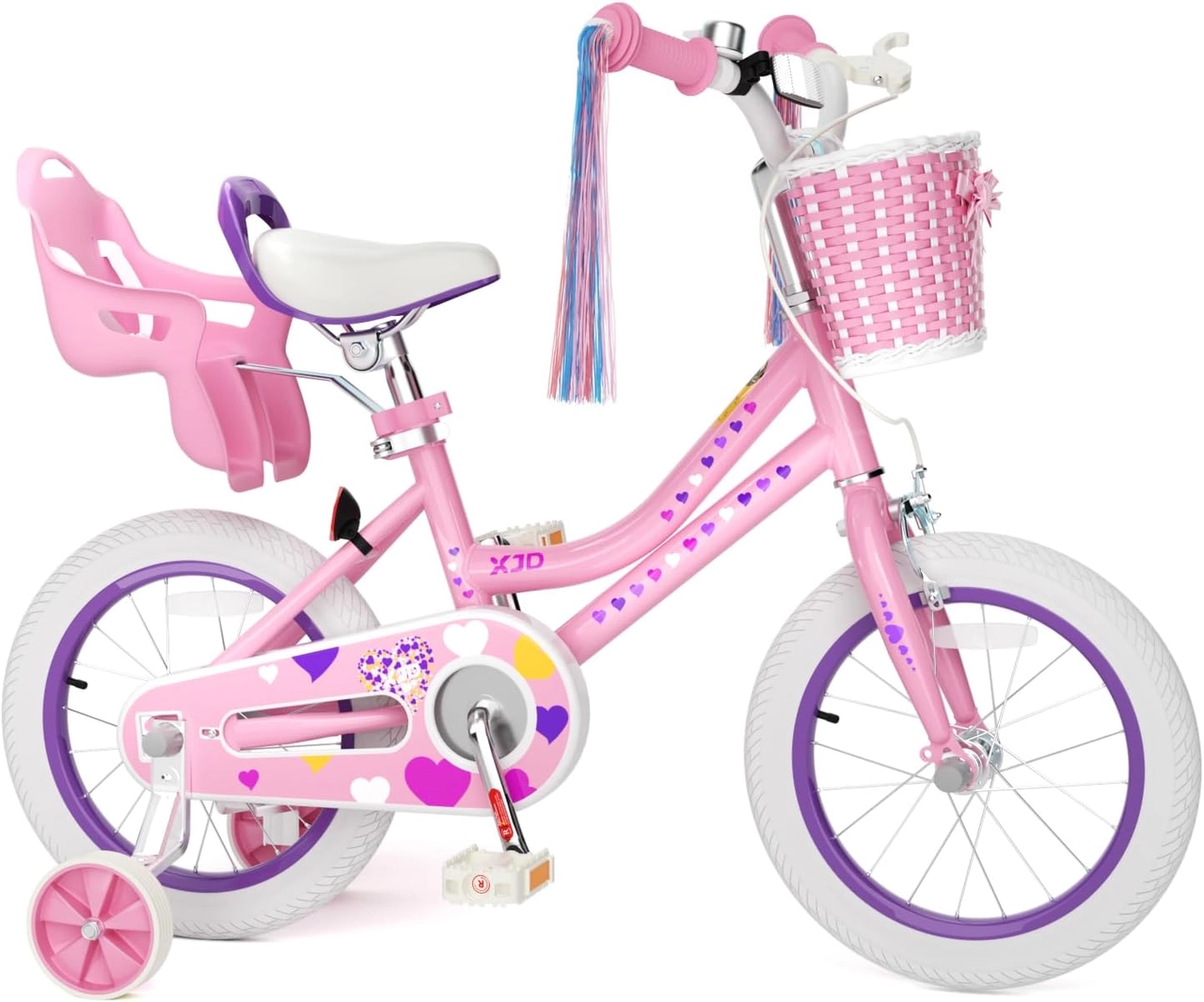 Pink Girls' 12/14/16" Bike by XJD – Basket & Doll Seat
This Training Wheel Bikes model has 12 Inch, 14 Inch and 16 Inch labels, making its 14- and 16-inch versions useful comparison points when the child's measurements support them.
Neither supplied product has an 18-inch or 20-inch SKU label. If the child's height and fit check point to 18 or 20 inches, these products are nearest-size comparison points only, not substitutes. A 16-inch bicycle is not equivalent to an 18- or 20-inch bicycle.
Use this decision sequence
- Measure the child's standing height and inseam.
- Use height to shortlist the relevant wheel sizes from the table.
- Have the child try each shortlisted bicycle rather than relying on its label.
- Check frame clearance, comfortable handlebar reach and reliable access to the brakes.
- Observe starting, steering, stopping and dismounting at the child's present confidence level.
- Choose only the size the child can control now; do not size up solely for future growth.
For assembly, adjustment, maintenance, load limits, compatibility and torque requirements, follow the exact product manual or ask a qualified bicycle mechanic. Do not improvise settings that the manufacturer specifies.
Finish with helmet fit
A properly fitting bicycle helmet is necessary whichever bike size is selected. It should sit level on the child's head, fit properly, and use its straps according to the helmet manufacturer's instructions. A larger helmet intended for future growth is not an appropriate substitute for a correct present fit.
For a 6-year-old, begin by comparing 14, 16 and 18 inches against measured height, then buy only after the child passes the stand-over, reach, brake-control and confidence checks on that exact bicycle.
Bikes for your next adventure
-

Pink Girls' 12/14/16" Bike by XJD – Basket & Doll Seat
The XJD Pink Girls' Bike with Basket & Doll Seat is made for riders 71–122 cm ta…$75.99
$99.99 -

XJD Pink Beach Cruiser for Girls – Rear Rack & V-Brake
The XJD Pink Beach Cruiser for girls is the step-up bike for riders who've outgr…$179.99
$209.99 -
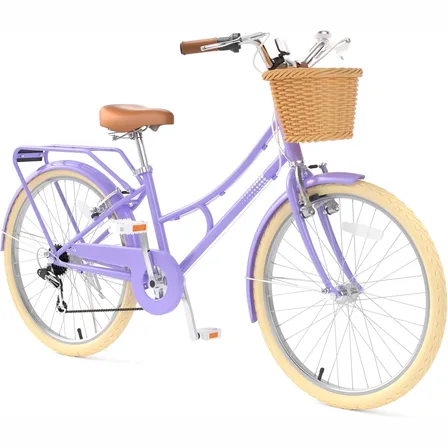
24-Inch Purple XJD Beach Cruiser Bike with U-Brake
The XJD 24-Inch Purple Beach Cruiser is built for girls and young women roughly …$159.99