

What size bike is appropriate for a 5 year old
For most 5-year-olds, start by comparing 14-, 16-, and 18-inch bikes, then choose by measured height and fit—not age alone.
Match height to wheel size first
Measure your child barefoot, standing straight against a wall. Use that height to find the starting range below. Wheel size describes the wheels, not the complete frame, so two bikes with the same wheel size can still fit differently.
| Wheel size | XBikes age starting point | Rider height |
|---|---|---|
| 12 Inch | Ages 3–4 | 34–40 in / 86–102 cm |
| 14 Inch | Ages 3–6 | 37–45 in / 94–114 cm |
| 16 Inch | Ages 4–7 | 40–48 in / 102–122 cm |
| 18 Inch | Ages 5–9 | 43–52 in / 109–132 cm |
| 20 Inch | Ages 7–12 | 48–60 in / 122–152 cm |
These ranges overlap because children of the same age differ in height, proportions, and confidence. A 5-year-old measuring 39 inches may begin with a 14-inch comparison, while one measuring 44 inches should compare 14-, 16-, and 18-inch fits. At 49 inches, an 18-inch bike is the age-and-height starting point; a 20-inch bike enters the height range but still requires especially careful checking because its age starting point is seven.
Measure inseam before trying a bike
Height narrows the options; inseam helps determine whether the frame is manageable. Have the child stand barefoot with feet slightly apart. Place a firm, thin book between the legs, raise it gently to simulate a saddle, and measure from the floor to the top edge.
Compare that measurement with the bicycle manufacturer’s stand-over and saddle information. The child needs suitable clearance when straddling the bicycle and must be able to get on and off without leaning the bike dangerously. Because those dimensions are not supplied here, check the exact product specifications or manual rather than inferring them from wheel diameter.
Perform the fit check with the child
Have your child try the actual bicycle whenever possible. The American Academy of Pediatrics advises against buying an oversized bike merely for future growth. During the trial, check whether the rider can:
- Straddle the frame with appropriate clearance.
- Reach the handlebar without stretching, locking the elbows, or losing an upright, controlled position.
- Turn the handlebar smoothly while remaining balanced.
- Reach and operate every fitted brake control reliably with their normal hand position.
- Start, stop, place a foot down, and dismount with current confidence.
If the child looks cramped on one size but stretched or hesitant on the next, do not assume the larger bicycle is acceptable. Compare another frame in the same wheel size or seek help from a qualified bicycle mechanic.
How the supplied bike helps with comparison
The Black XJD Kids Bike for Boys – 12, 14 & 16 Inch Sizes is listed in the Training Wheel Bikes category and has 12 Inch, 14 Inch, and 16 Inch SKU labels. For a 5-year-old, its 14- and 16-inch choices are relevant XBikes starting points when the measured height falls within their ranges. The 12-inch choice is a smaller comparison point, but the XBikes standard associates it with ages 3–4 and heights of 34–40 inches; age five alone does not establish that it fits. This product does not offer the supplied 18-inch starting point, so it is not a substitute when an individual fit check indicates an 18-inch bicycle.

Use the displayed options to compare only the listed wheel sizes. Do not infer frame dimensions, brake type, assembly requirements, load limits, or other specifications from the title or category. Consult the exact product manual for missing requirements, and use a qualified bicycle mechanic for assembly or adjustments when needed.
Account for confidence and control
A measured fit can still be wrong for the rider’s present ability. A cautious beginner may control a properly fitting smaller option more confidently than a larger option that also overlaps the height chart. Conversely, do not force a child onto a bicycle that is visibly cramped simply because it feels familiar.
Training wheels describe a bicycle category, not proof of fit. Whether they are appropriate depends on the child’s current balance skills and the instructions for the exact bicycle. Confirm all setup and compatibility details in the product manual rather than assuming every training-wheel configuration works identically.
Make the final size decision
- Measure standing height and inseam.
- Use height to shortlist 14, 16, or 18 inches for a typical 5-year-old; include another size only when the supplied height range supports it.
- Compare inseam with the maker’s stand-over and saddle information.
- Have the child test stand-over clearance, reach, steering, braking, starting, and stopping.
- Reject any bike that requires stretching, compromises control, or is being chosen mainly for growth.
Before riding, provide a bicycle helmet that fits properly, sits level, and has its straps adjusted according to the helmet manufacturer’s instructions, as directed by the U.S. Consumer Product Safety Commission. For your 5-year-old, buy only the wheel size and frame they can control comfortably now—even if that means passing over a larger size they may grow into later.
Bikes for your next adventure
-

Pink Girls' 12/14/16" Bike by XJD – Basket & Doll Seat
The XJD Pink Girls' Bike with Basket & Doll Seat is made for riders 71–122 cm ta…$75.99
$99.99 -
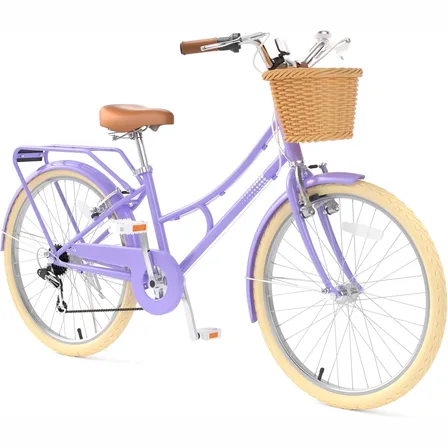
24-Inch Purple XJD Beach Cruiser Bike with U-Brake
The XJD 24-Inch Purple Beach Cruiser is built for girls and young women roughly …$159.99
-

XJD Kids Bike for Girls – Pink, 12/14/16/20 Inch with Training Wheels
The XJD Kids Bike for Girls in Pink is a training-wheel bike built to carry your…$139
$159