

What size bike to get my child
Choose your child’s bike size from their measured height, then confirm it in person with an inseam, stand-over, reach and brake-control check. Use age only as a starting clue, and never buy an oversized bicycle for your child to grow into.
Measure before comparing wheel sizes
Measure your child without shoes, standing straight against a wall. Record their total height from the floor to the top of the head. Then measure inseam from the floor to the crotch; a book held level between the legs can provide a clear measuring point.
Bring both measurements when shopping. Height identifies the wheel sizes worth trying, while inseam helps you judge whether the child can stand over the actual frame comfortably. Wheel size does not determine every frame dimension, so two bicycles with the same wheel size may fit differently.
Find the starting range
Compare measured height with the XBikes starting points below. When ranges overlap, try both sizes rather than choosing automatically by age.
| Wheel size | Starting age | Rider height |
|---|---|---|
| 12 Inch | 3–4 | 34–40 in / 86–102 cm |
| 14 Inch | 3–6 | 37–45 in / 94–114 cm |
| 16 Inch | 4–7 | 40–48 in / 102–122 cm |
| 18 Inch | 5–9 | 43–52 in / 109–132 cm |
| 20 Inch | 7–12 | 48–60 in / 122–152 cm |
| 24 Inch | 10–14 | 54–64 in / 137–163 cm |
| 26 Inch | Youth and adults | Over 60 in / 153 cm |
Age bands are secondary because children of the same age can differ substantially in height, proportions, coordination and confidence. At a boundary, the correct choice is the bicycle the child can control now—not necessarily the larger wheel.
Perform the fit check on the actual bike
Have your child try the assembled bicycle. The American Academy of Pediatrics advises against buying an oversized bike for future growth and recommends checking stand-over clearance, control and brake reach.
- Stand-over: Ask the child to straddle the bicycle with both feet planted. They should be able to stand securely rather than being forced onto their toes or against the frame.
- Starting and stopping: Confirm that they can get on, start, stop and put a foot down without panic or excessive leaning.
- Reach: Their hands should reach the handlebar naturally, without a deep forward stretch or locked elbows.
- Brake control: Where hand brakes are fitted, the child must reach and operate the controls confidently while maintaining steering control.
- Confidence: Let the rider make slow turns and controlled stops in a suitable protected area. Awkward handling is a reason to reconsider the size.
How the supplied XBikes options compare
These catalog options provide concrete comparison points across several ranges in the chart: one model offers 12-, 14- and 16-inch selections, while the others represent 20- and 24-inch categories. They help narrow the shortlist after measurement, but the title alone cannot confirm individual fit.
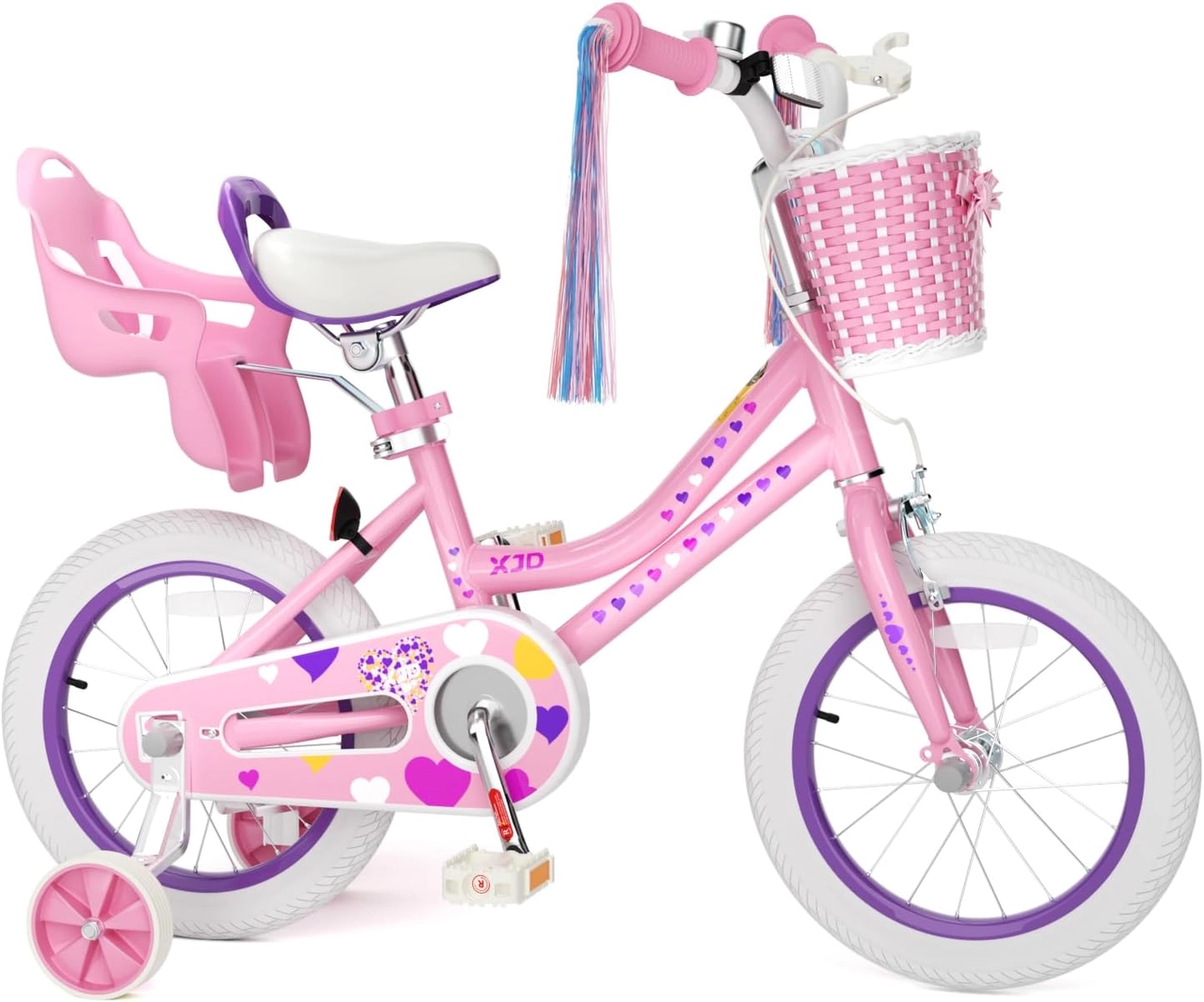 Pink Girls' 12/14/16" Bike by XJD – Basket & Doll Seat
Available in 12 Inch, 14 Inch and 16 Inch SKU labels, this model is relevant when measured height points to those starting ranges; confirm the selected size with an individual fit check.
 24-Inch Purple XJD Beach Cruiser Bike with U-Brake
This 24-inch model is a comparison option for riders in the 54–64 inch / 137–163 cm starting range, subject to stand-over, reach, brake control and confidence checks.
 Blue XJD Freestyle BMX Bike, 20-Inch – No Pegs
This 20-inch BMX model is relevant to the 48–60 inch / 122–152 cm starting range. Its wheel size is only a starting point, so the child must try it for fit and control.
The Pink Girls' 12/14/16" Bike by XJD – Basket & Doll Seat is available with 12 Inch, 14 Inch and 16 Inch SKU labels. That makes it relevant when the child’s measured height falls within one or more of those starting ranges. Select the intended SKU deliberately, then perform the full fit check on that exact size.
The Blue XJD Freestyle BMX Bike, 20-Inch – No Pegs is a 20-inch comparison for riders starting around 48–60 inches / 122–152 cm and ages 7–12. Those figures identify who should try it; they do not establish fit without checking reach, control and confidence.
The 24-Inch Purple XJD Beach Cruiser Bike with U-Brake is a 24-inch comparison for the 54–64 inches / 137–163 cm starting range, associated with ages 10–14. Its available SKU label is Default, so do not interpret that label as a choice of wheel sizes or as fit evidence.
If measurement points instead toward 18 or 26 inches, none of these supplied products provides that exact wheel size. Treat the listed products only as nearest-size comparison points, not substitutes; an adjacent size is not equivalent.
Make the final decision
Shortlist by measured height, use inseam to prepare for stand-over assessment, and let the child try the exact model and size. Reject any bicycle that requires stretching, tiptoe balancing, strained steering or uncertain braking, even when age or height appears to match the chart.
Before riding, follow the exact product manual for assembly, adjustment, maintenance, load limits, compatibility and torque. If anything is unclear, use a qualified bicycle mechanic rather than improvising a procedure or setting.
Add a properly fitting bicycle helmet. The U.S. Consumer Product Safety Commission advises that it sit level and that its straps be used according to the helmet manufacturer’s instructions. The final choice should be the wheel size your child can stand over, reach, steer, brake and stop confidently today.
Bikes for your next adventure
-

Green XJD Toddler Bike Helmet with Adjustable Fit, XS (46–51 cm)
The XJD toddler bike helmet in Green is built for the youngest riders — the size…$20.39
$23.99 -

Kids Bike Helmet by XJD for Boys & Girls – Black, Blue, Green, Pink, Purple
The XJD Kids Bike Helmet covers a wide 2-to-8-year age range thanks to two head-…$59.99
-

Kids Bike Helmet by XJD for Girls – Pink
The XJD Kids Bike Helmet in Pink is a lightweight multi-sport helmet for girls r…$59.99
$99