

What size bike would a 12 year old need
Most 12-year-olds need a 24-inch bike, but a shorter rider may fit a 20-inch bike and a rider over 60 inches may need a 26-inch bike. Measure the child before choosing.
Choose by measured height, not age alone
For a 12-year-old, compare current standing height with these XBikes starting points. They narrow the choice, but they do not replace trying the bicycle and checking control.
| Wheel size | XBikes age starting point | Rider height |
|---|---|---|
| 20 Inch | Ages 7–12 | 48–60 in / 122–152 cm |
| 24 Inch | Ages 10–14 | 54–64 in / 137–163 cm |
| 26 Inch | Youth and adults | Over 60 in / 153 cm |
The ranges overlap because wheel diameter alone does not determine fit. At 54–60 inches, both 20-inch and 24-inch starting ranges apply; the better choice depends on the particular frame, stand-over clearance, reach, brake access and the rider’s confidence. A child just over 60 inches may fall within both the 24-inch range and the 26-inch starting point, so an individual fit check remains essential.
Measure height and inseam
Measure the child in socks or the shoes normally worn for riding. For height, have them stand upright against a wall and measure from the floor to the top of the head.
For inseam, place a book firmly between the legs to represent the bicycle saddle, keeping its spine level. Measure from the floor to the top edge of the book. Record both measurements in inches or centimetres. Height selects a likely wheel-size range; inseam helps determine whether the child can stand over a particular frame comfortably.
Do not infer inseam from overall height. Two 12-year-olds of the same height can have different leg lengths and may not fit the same frame.
Check the actual bicycle before buying
Have the child try the exact bicycle whenever possible. Do not move up to an oversized model merely to leave growing room. A bicycle that is hard to mount, balance or stop is not made suitable by the expectation that the rider will grow into it.
- Stand-over: With the child straddling the bicycle, confirm there is comfortable clearance rather than contact with the frame.
- Reach: Seated in a normal riding position, the child should reach the handlebar without stretching, locking the arms or losing an easy posture.
- Brake control: The child must be able to reach and operate the available brake controls confidently with their hands in a stable riding position.
- Handling: Ask the child to start, steer, turn and stop under close supervision in a traffic-free area. Watch for wobbling caused by struggling with the bicycle’s size.
If adjustment, assembly or compatibility is uncertain, follow the exact product manual or ask a qualified bicycle mechanic. Do not improvise settings or torque values.
When the supplied 20-inch options are relevant
The supplied catalog does not include a 24-inch or 26-inch option. Its two models offer 12-, 14-, 16- and 20-inch SKU labels, so only their 20-inch versions are plausible comparison points for a 12-year-old. They are relevant when the rider measures 48–60 inches / 122–152 cm and passes the individual fit check; they are not substitutes when a 24-inch or 26-inch bicycle fits better.
Girls' Training Wheel Bike by XJD, 12–20 Inch Wheels – Blue and XJD Girls' Bike with Training Wheels, 12/14/16/20 Inch – Purple help show the available 20-inch catalog choice in two listed colours. Both are categorized as Training Wheel Bikes and have the same supplied wheel-size labels: 12, 14, 16 and 20 Inch.
 Girls' Training Wheel Bike by XJD, 12–20 Inch Wheels – Blue
Its 20 Inch SKU is relevant for a 12-year-old measuring 48–60 inches, subject to a complete fit check. The smaller supplied sizes are outside the usual height range for this question.
 XJD Girls' Bike with Training Wheels, 12/14/16/20 Inch – Purple
This purple training-wheel bike includes a 20 Inch SKU as its largest supplied option. Compare it only for riders measuring 48–60 inches; it does not replace a better-fitting 24- or 26-inch bike.
Do not use the smaller 12-, 14- or 16-inch labels for a typical 12-year-old merely because those variants appear on the same product listing. Under the supplied standard, their height ranges end at 40, 45 and 48 inches respectively. The rider’s measured height and real-world control decide whether even the 20-inch variant remains appropriate.
Make the final size decision
- Measure height and inseam.
- Use height to shortlist 20, 24 or 26 Inch from the table.
- Try the exact bicycle and check stand-over, reach, brake operation and handling.
- Reject any size the child cannot control confidently, even if its age range includes 12.
Complete the choice with a properly fitting bicycle helmet. It should sit level and its straps should be adjusted according to the helmet manufacturer’s instructions.
For this 12-year-old, choose 24 Inch as the initial size to try unless measured height points elsewhere: compare 20 Inch below 60 inches, consider 26 Inch above 60 inches, and buy only after the child passes the complete fit and control check.
Bikes for your next adventure
-
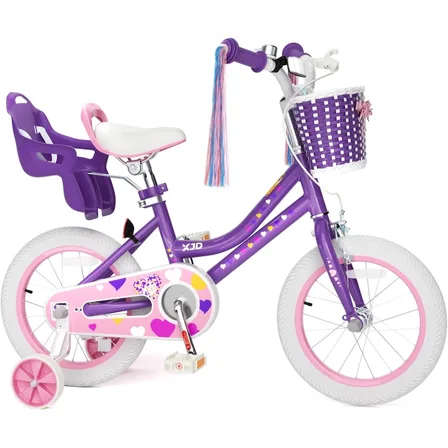
Purple XJD Girls' Bike with Doll Seat & Basket
For girls 71–122 cm tall (about ages 3–7), this XJD girls' bike in Purple pairs …$75.99
$99.99 -
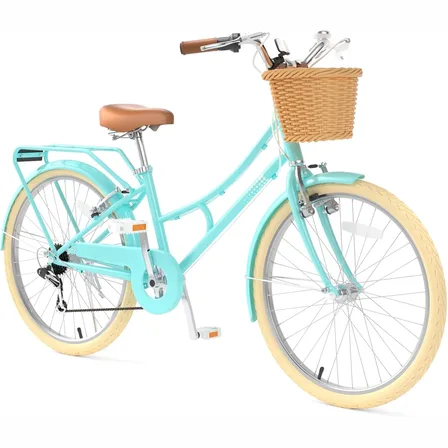
XJD 24-Inch Green Beach Cruiser Bike with U-Brake
This XJD 24-inch beach cruiser in green is made for riders about 4'8" to 5'4" ta…$159.99
$199.99 -

Kids Bike Helmet by XJD for Boys & Girls – Black, Blue, Green, Pink, Purple
The XJD Kids Bike Helmet covers a wide 2-to-8-year age range thanks to two head-…$59.99