

What size bike would a 12 year old ride
Most 12-year-olds start by comparing a 20-inch or 24-inch bike: use 20 inches for a measured height of 48–60 in (122–152 cm), 24 inches for 54–64 in (137–163 cm), and consider 26 inches above 60 in (153 cm). Age is only a starting point; the correct bike must also fit the child’s inseam, reach, brake control and confidence.
Choose the starting wheel size by height
Measure the child without shoes, standing straight against a wall. Record total height, then compare it with the XBikes starting points below. The ranges overlap because wheel diameter alone does not determine whether a particular frame fits.
| Wheel size | XBikes age starting point | Rider height starting point |
|---|---|---|
| 20 Inch | Ages 7–12 | 48–60 in / 122–152 cm |
| 24 Inch | Ages 10–14 | 54–64 in / 137–163 cm |
| 26 Inch | Youth and adults | Over 60 in / 153 cm |
For example, a 12-year-old who is 56 inches tall falls within both the 20-inch and 24-inch starting ranges. That does not make the sizes equivalent: compare the actual bikes and choose the one the rider can stand over and control comfortably. A child below or above the typical range should be sized by measurements rather than birthday.
Measure inseam as well as total height
To measure inseam, have the child stand in socks with feet naturally spaced. Place a firm, thin book between the legs and raise it gently to simulate the saddle contact point. Measure vertically from the floor to the top edge of the book.
Compare that measurement with the stand-over clearance and saddle-adjustment guidance for the exact bicycle. Those dimensions are not supplied here, so consult the product specification or manual rather than estimating them from wheel size. When the child straddles the bike, the frame should not prevent a comfortable, controlled stance.
Perform an individual fit check
Have the child try the bicycle before deciding. The American Academy of Pediatrics advises against buying an oversized bicycle merely for growth. During the fit check, confirm that the rider can:
- stand over the bicycle without being forced onto tiptoes or against the frame;
- sit in a stable position and reach the handlebars without excessive stretching;
- turn the bars while remaining balanced and in control;
- reach and operate the brake controls reliably; and
- start, stop and dismount with confidence.
If the rider is stretched, cannot control the brakes, or feels intimidated, move to a more manageable fit even when the age chart suggests a larger wheel. If two sizes both appear plausible, a supervised trial is more useful than choosing solely from the height overlap.
How the supplied XBikes options relate
The supplied catalog options are training-wheel bikes that help with the 20-inch side of the comparison. They do not include a verified 24-inch or 26-inch option, so they are nearest-size comparison points for a taller 12-year-old—not substitutes for the wheel size indicated by that rider’s measurements and fit check.
 XJD Girls' Bike with Training Wheels, 12/14/16/20 Inch – Purple
Offers supplied 12-, 14-, 16- and 20-inch SKU labels. Its 20-inch option is relevant for comparison when a 12-year-old’s measured height, reach, brake control and confidence confirm the fit.
 XJD Kids Bike for Girls – Pink, 12/14/16/20 Inch with Training Wheels
The supplied SKU labels include 12, 14, 16 and 20 inches. Consider the 20-inch version only for a rider whose measurements and individual fit check support that wheel size.
 XJD Light Purple Girls Bike with Basket, Training Wheels, 12/14/16/20 Inch
Although the exact title mentions 20 Inch, the supplied available SKU labels list only 12, 14 and 16 inches. It is therefore generally a smaller-size comparison, not a 24-inch substitute.
XJD Girls' Bike with Training Wheels, 12/14/16/20 Inch – Purple and XJD Kids Bike for Girls – Pink, 12/14/16/20 Inch with Training Wheels each have supplied SKU labels for 12, 14, 16 and 20 inches. Their 20-inch versions are relevant only when the child’s measured height and hands-on control support a 20-inch bike.
XJD Light Purple Girls Bike with Basket, Training Wheels, 12/14/16/20 Inch must be read carefully: although 20 Inch appears in its exact catalog title, the supplied available SKU labels list only 12, 14 and 16 inches. Those are below the usual 20- or 24-inch starting comparison for a 12-year-old, so this product is generally not relevant unless the rider’s measurements and individual needs point unusually small and a proper fit check confirms it.
Training wheels may matter when confidence or balance support is part of the decision, but their presence does not correct an unsuitable frame or wheel size. Follow the exact product manual or use a qualified bicycle mechanic for assembly, adjustment, maintenance, compatibility and torque guidance.
What to do before the first ride
- Measure the child’s height and inseam.
- Use height to shortlist 20, 24 or 26 inches from the supplied ranges.
- Try the shortlisted bike and check stand-over position, reach, steering, brake operation and confidence.
- Reject a bike that is oversized for future growth or difficult to control.
- Fit a bicycle helmet that sits level and uses its straps according to the helmet manufacturer’s instructions.
For a 12-year-old, choose 20 inches only when the rider is within its height range and controls that specific bike well; compare 24 inches at 54–64 inches tall, and move to a 26-inch comparison above 60 inches. Let the measurements and fit trial make the final decision.
Bikes for your next adventure
-
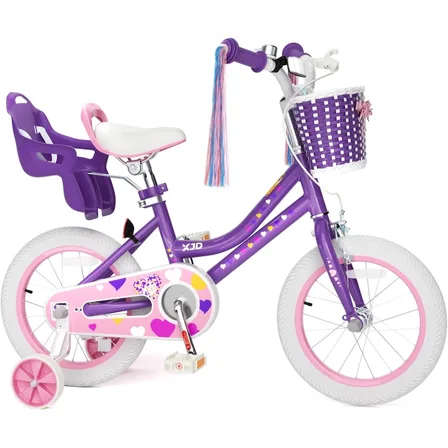
Purple XJD Girls' Bike with Doll Seat & Basket
For girls 71–122 cm tall (about ages 3–7), this XJD girls' bike in Purple pairs …$75.99
$99.99 -

XJD 24-Inch Green Beach Cruiser Bike with U-Brake
This XJD 24-inch beach cruiser in green is made for riders about 4'8" to 5'4" ta…$159.99
$199.99 -

Kids Bike Helmet by XJD for Boys & Girls – Black, Blue, Green, Pink, Purple
The XJD Kids Bike Helmet covers a wide 2-to-8-year age range thanks to two head-…$59.99