

What to look for kids bike quality
A quality kids bike fits the child now, feels easy to control, and has secure, correctly assembled parts. Measure height and inseam, then check stand-over clearance, reach and brake access in person.
Start with fit, because size affects quality in use
A well-made bicycle is still a poor choice if the rider cannot control it. Measure the child’s height without shoes and inseam from the floor to the crotch. Use height to identify a starting wheel size, then have the child try the bicycle. Age is only a secondary guide.
| Wheel size | Starting age | Rider height |
|---|---|---|
| 12 Inch | 3–4 | 34–40 in / 86–102 cm |
| 14 Inch | 3–6 | 37–45 in / 94–114 cm |
| 16 Inch | 4–7 | 40–48 in / 102–122 cm |
| 18 Inch | 5–9 | 43–52 in / 109–132 cm |
| 20 Inch | 7–12 | 48–60 in / 122–152 cm |
| 24 Inch | 10–14 | 54–64 in / 137–163 cm |
| 26 Inch | Youth and adults | Over 60 in / 153 cm |
These are starting points, not proof of fit. With the child straddling the bike, check that there is comfortable clearance rather than contact with the frame. Seated, the child should reach the handlebar without stretching or locking the arms. They must also operate every brake control comfortably and keep the bicycle balanced at low speed.
Do not buy an oversized bike for future growth. If the rider looks tense, cannot start and stop predictably, or struggles to turn the handlebar, try a more suitable size or setup.
Inspect the parts you can see and operate
Compare candidate bikes side by side and look for consistent assembly rather than decorative extras. Useful checks include:
- Frame and fork: Look for visible dents, cracks, distortion, sharp edges or damaged finishes around joints.
- Wheels: Lift each wheel and spin it. It should rotate freely without obvious side-to-side wobble, rubbing or looseness.
- Steering: Turn the handlebar through its normal range. Movement should feel smooth, with no binding or play.
- Seat and handlebar: Confirm that both remain aligned and secure under ordinary hand pressure.
- Pedals and drivetrain: Rotate them and listen for scraping while checking for damaged, loose or missing parts.
- Brakes: Have the child use them. Controls should be reachable, move predictably and stop the bicycle appropriately during a supervised fit check.
A failed check does not reveal the precise repair or adjustment required. Follow the exact product manual or ask a qualified bicycle mechanic; do not guess at compatibility, assembly steps or torque.
Compare construction by function, not appearance
Quality is easier to judge when each feature has a purpose. Ask whether the bike stays stable while the child mounts, starts, turns and stops. Check that cables, fasteners and moving parts appear orderly and do not snag clothing. Look for grips, pedal surfaces and contact points that let the rider maintain control.
Repeat the inspection after adjusting the bike within the manual’s permitted range. A component that cannot be positioned for the child’s reach is not made suitable merely because the wheel size matches the table. Likewise, training wheels may support a particular learning stage, but they do not replace correct fit or confident brake use.
Use the catalog options as focused comparison points
The supplied options help compare two distinct purchase contexts: a 20-inch kids’ BMX category bike and a training-wheel bike offered in four wheel-size labels. They are relevant only when their category, wheel size and setup suit the rider after an individual fit check.
 Blue XJD Freestyle BMX Bike, 20-Inch – No Pegs
A 20-inch Kids’ BMX Bikes comparison option. Consider it only when the rider’s measured height, inseam, reach, brake control and confidence support an individual 20-inch fit check.
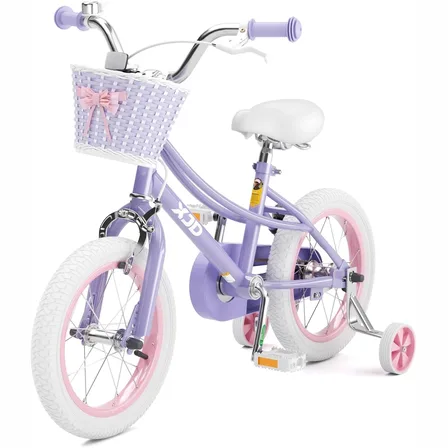
 Pink 12/14/16/20" XJD Girls Bike with Training Wheels & Basket
A Training Wheel Bikes option with 12 Inch, 14 Inch, 16 Inch and 20 Inch SKU labels, useful for comparing size starting points before verifying the child’s individual fit and control.
Blue XJD Freestyle BMX Bike, 20-Inch – No Pegs is a 20-inch option in the Kids’ BMX Bikes category. Use the 20-inch starting range of ages 7–12 and 48–60 in / 122–152 cm only to decide whether an in-person fit check is sensible. Its “No Pegs” wording distinguishes this catalog item; it does not establish construction quality or fit.
Pink 12/14/16/20" XJD Girls Bike with Training Wheels & Basket is in the Training Wheel Bikes category and has 12 Inch, 14 Inch, 16 Inch and 20 Inch SKU labels. Select a label from measured height first, then verify inseam clearance, reach, brake control and confidence. “Girls Bike” is part of the catalog title, not fit evidence.
Finish with a controlled ride and a recheck
In a clear, supervised area, ask the child to mount, start, ride straight, turn both ways and stop several times. Watch for wobbling caused by excessive reach, difficulty accessing the brakes, or needing to lean the bike sharply just to put a foot down. A properly fitting helmet should sit level and use its straps according to the helmet manufacturer’s instructions.
Before choosing, write down the child’s height and inseam, compare the visible and operating checks, and reject any bike that is oversized or hard to control. If assembly, maintenance, load limits or compatibility remain uncertain, consult the exact manual or a qualified bicycle mechanic before riding.
Bikes for your next adventure
-

Black XJD Kids Bike for Boys – 12, 14 & 16 Inch Sizes
For a son between roughly 3 and 8 years old, the XJD Kids Bike in Black covers t…$169
$199 -
Girls' Training Wheel Bike by XJD with Basket – Purple
If you're shopping for a first bike for a girl roughly 3 to 12 years old (91–152…$75.99
-

XJD Boys & Girls BMX Bike with Training Wheels, 12/14/16" – Blue
The XJD Boys & Girls BMX Bike in Blue is a first pedal bike for kids roughly age…$99.99
$119.99