

When can kids learn to ride a bike
Most kids can start learning to ride between ages 3 and 6, but readiness and individual bike fit matter more than a birthday. Measure the child, check control and confidence, then choose a bike they can handle now.
How to tell whether your child is ready
A child is ready to learn when they are interested, can follow simple directions and can stay attentive during short practice sessions. They should also be able to get on and off the bicycle without being lifted, hold the handlebar comfortably and understand when to stop.
Do not force the process because another child learned at the same age. Hesitation, difficulty steering or an inability to operate the brakes within easy reach are reasons to pause, adjust the fit or try again later. Confidence usually develops more readily when the bicycle feels manageable.
Measure before comparing wheel sizes
Measure the child's height without shoes, then measure the inseam from the floor to the crotch while the child stands upright. Height narrows the wheel-size choices; inseam helps you judge stand-over clearance and whether the child can stabilize the bike. Age is only a starting point.
| Wheel size | Starting age | Rider height |
|---|---|---|
| 12 Inch | 3–4 | 34–40 in / 86–102 cm |
| 14 Inch | 3–6 | 37–45 in / 94–114 cm |
| 16 Inch | 4–7 | 40–48 in / 102–122 cm |
| 18 Inch | 5–9 | 43–52 in / 109–132 cm |
| 20 Inch | 7–12 | 48–60 in / 122–152 cm |
| 24 Inch | 10–14 | 54–64 in / 137–163 cm |
| 26 Inch | Youth and adults | Over 60 in / 153 cm |
These ranges overlap deliberately because two children of the same height can differ in inseam, reach, strength and experience. Never move up simply to leave room for growth. An oversized bicycle can make mounting, steering, braking and stopping harder.
Perform the fit check on the actual bicycle
Have the child try the bicycle rather than relying only on the label. Check that they can stand over it, reach the handlebar without stretching and turn it while keeping comfortable control. They must be able to reach and operate the brakes reliably. Confirm that they can start, stop and put a foot down without panic.
Compare overlapping sizes by control, not by which wheel is larger. If the child can manage the smaller option but struggles to steer or brake on the larger one, choose the manageable fit. If neither permits stable control, neither is the right current choice.
Where the supplied XBikes options fit
The two catalog options help families compare three relevant learning-bike starting points because each is offered with 12 Inch, 14 Inch and 16 Inch SKU labels. The Black XJD Kids' BMX Bicycle with Training Wheels is categorized as a Kids' BMX Bike. The Pink Girls' 12/14/16" Bike by XJD – Basket & Doll Seat is categorized as a Training Wheel Bike. Those catalog distinctions can guide which listing to inspect, but they do not replace the same individual fit check.
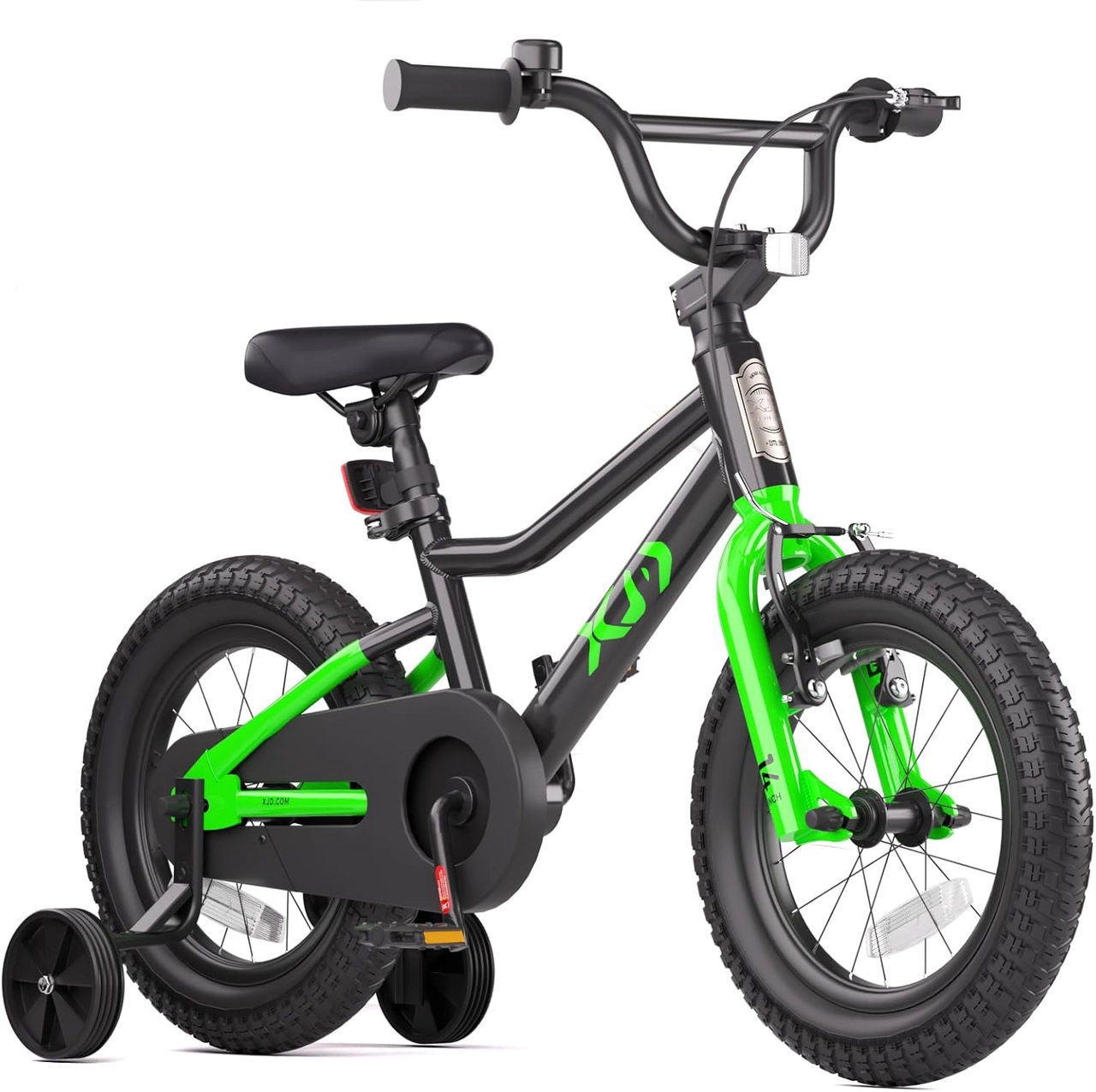 Black XJD Kids' BMX Bicycle with Training Wheels
Available in 12 Inch, 14 Inch and 16 Inch labels, this Kids' BMX Bikes option is relevant for comparing early learning sizes after measuring the rider and checking control.
 Pink Girls' 12/14/16" Bike by XJD – Basket & Doll Seat
This Training Wheel Bikes listing offers 12 Inch, 14 Inch and 16 Inch labels, making it relevant when comparing fitted learning-bike options within the supplied height ranges.
Use the measured height to identify which available label to try: 12 Inch starts at 34–40 inches, 14 Inch at 37–45 inches and 16 Inch at 40–48 inches. Where ranges overlap, compare stand-over, reach, brake control and confidence on each candidate. Do not infer construction, brake type, weight, availability or other specifications that are not provided here; consult the exact product listing and manual.
Training wheels and learning progression
Training wheels may help a child become familiar with sitting, pedaling and steering, but their presence does not prove that a bicycle fits. Both catalog options reference training wheels through either the exact title or category, so they are relevant when a parent specifically wants to compare 12-, 14- or 16-inch learning-bike options.
Practice in a flat area away from traffic and obstacles, with close adult supervision. Keep sessions short enough that fatigue does not undermine control. Progress when the child can look ahead, steer deliberately, stop on request and remain calm. For assembly, adjustments, compatibility, maintenance or torque requirements, follow the exact product manual or ask a qualified bicycle mechanic.
Helmet fit belongs in the decision
Use a bicycle helmet that fits the child properly. It should sit level, and its straps must be used according to the helmet manufacturer's instructions. Recheck the fit before each ride rather than assuming a previous adjustment remains correct.
The next step is simple: measure height and inseam today, shortlist only the wheel-size ranges that include the measured height, and have the child try those bicycles. Begin learning only when one allows comfortable stand-over, easy reach, dependable brake operation and calm control.
Bikes for your next adventure
-

XJD Kids Bike for Girls – Pink, 12/14/16/20 Inch with Training Wheels
The XJD Kids Bike for Girls in Pink is a training-wheel bike built to carry your…$139
$159 -

Black XJD Kids Bike for Boys – 12, 14 & 16 Inch Sizes
For a son between roughly 3 and 8 years old, the XJD Kids Bike in Black covers t…$169
$199 -

Blue XJD Girls Bike with Training Wheels – 12/14/16 Inch
If you're shopping for a first pedal bike for a daughter roughly 3 to 8 years ol…$149
$169