

When can my kid learn to ride a bike
Most children can start learning when they can walk steadily, follow simple directions and control a correctly fitted bike; readiness matters more than age.
Check readiness before choosing a wheel size
A child is ready to practise when they are interested, can balance while moving, understand “stop,” and can keep their attention on a short activity. Hesitation is not failure. If your child becomes frightened or cannot follow stopping instructions, pause and try again later.
Age provides only a starting point. Measure your child’s standing height and inseam, then have them try the actual bicycle. They should be able to stand over it, reach the handlebars without stretching, steer comfortably and operate its brakes with their hands in a normal riding position. Current confidence also matters: a size that looks correct on paper may still feel difficult to control.
Use height to narrow the wheel-size range
Compare the measured standing height with the XBikes starting points below. Overlapping ranges are intentional; where two sizes appear possible, the individual fit check decides.
| Wheel size | Starting age | Rider height |
|---|---|---|
| 12 Inch | 3–4 | 34–40 in / 86–102 cm |
| 14 Inch | 3–6 | 37–45 in / 94–114 cm |
| 16 Inch | 4–7 | 40–48 in / 102–122 cm |
| 18 Inch | 5–9 | 43–52 in / 109–132 cm |
| 20 Inch | 7–12 | 48–60 in / 122–152 cm |
| 24 Inch | 10–14 | 54–64 in / 137–163 cm |
| 26 Inch | Youth and adults | Over 60 in / 153 cm |
Do not move up merely because a child is near the top of an age band. The American Academy of Pediatrics advises having the child try the bicycle rather than buying an oversized bike for future growth. Check stand-over clearance, overall control and brake reach on the exact model.
Compare the supplied bicycles by size and type
These catalog options are useful because they provide comparison points across 12, 14, 16, 20, 24 and 26 Inch sizes, while also showing different bicycle types. Their labels narrow the search; they do not replace measuring and an individual test ride.
 XJD Light Purple Girls Bike with Basket, Training Wheels, 12/14/16/20 Inch
A Training Wheel Bike offered with 12, 14 and 16 Inch SKU labels, relevant for comparing smaller starting sizes after measuring the rider and checking control.
 XJD Kids Beach Cruiser Bicycle, Rear Rack & V-Brakes, Mint Green
A Beach Cruiser Bike with 20, 24 and 26 Inch SKU labels, relevant to taller riders whose measured height, reach and brake control suit the actual bicycle.
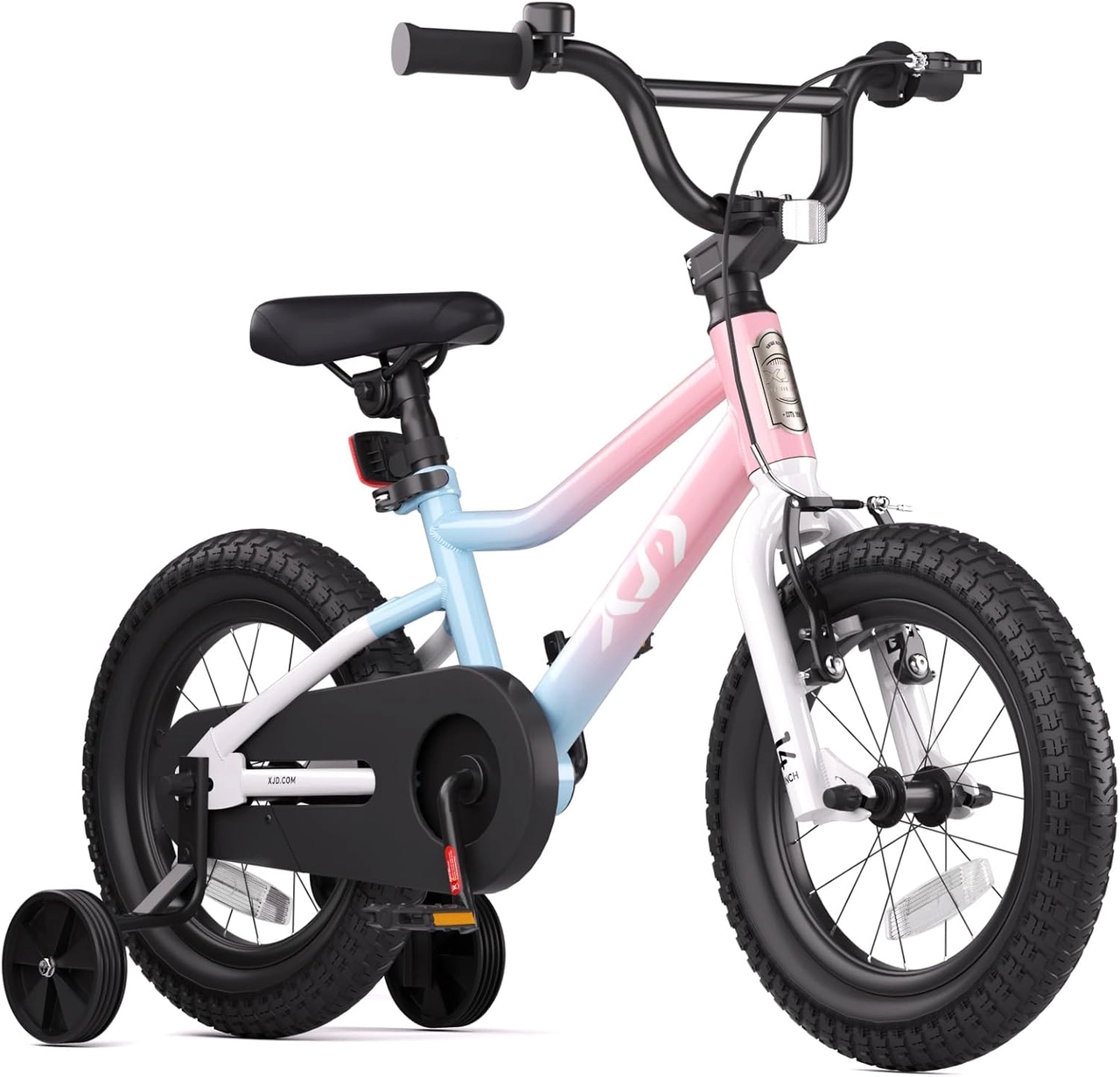 XJD Girls BMX Bike 12/14/16 Inch with Training Wheels – Pink Blue
A Kids’ BMX Bike offered with 12, 14 and 16 Inch SKU labels and training wheels, useful for size comparison when the child is ready to practise.
The XJD Light Purple Girls Bike with Basket, Training Wheels, 12/14/16/20 Inch is categorized as a Training Wheel Bike and is supplied in 12, 14 and 16 Inch SKU labels. It is relevant when your measurements indicate one of those three starting ranges and training wheels suit the child’s current stage.
The XJD Girls BMX Bike 12/14/16 Inch with Training Wheels – Pink Blue is categorized as a Kids’ BMX Bike and likewise has 12, 14 and 16 Inch SKU labels. Compare it only after confirming which of those sizes the rider can stand over, reach and control.
For taller riders, the XJD Kids Beach Cruiser Bicycle, Rear Rack & V-Brakes, Mint Green is categorized as a Beach Cruiser Bike and has 20, 24 and 26 Inch SKU labels. Brake reach and control must be checked on the actual bicycle, even when the height range appears suitable.
None of these products has an 18 Inch SKU label. If measurements point to 18 Inch, the listed 16 and 20 Inch products are nearest-size comparison points, not substitutes; neither should be treated as equal to an 18 Inch bicycle.
Make the first practice session manageable
- Choose a flat, open area away from traffic, slopes and obstacles.
- Confirm that the child can mount, look ahead, steer and stop while remaining in control.
- Keep the first sessions brief and finish before fatigue causes frustration.
- Stay close enough to assist without pulling the handlebars or forcing speed.
Training wheels may support early pedalling confidence, but their presence does not prove that a bicycle fits. Whether using them or not, practise starting, steering and stopping as separate skills before combining them.
Complete the safety and setup checks
A bicycle helmet must fit properly, sit level and have its straps adjusted according to the helmet manufacturer’s instructions, as advised by the U.S. Consumer Product Safety Commission. Recheck the fit whenever the helmet is worn.
Before riding, follow the exact bicycle’s product manual for assembly, adjustments, maintenance, compatibility, load limits and torque requirements. When instructions are missing, unclear or beyond your experience, use a qualified bicycle mechanic rather than guessing.
Decide whether to begin now
Measure height and inseam today, compare the height with the table, and arrange an actual fit check. Begin learning only when your child can stand over the chosen bike, reach its controls, operate the brakes and respond calmly to stopping directions. If any one of those checks fails, choose a better-fitting bicycle or wait and reassess.
Bikes for your next adventure
-

Green XJD Toddler Bike Helmet with Adjustable Fit, XS (46–51 cm)
The XJD toddler bike helmet in Green is built for the youngest riders — the size…$20.39
$23.99 -

Kids Bike Helmet by XJD for Boys & Girls – Black, Blue, Green, Pink, Purple
The XJD Kids Bike Helmet covers a wide 2-to-8-year age range thanks to two head-…$59.99
-

Kids Bike Helmet by XJD for Girls – Pink
The XJD Kids Bike Helmet in Pink is a lightweight multi-sport helmet for girls r…$59.99
$99