

When do kids learn to ride 2 wheel bike
Most children learn to ride a two-wheel bike between ages 3 and 7, but there is no single correct age. Start when your child can balance, steer, stop on command and confidently control a bike that fits their measured body—not when a birthday says they should.
Readiness matters more than the average age
A child may be ready to learn if they can sit securely, look ahead while moving, steer around a gentle turn and put a foot down without panic. They should also understand a simple instruction such as “slow down and stop.” Comfort on a balance bike or other pedal-free practice can help, but it is not a requirement.
Wait if the child strongly resists, cannot support the bicycle at a stop, repeatedly loses control of the handlebars or cannot operate the brakes. A short pause of several weeks can be more productive than turning practice into a struggle.
Measure before choosing a learning bike
Measure the child’s height without shoes. Then check inseam, reach and brake control on the actual bicycle. The American Academy of Pediatrics advises having the child try the bike, checking stand-over clearance and control, and avoiding an oversized bicycle bought for future growth.
Use these XBikes ranges only as starting points:
| Wheel size | Starting age | Rider height |
|---|---|---|
| 12 Inch | 3–4 | 34–40 in / 86–102 cm |
| 14 Inch | 3–6 | 37–45 in / 94–114 cm |
| 16 Inch | 4–7 | 40–48 in / 102–122 cm |
| 18 Inch | 5–9 | 43–52 in / 109–132 cm |
| 20 Inch | 7–12 | 48–60 in / 122–152 cm |
| 24 Inch | 10–14 | 54–64 in / 137–163 cm |
| 26 Inch | Youth and adults | Over 60 in / 153 cm |
Overlapping ranges are normal. Choose using measured height first, then confirm that the child can stand over the bike, reach the handlebars without stretching, turn them comfortably and operate the brakes. Current confidence matters too. Wheel diameter alone does not prove a bike fits.
A quick fit check before the first lesson
- Stand-over: Have the child straddle the bicycle while wearing riding shoes. They should be able to stabilize themselves without the frame obstructing them.
- Starting and stopping: Confirm they can get into position, move off and put a foot down promptly.
- Reach: Check that steering does not require locked arms or a forward lunge.
- Brake control: The child must reach and operate the bike’s braking controls while maintaining steering control.
- Confidence: Ask the child to demonstrate each action in a quiet, traffic-free practice area before adding speed.
If any check fails, adjust the bike only as permitted by its exact manual, try a more suitable size or consult a qualified bicycle mechanic. Do not improvise assembly, compatibility or torque procedures.
How to teach two-wheel riding
Begin on a wide, flat, dry area away from traffic and obstacles. Lower-speed balance practice should come before sustained pedaling. Let the child push along, lift both feet briefly and learn to look toward the intended path. Once gliding is controlled, introduce pedals and practice smooth starts.
Walk nearby without gripping the handlebars, because unexpected steering corrections can disrupt balance. Use one instruction at a time: look ahead, pedal, then stop. Keep sessions short and finish after a successful stop or controlled glide. Progress means improving control, not removing support by a fixed deadline.
Where the supplied bikes fit into the decision
The catalog options help show when a learner may have moved beyond the smaller 12-, 14-, 16- or 18-inch starting points. The Blue XJD Freestyle BMX Bike, 20-Inch – No Pegs is a 20-inch comparison for the XBikes 48–60 in / 122–152 cm starting range. The 26-Inch XJD Beach Cruiser Bike for Girls – Purple, V-Brake includes catalog variants in 20, 24 and 26 Inch. The XJD 24-Inch Green Beach Cruiser Bike with U-Brake includes 24- and 26-inch variants. These labels identify catalog options; they do not replace an individual fit check.
 Blue XJD Freestyle BMX Bike, 20-Inch – No Pegs
A 20-inch BMX comparison for riders whose measured height falls within the XBikes 48–60 in / 122–152 cm starting range; individual stand-over, reach, brake control and confidence still determine fit.
 26-Inch XJD Beach Cruiser Bike for Girls – Purple, V-Brake
Its supplied variants span 20, 24 and 26 Inch, making it useful for comparing larger wheel-size stages. Select by measured height and an individual control check, not by the product title alone.
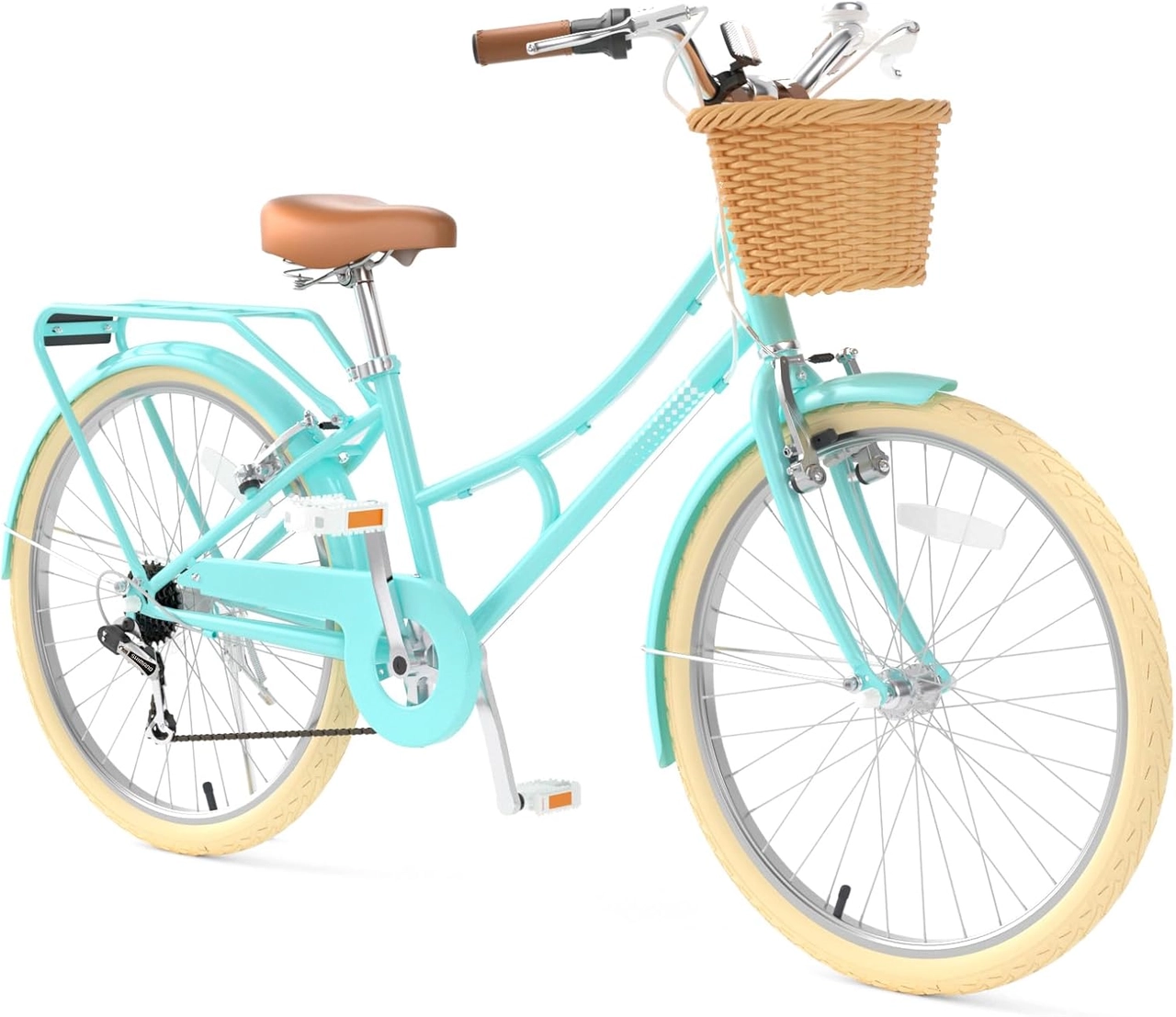 XJD 24-Inch Green Beach Cruiser Bike with U-Brake
This listing supplies 24- and 26-inch variants for comparison with older or taller rider starting points. It is not relevant when the child’s measurements indicate a smaller learning bike.
For a smaller or younger beginner whose measurements point to 12, 14, 16 or 18 Inch, none of these supplied product listings provides that size. Treat the displayed bikes as larger-wheel comparison points, not substitutes. For riders considering 20, 24 or 26 Inch, compare only an available size and still verify stand-over, reach, brake operation and confidence in person.
Helmet and final go-or-wait decision
Use a bicycle helmet that fits properly, sits level and has its straps positioned according to the helmet manufacturer’s instructions, consistent with U.S. Consumer Product Safety Commission guidance. Recheck the fit each ride rather than assuming yesterday’s adjustment remains correct.
Start two-wheel lessons now only if your child willingly participates and can control a correctly sized bike through balancing, steering and stopping. If fit or control is uncertain, measure again, try another size and delay unsupported riding—the right time is when both the child and the bicycle are ready.
Bikes for your next adventure
-

Blue XJD Girls Bike with Training Wheels – 12/14/16 Inch
If you're shopping for a first pedal bike for a daughter roughly 3 to 8 years ol…$149
$169 -

Black XJD Kids Bike for Boys – 12, 14 & 16 Inch Sizes
For a son between roughly 3 and 8 years old, the XJD Kids Bike in Black covers t…$169
$199 -

XJD Kids Bike for Girls – Pink, 12/14/16/20 Inch with Training Wheels
The XJD Kids Bike for Girls in Pink is a training-wheel bike built to carry your…$139
$159