

When do kids learn to ride a pedal bike
Most children learn to ride a pedal bike between ages 3 and 8, but readiness matters more than age. Measure height and inseam, then check control.
What determines when a child is ready?
A child is ready to learn when physical fit and basic coordination come together. Look for the ability to balance while moving, steer toward a clear target, start and stop on request, and follow simple safety directions. Confidence counts too: pressure can make learning harder, while willing practice usually produces steadier progress.
Previous balance-bike or scooter experience may help, but it is not required. Likewise, reaching a particular birthday does not prove readiness. Use age only to find a possible wheel-size range, then judge the actual child on the actual bicycle.
Measure before choosing a pedal bike
Measure the child barefoot or in the shoes normally worn for riding. Record standing height, then measure inseam from the floor to the crotch. Compare those measurements with the bicycle’s fit information and have the child try the bike whenever possible.
- Stand-over: The child should be able to straddle the bicycle securely rather than being held above the ground by the frame.
- Reach: Seated or in a ready position, the child should reach the handlebar without stretching, locking the elbows or losing a stable posture.
- Brake control: The child must reach and operate the fitted brakes with their own hands while maintaining steering control.
- Ground contact: Confirm that the child can support the bike and stop without panic, following the setup guidance in the exact product manual.
Do not buy an oversized bicycle merely to allow room for growth. A bike that a child cannot mount, steer or stop confidently can delay learning rather than extend its useful life.
Use wheel size as a starting point
| Wheel size | Starting age | Rider height |
|---|---|---|
| 12 Inch | 3–4 | 34–40 in / 86–102 cm |
| 14 Inch | 3–6 | 37–45 in / 94–114 cm |
| 16 Inch | 4–7 | 40–48 in / 102–122 cm |
| 18 Inch | 5–9 | 43–52 in / 109–132 cm |
| 20 Inch | 7–12 | 48–60 in / 122–152 cm |
| 24 Inch | 10–14 | 54–64 in / 137–163 cm |
| 26 Inch | Youth and adults | Over 60 in / 153 cm |
These ranges overlap because children grow and develop differently. Prioritize measured height, inseam, reach, brake control and current confidence over age alone. Wheel diameter also does not establish complete fit: frame shape and component position still need an individual check.
How to begin pedal-bike practice
- Choose a flat, open area away from traffic, obstacles and steep slopes.
- Fit a bicycle helmet so it sits level and secure, with its straps adjusted according to the helmet manufacturer’s instructions.
- Let the child become comfortable mounting, holding the handlebar, steering and stopping before expecting continuous pedaling.
- Use short sessions. Ask the child to look forward, begin with a controlled push, pedal, and then make a planned stop.
- End after a small success or when concentration fades. Repeat rather than moving immediately to a larger or faster challenge.
If the child repeatedly tips because the bike feels tall, cannot turn the handlebar comfortably, or cannot use the brakes reliably, stop and reassess fit. More practice cannot correct a bicycle that is too large.
When the supplied catalog options are relevant
The 26-Inch XJD Beach Cruiser Bike for Girls – Purple, V-Brake provides 20-, 24- and 26-inch catalog options: Mint Green and Pink appear in 20, 24 and 26 Inch, while Purple appears in 26 Inch. These sizes help families compare later stages in the supplied fit progression, rather than assuming every new learner needs the smallest bicycle.
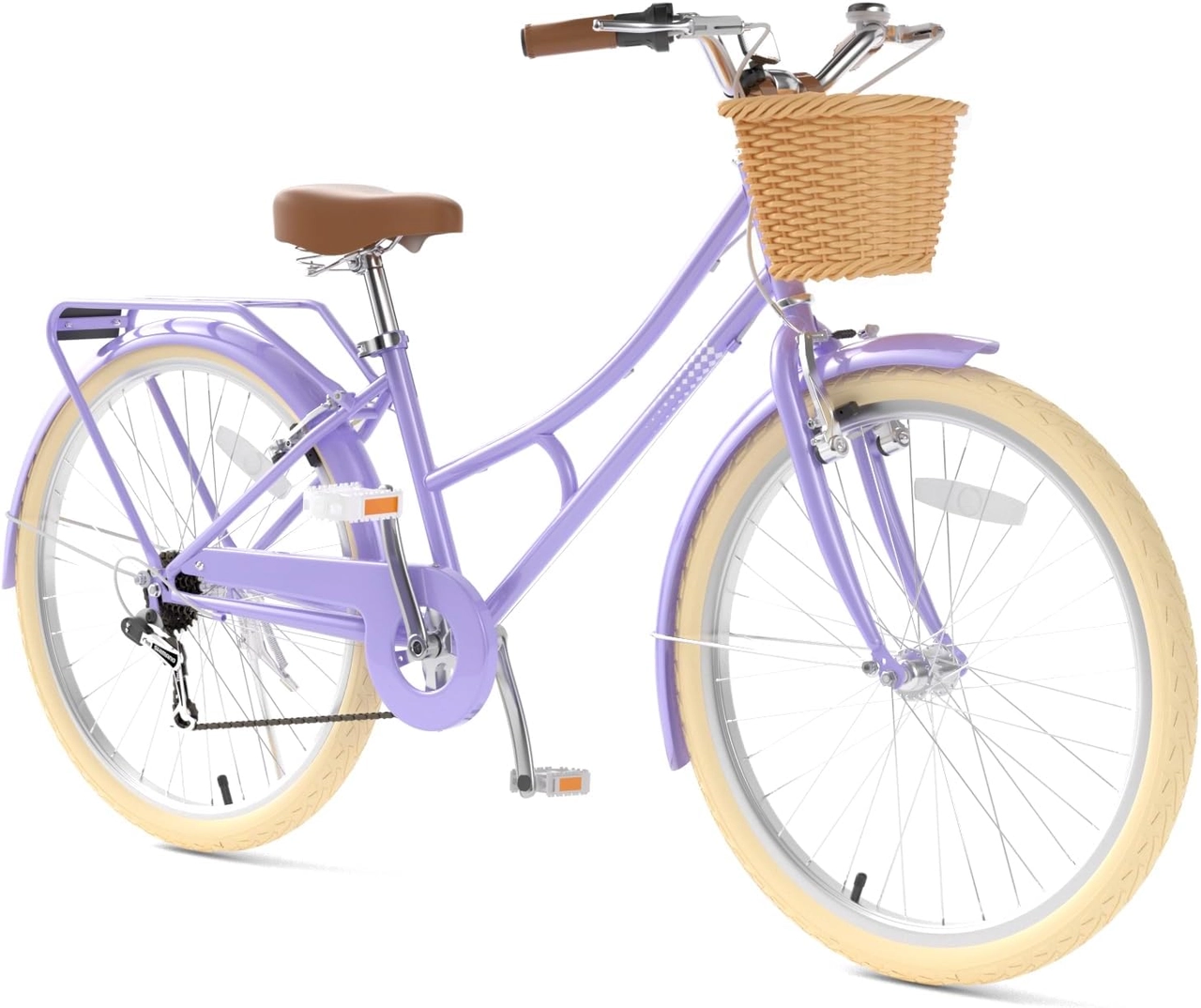
The 20-inch labels are starting points for riders ages 7–12 and 48–60 in / 122–152 cm. The 24-inch labels correspond to ages 10–14 and 54–64 in / 137–163 cm. The 26-inch labels are for youth and adults over 60 in / 153 cm. Therefore, these catalog options are generally not relevant to a smaller beginner whose measurements point to 12, 14, 16 or 18 Inch; they are comparison points, not equal substitutes.
The title identifies a V-brake, so brake reach and control must be checked on the actual bicycle. For assembly, adjustment, maintenance, torque, load limits or compatibility, follow the exact product manual or use a qualified bicycle mechanic.
Make the decision today
Measure the child’s height and inseam, select only the matching starting range, and arrange an individual stand-over, reach and brake-control check. Begin teaching now if the child fits, can stop deliberately and wants to try; otherwise choose a better-fitting size or wait and revisit the same checks later.
Bikes for your next adventure
-

Blue XJD Girls Bike with Training Wheels – 12/14/16 Inch
If you're shopping for a first pedal bike for a daughter roughly 3 to 8 years ol…$149
$169 -

Black XJD Kids Bike for Boys – 12, 14 & 16 Inch Sizes
For a son between roughly 3 and 8 years old, the XJD Kids Bike in Black covers t…$169
$199 -

XJD Kids Bike for Girls – Pink, 12/14/16/20 Inch with Training Wheels
The XJD Kids Bike for Girls in Pink is a training-wheel bike built to carry your…$139
$159