

When does the average kid learn to ride a bike
There is no single age when the average child learns to ride a bike. Readiness matters more than a birthday: balance, confidence, fit and control determine when learning is likely to click.
What “average” means for your child
Children develop balance, coordination and confidence at different rates. Instead of treating a particular birthday as a deadline, look for a child who wants to practise, can follow simple directions and can stay attentive in a traffic-free riding area.
A later start is not evidence that something is wrong, and an early start does not justify moving to a larger bicycle. Progress may also be uneven: a child might balance well but still need practice starting, stopping or steering.
Measure before choosing a bicycle
Measure the child’s height without shoes and check inseam, reach and brake control on the actual bicycle. The child should be able to stand over it comfortably, hold the controls without stretching and steer without the bicycle feeling unwieldy. Have the child try the bicycle whenever possible.
Do not buy an oversized bicycle merely to allow room for growth. A size chart narrows the search, but the individual fit check decides whether a bicycle is manageable now.
| Wheel size | XBikes age starting point | Rider-height starting point |
|---|---|---|
| 12 Inch | Ages 3–4 | 34–40 in / 86–102 cm |
| 14 Inch | Ages 3–6 | 37–45 in / 94–114 cm |
| 16 Inch | Ages 4–7 | 40–48 in / 102–122 cm |
| 18 Inch | Ages 5–9 | 43–52 in / 109–132 cm |
| 20 Inch | Ages 7–12 | 48–60 in / 122–152 cm |
| 24 Inch | Ages 10–14 | 54–64 in / 137–163 cm |
| 26 Inch | Youth and adults | Over 60 in / 153 cm |
Overlapping ranges are expected. Prioritize measured height, inseam, reach, brake control and current confidence over age alone.
Signs that it is time to practise
- The child is interested rather than being pressured to ride.
- The child can sit in a stable position and look ahead while moving.
- The bicycle allows comfortable stand-over clearance and an unstrained reach.
- The child can operate the available controls reliably during a supervised fit check.
- The child accepts a properly fitted helmet and can follow instructions about where to stop.
If fit or control is uncertain, pause before riding. Ask a qualified bicycle mechanic to check the bicycle, and follow the exact product manual for assembly, adjustments, maintenance, compatibility, load limits and torque requirements.
How the supplied bicycles compare
The three supplied catalog options help answer the sizing part of the question because each is offered in 12 Inch, 14 Inch and 16 Inch labels. Those sizes cover overlapping XBikes starting points from ages 3–7 and heights 34–48 inches, but each child still needs an individual fit check.
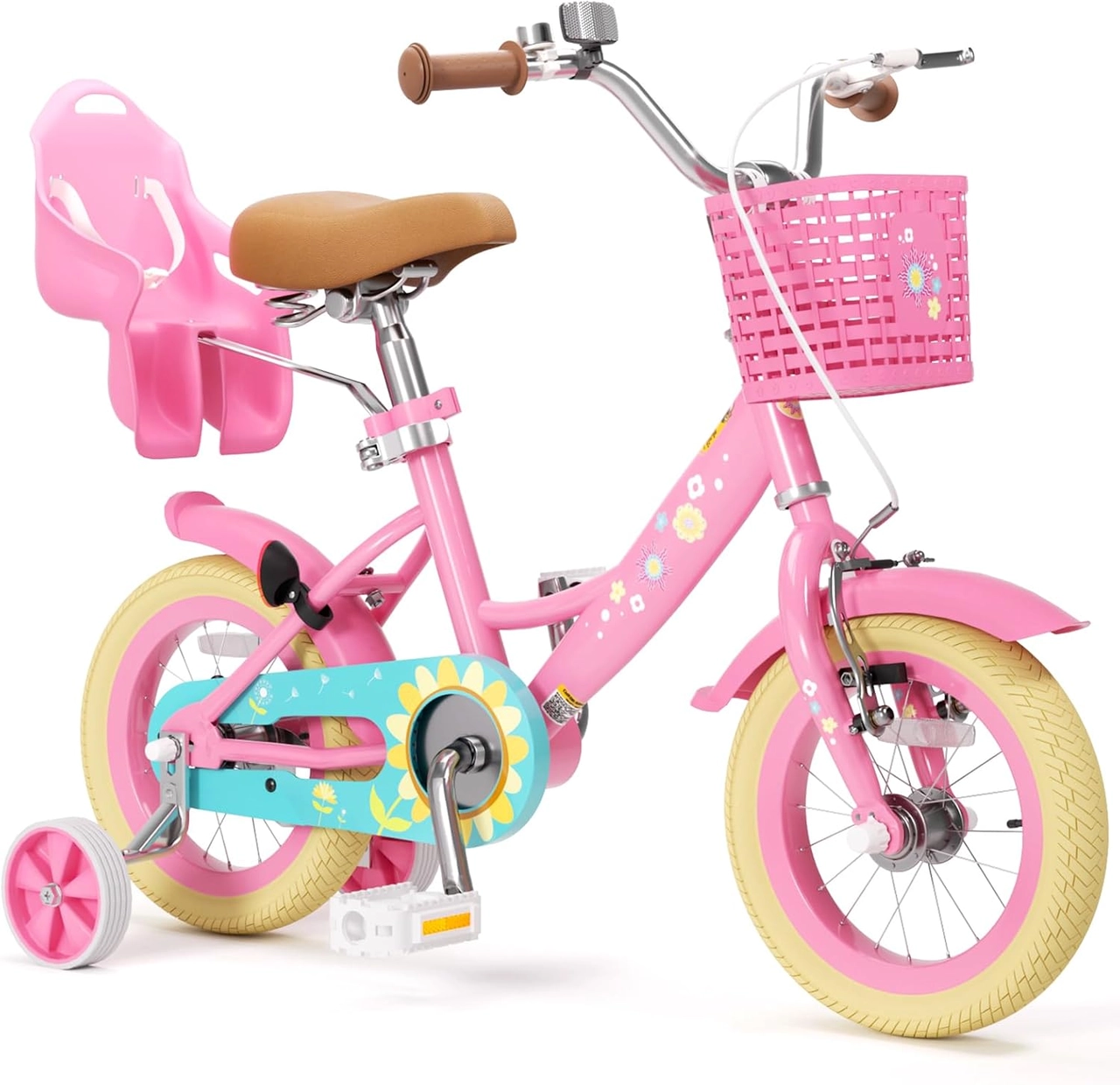 Flower Pink XJD Girls Bike with Doll Seat & Basket
A Training Wheel Bike offered in 12 Inch, 14 Inch and 16 Inch labels. Compare the rider’s measured height with XBikes starting points, then verify stand-over, reach, brake control and confidence on the actual bicycle.
 Purple XJD Girls' Bike with Doll Seat & Basket
This Training Wheel Bike has 12 Inch, 14 Inch and 16 Inch SKU labels. It is relevant when one of those size starting points matches the child’s height and the bicycle passes an individual fit check.
 Black XJD Kids' BMX Bicycle with Training Wheels
A Kids' BMX Bike with 12 Inch, 14 Inch and 16 Inch labels. Its category does not establish fit; use measured height to narrow the size, then check inseam, reach, controls and current confidence.
The Flower Pink XJD Girls Bike with Doll Seat & Basket and Purple XJD Girls' Bike with Doll Seat & Basket are both categorized as Training Wheel Bikes. Each has 12 Inch, 14 Inch and 16 Inch SKU labels, so compare the child’s measured height with the corresponding row before arranging a try-on.
The Black XJD Kids' BMX Bicycle with Training Wheels is categorized as a Kids' BMX Bike and carries the same three wheel-size labels. Its category differs, but the supplied facts do not establish differences in weight, brakes, geometry, materials or performance. Do not infer those features from the title or category.
These products are relevant only when a 12, 14 or 16 Inch starting point matches the rider’s measurements and the actual bicycle passes the fit-and-control check. For a rider whose measurements point toward 18, 20, 24 or 26 Inch, they are nearest-range comparison points, not substitutes; one wheel size is not equivalent to another.
Make the first sessions manageable
- Choose a flat, open area away from vehicles and other hazards.
- Keep practice short enough that attention and confidence remain intact.
- Work on looking ahead, steering, controlled stopping and starting before adding distance.
- Stop if the child becomes tired, frightened or unable to control the bicycle consistently.
A bicycle helmet should fit properly, sit level and have its straps used according to the helmet manufacturer’s instructions. Supervision and a suitable riding environment remain necessary even after the child begins riding independently.
Your next decision
Do not wait for an “average” birthday or rush to meet one. Measure height and inseam today, identify the matching wheel-size starting points, then have the child check stand-over, reach, braking and confidence on the actual bicycle. Practise only when all of those signals point to a manageable fit.
Bikes for your next adventure
-

Kids Bike Helmet by XJD for Boys & Girls – Black, Blue, Green, Pink, Purple
The XJD Kids Bike Helmet covers a wide 2-to-8-year age range thanks to two head-…$59.99
-

Kids Bike Helmet by XJD for Girls – Pink
The XJD Kids Bike Helmet in Pink is a lightweight multi-sport helmet for girls r…$59.99
$99 -

XJD Kids Bike for Girls – Pink, 12/14/16/20 Inch with Training Wheels
The XJD Kids Bike for Girls in Pink is a training-wheel bike built to carry your…$139
$159