

When is a child ready to ride a bike
A child is ready to ride a bike when they can balance, steer, stop on command and confidently control a correctly fitted bicycle. Measure height and inseam, then confirm fit in person rather than choosing by age alone.
Look for control, not a birthday
Age ranges are only starting points. Readiness depends on whether the child can follow simple directions, stay aware of nearby people and obstacles, and coordinate pedalling, steering and stopping without becoming overwhelmed.
Ask the child to demonstrate four things in a quiet, traffic-free practice area: look ahead while moving, steer around a broad obstacle, stop when asked and put a foot down without panic. A hesitant beginner may need more balance practice even when their height falls within a common wheel-size range. A confident child still needs a bicycle that physically fits.
Measure before comparing wheel sizes
Measure the child without shoes, standing straight against a wall, for an accurate height. For inseam, measure from the floor to the top of the inside leg. Record both measurements in inches or centimetres and take them to the fit check.
Use the XBikes ranges below only to identify likely sizes to try:
| Wheel size | Starting age | Rider height |
|---|---|---|
| 12 Inch | 3–4 | 34–40 in / 86–102 cm |
| 14 Inch | 3–6 | 37–45 in / 94–114 cm |
| 16 Inch | 4–7 | 40–48 in / 102–122 cm |
| 18 Inch | 5–9 | 43–52 in / 109–132 cm |
| 20 Inch | 7–12 | 48–60 in / 122–152 cm |
| 24 Inch | 10–14 | 54–64 in / 137–163 cm |
| 26 Inch | Youth and adults | Over 60 in / 153 cm |
Where ranges overlap, do not automatically select the larger wheel. Compare stand-over clearance, reach, brake access and the child’s control on each candidate. Never buy an oversized bicycle merely to allow room for growth.
Perform the fit check in this order
- Stand-over: Have the child straddle the bicycle with both feet on the ground. They should be able to stand securely rather than being held up by the frame.
- Seated position: Check that they can get on and off without being caught or tipped off balance. A beginner needs a position that supports confident starts and stops.
- Reach: With hands on the handlebar, the child should not have to stretch, lock their arms or lose a stable seated posture.
- Steering: Ask them to turn the handlebar both ways while remaining balanced. Their knees, hands and body should move freely.
- Brake control: Confirm that the child can comfortably reach and operate the bicycle’s braking controls. Do not infer the brake type or adjustment method; consult the exact product manual or a qualified bicycle mechanic.
If any check fails, try another size or setup. A matching height range does not override poor stand-over, reach, braking or confidence.
How the supplied training-wheel bicycle is relevant
The Purple XJD Girls' Bike with Doll Seat & Basket is catalogued as a Training Wheel Bike and is offered with 12 Inch, 14 Inch and 16 Inch SKU labels. Those three options provide relevant comparison points for children whose measured heights fall within the corresponding XBikes starting ranges, but the label alone cannot establish readiness or fit.

Compare the child’s measured height with the individual 12 Inch, 14 Inch or 16 Inch range, then have them try the chosen option. The doll seat and basket are catalog features, not evidence that the bicycle fits or that the child can control it. If the measured starting point is 18 Inch or larger, this supplied product does not offer that wheel-size label and should not be treated as an equal substitute.
Training wheels do not replace readiness
Training wheels can support an early pedalling stage, but their presence does not prove that a child is ready to ride independently. The child must still steer deliberately, stop when asked, remain attentive and fit the bicycle. When changing, adjusting or removing training wheels, follow the exact product manual or ask a qualified bicycle mechanic; no universal compatibility or torque procedure should be assumed.
Prepare for the first ride
- Use a properly fitting bicycle helmet that sits level, with straps secured according to the helmet manufacturer’s instructions.
- Choose a flat practice space away from traffic, slopes and crowded paths.
- Start with short sessions covering starts, wide turns and controlled stops.
- Stay close enough to assist without steering for the child.
- Stop if fatigue, fear or repeated loss of control appears.
The next step is simple: record height and inseam, shortlist the wheel sizes whose ranges include that measured height, and let the child try them. Choose only when stand-over, reach, brake operation and calm control all work together; otherwise, continue practising or compare a different size.
Bikes for your next adventure
-

XJD Kids Bike for Girls – Pink, 12/14/16/20 Inch with Training Wheels
The XJD Kids Bike for Girls in Pink is a training-wheel bike built to carry your…$139
$159 -

XJD Girls Bike for Kids Ages 3-8, 12/14/16 Inch with Training Wheels – Purple
The XJD Girls Bike in Purple is a training-wheel bicycle for kids ages 3 to 8, f…$149
$169 -
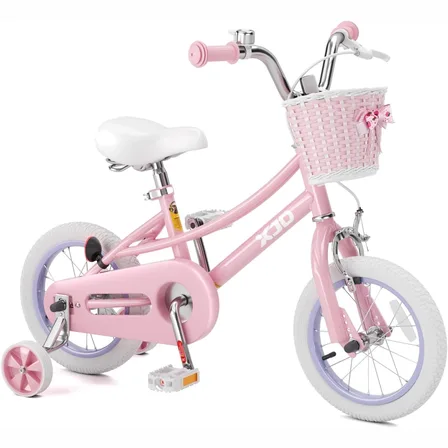
Pink 12/14/16/20" XJD Girls Bike with Training Wheels & Basket
The Pink XJD Girls Bike with Training Wheels & Basket is a first-bike pick f…$65.99
$75.99