

When kids are ready for a 2 wheel bike
A child is ready for a 2 wheel bike when the bike fits now and the child can balance, steer, stop and follow directions with calm, consistent control.
Check readiness before choosing a size
Readiness is not a birthday. Start with what the child can do today. On a correctly fitted bike in a quiet, traffic-free area, look for the ability to move forward without repeated panic, steer around a simple obstacle, slow down or stop on request, and remain aware of nearby people.
Confidence matters too. Hesitation is normal, but a child who freezes, cannot follow a stop instruction or strongly resists riding needs more low-pressure practice. A balance bike or a bicycle used with its supplied training wheels may remain more appropriate until balance and control improve.
Measure height, inseam and reach
Measure the child's standing height without shoes. For inseam, have the child stand straight with feet slightly apart, then measure from the floor to the crotch. Use height to identify a starting wheel size, but use the inseam and an actual try-on to judge stand-over clearance and starting comfort.
During the fit check, confirm that the child can stand over the bicycle without being forced against the frame. Seated, they should reach the handlebar without stretching, turning the torso or locking the arms. They must also be able to operate the bicycle's controls and reach its brakes confidently. Do not choose an oversized bicycle merely to allow room for growth.
Compare the XBikes wheel-size starting points
| Wheel size | Age starting point | Rider-height starting point |
|---|---|---|
| 12 Inch | 3–4 | 34–40 in / 86–102 cm |
| 14 Inch | 3–6 | 37–45 in / 94–114 cm |
| 16 Inch | 4–7 | 40–48 in / 102–122 cm |
| 18 Inch | 5–9 | 43–52 in / 109–132 cm |
| 20 Inch | 7–12 | 48–60 in / 122–152 cm |
| 24 Inch | 10–14 | 54–64 in / 137–163 cm |
| 26 Inch | Youth and adults | Over 60 in / 153 cm |
Overlapping ranges are intentional starting points, not permission to guess. Prioritize measured height, inseam, reach, brake control and current confidence over age. If two sizes appear plausible, have the child try both and choose the one that provides better stand-over, reach and control now.
Decide whether training wheels still help
Training wheels can support a child who is learning pedaling and steering but is not yet ready to balance independently. They do not establish that the child can ride without them. If the child already glides, balances, steers and stops consistently, a properly fitted bicycle may be used for supervised two-wheel practice according to its manual.
The catalog option relevant to this decision is the XJD Girls' Bike with Training Wheels, 12/14/16/20 Inch – Purple. Its supplied 12, 14, 16 and 20 Inch labels let parents compare several XBikes height starting points while considering a training-wheel format. They do not replace an individual fit check, and there is no supplied 18 Inch option for this product.

This product is relevant when its available wheel-size label matches the child's measured-height starting range and training wheels suit the child's current confidence. It is not automatically suitable because of its title, color or wheel label. If the child needs an 18, 24 or 26 Inch starting point, this product is not an equal substitute; seek the correct size and verify fit in person.
Run a short supervised fit test
- Place the child in a properly fitted bicycle helmet before riding.
- Confirm comfortable stand-over clearance and a natural seated reach.
- Ask the child to identify and operate the bicycle's controls, including the brakes, without struggling to reach them.
- In a quiet area away from traffic, observe a start, a straight ride, a gentle turn and a controlled stop.
- Stop the session if the bicycle feels too large, control is inconsistent or fear is increasing.
The U.S. Consumer Product Safety Commission advises that a helmet must fit properly, sit level and have its straps used according to the helmet manufacturer's instructions. Adult supervision and a suitable practice area remain necessary even when the basic test goes well.
Make the go, wait or resize decision
Go: the child fits the bicycle now, reaches and operates the brakes, demonstrates basic balance and steering, stops on request and wants to continue. Wait: fit is acceptable but balance, stopping, attention or confidence is not yet consistent; continue short practice sessions with appropriate support. Resize: stand-over, reach or brake access is poor, even if the age range appears to match.
Before assembly, adjustment or maintenance, follow the exact product manual; use a qualified bicycle mechanic when the instructions or fit are uncertain. The next step is simple: measure the child, shortlist the matching wheel-size starting points, and let the child's real fit and controlled test ride decide whether two-wheel riding starts now.
Bikes for your next adventure
-
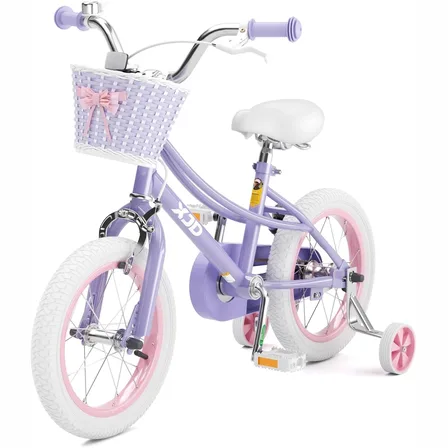
Girls' Training Wheel Bike by XJD with Basket – Purple
If you're shopping for a first bike for a girl roughly 3 to 12 years old (91–152…$75.99
-

XJD Kids Bike for Girls – Pink, 12/14/16/20 Inch with Training Wheels
The XJD Kids Bike for Girls in Pink is a training-wheel bike built to carry your…$139
$159 -
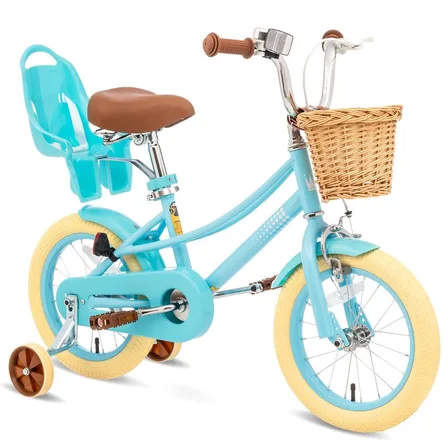
Girls' Training Wheel Bike by XJD, 12–20 Inch Wheels – Blue
This XJD girls' training wheel bike in Blue covers one of the widest fit ranges …$139
$159