

Who rides a 24 inch bike
A 24-inch bike generally suits a rider about 54–64 inches (137–163 cm) tall, often ages 10–14, but only an individual fit check can confirm it.
Who should try a 24-inch bike?
Start with the rider’s measured height, not age alone. Under the XBikes starting points, a 24-inch wheel size corresponds to a height of 54–64 inches (137–163 cm). The age range of 10–14 is a useful screening guide, but children of the same age can have very different proportions, reach and confidence.
A rider near the lower end of that height range may still need a smaller bike if the frame is difficult to stand over, the handlebar feels too far away or the brakes are hard to operate. A rider near the upper end may need to compare a 26-inch option, especially if the 24-inch bike feels cramped. Wheel size narrows the search; it does not establish fit by itself.
Measure before comparing bikes
Measure the child’s height without shoes, standing straight against a wall. Then measure inseam from the floor to the crotch while the child stands upright. Record both measurements so they can be compared with the geometry and adjustment information for the exact bicycle.
Height determines whether a 24-inch bike is a reasonable candidate. Inseam helps assess whether the rider can stand over that particular frame comfortably. Because two 24-inch bicycles can have different frame shapes, the same rider may fit one and not another.
- Below 54 inches (137 cm): compare a 20-inch bike, whose starting range is 48–60 inches (122–152 cm), instead of buying a 24-inch bike for future growth.
- From 54–64 inches (137–163 cm): try a 24-inch bike and complete every control check.
- Over 60 inches (153 cm): a 26-inch bike becomes another starting point for comparison, particularly as the rider approaches the top of the 24-inch range.
Check the fit on the actual bicycle
Have the child try the assembled bicycle. With the rider straddling the frame, confirm that standing over it feels comfortable and controlled. Do not choose an oversized bicycle merely to leave room for growth.
Next, seat the rider and check reach. The child should be able to hold the handlebar without stretching, twisting forward or locking the arms. Ask the rider to turn the handlebar in both directions and confirm that steering remains manageable.
Brake access matters just as much as height. The rider must be able to reach and operate the brake controls reliably while maintaining a secure grip. Also observe starting, stopping and putting a foot down. If any action looks strained or uncertain, compare another frame or wheel size rather than assuming practice will correct a poor fit.
How the catalog option helps with comparison
The catalog includes the 26-Inch XJD Beach Cruiser Bike for Girls – Purple, V-Brake. Despite its exact product title, its listed choices include Mint Green / 24 Inch and Pink / 24 Inch, alongside 20-inch and 26-inch choices. Those options make the product relevant for comparing wheel sizes around the requested 24-inch size; the title alone should not be used to identify the selected wheel size.

For a rider in the 24-inch starting range, consider only the explicitly labeled 24-inch variants when answering this page’s question. The 20-inch and 26-inch variants are comparison points, not equivalent substitutes. Confirm the chosen size and color label before proceeding, then assess the actual bicycle’s stand-over clearance, reach and brake control.
Confidence can change the decision
A child whose height falls within the overlap between size ranges may have more than one plausible starting point. Current riding confidence helps resolve that overlap. A cautious or less experienced rider may control a smaller-fitting bicycle more comfortably, while a confident rider still must demonstrate safe reach, braking and stand-over clearance on any larger candidate.
Do not let age or appearance overrule what happens during the fit check. If the child cannot start, steer, brake and stop with control, that particular bicycle is not a suitable fit now, even when the height chart initially points to 24 inches.
Complete the safety and setup checks
Use a bicycle helmet that fits properly, sits level and has straps adjusted according to the helmet manufacturer’s instructions. A helmet that is loose, tilted or incorrectly strapped needs adjustment before riding.
For assembly, maintenance, fastener torque, load limits and component compatibility, follow the manual for the exact product or ask a qualified bicycle mechanic. These details cannot be inferred from wheel size or a catalog variant label.
The practical decision is simple: measure the rider, shortlist 24 inches at 54–64 inches (137–163 cm), and choose it only if the child can comfortably stand over, reach, steer and operate the brakes on the exact bike.
Bikes for your next adventure
-

26-Inch XJD Beach Cruiser Bike for Girls – Purple, V-Brake
This XJD 26-inch purple beach cruiser is sized for big kids and teens — suggeste…$218.49
$229.99 -
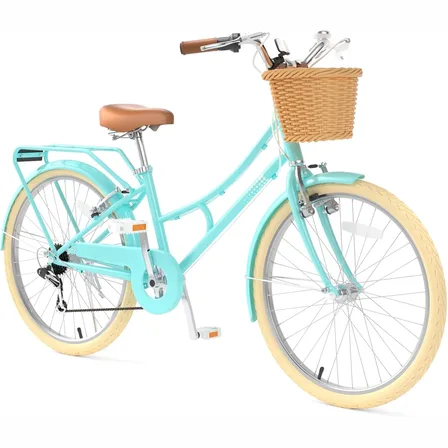
XJD 24-Inch Green Beach Cruiser Bike with U-Brake
This XJD 24-inch beach cruiser in green is made for riders about 4'8" to 5'4" ta…$159.99
$199.99 -
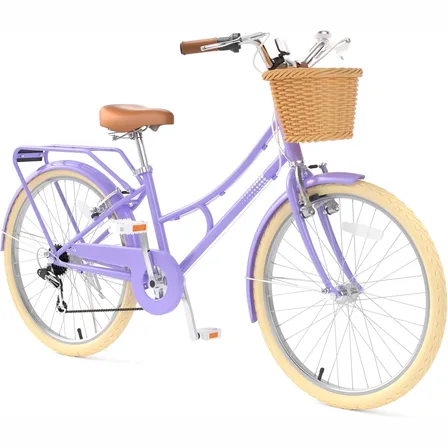
24-Inch Purple XJD Beach Cruiser Bike with U-Brake
The XJD 24-Inch Purple Beach Cruiser is built for girls and young women roughly …$159.99