

Who rides a 26 inch bike
A 26 inch bike is a starting point for youth and adults over 60 inches (153 cm) tall, but only if the rider can stand over, reach, steer and brake confidently.
Who usually fits a 26 inch bike?
Under the XBikes sizing standard, a 26 inch wheel is intended for youth and adults taller than 60 inches (153 cm). That height threshold answers the title more reliably than age because two riders of the same age can have different leg lengths, arm reach and confidence.
Wheel size alone does not guarantee fit. Frame shape, saddle adjustment and handlebar position can change how a bicycle feels. A rider near the threshold should compare an actual 26 inch bike with the adjacent 24 inch size instead of choosing solely from the label.
Do not buy an oversized bicycle for a child to “grow into.” A bike that is difficult to stand over, balance or stop now is not an appropriate current fit.
Measure before comparing bikes
First measure the rider’s height without shoes, standing upright against a wall. Then measure inseam: place a firm, level object between the legs to represent the saddle area and measure from its top edge straight down to the floor. Record both measurements rather than estimating them.
Use height to choose a starting wheel size, then use inseam and an in-person fit check to assess the particular frame. The relevant XBikes comparison points are:
| Wheel size | XBikes starting point | How to use it |
|---|---|---|
| 20 Inch | Ages 7–12; 48–60 in / 122–152 cm | A smaller catalog comparison when relevant |
| 24 Inch | Ages 10–14; 54–64 in / 137–163 cm | Compare directly when the rider overlaps this range |
| 26 Inch | Youth and adults over 60 in / 153 cm | The requested starting size, subject to an individual fit check |
The overlapping height guidance matters: a rider just over 60 inches may be able to consider both 24 and 26 inch options. Age never overrides measured height, inseam, reach, brake control or present riding confidence.
What the rider should do on the actual bike
Have the rider try the bicycle rather than deciding from a size chart alone. Check these points with ordinary riding footwear:
- Stand-over: The rider should be able to straddle the frame with both feet securely on the ground and without the frame preventing a controlled stance.
- Starting and stopping: Ask the rider to mount, begin moving and stop in a calm, controlled way without needing to stretch or tip the bicycle sharply.
- Reach and steering: Hands should reach the handlebars naturally, with enough control to steer while looking ahead. A strained or locked posture signals a poor match.
- Brake control: The rider must reach and operate the brake controls reliably. Confirm this before riding beyond a protected practice area.
- Confidence: Watch the rider rather than asking only whether the bike “feels fine.” Hesitation during turns, stops or dismounts deserves attention.
If adjustment limits, assembly details or compatibility are unclear, follow the exact product manual or ask a qualified bicycle mechanic. Do not improvise settings or procedures.
How the supplied bikes help with the decision
Both supplied catalog options include an exact 26 Inch SKU and a 24 Inch SKU, so they can support a direct adjacent-size comparison. The Pink XJD Beach Cruiser Bike, 24"/26", U-Brake is offered in 24 Inch and 26 Inch. The XJD Kids Beach Cruiser Bicycle, Rear Rack & V-Brakes, Mint Green is offered in 20 Inch, 24 Inch and 26 Inch. Its word “Kids” is a catalog title, not evidence that every child fits it.
These particular options help answer who rides a 26 inch bike because each lets shoppers compare the requested wheel size with at least the neighboring 24 inch size while keeping product claims limited to the catalog information.
 Pink XJD Beach Cruiser Bike, 24"/26", U-Brake
Available in both 24 Inch and 26 Inch SKUs, this cruiser provides an adjacent-size comparison for riders considering the requested 26 inch wheel. Its catalog title specifies a U-Brake.
 XJD Kids Beach Cruiser Bicycle, Rear Rack & V-Brakes, Mint Green
Its 20 Inch, 24 Inch and 26 Inch SKUs offer several catalog size points for comparison. The title identifies a rear rack and V-Brakes, but the “Kids” label does not establish individual fit.
Use their size labels to identify candidates, not to declare fit. The titles also identify different listed brake types, but a label cannot show whether a particular rider can comfortably reach and control those brakes. Availability, frame measurements and adjustment instructions should be checked on the exact product information and manual.
When these products are not relevant
Neither product should be treated as suitable merely because it has a 26 Inch option. They are not the right current choice if the rider is 60 inches or shorter under the XBikes starting standard, cannot stand over the chosen frame securely, reaches awkwardly, cannot operate its brakes with control, or lacks confidence during a supervised fit check.
For a rider in the 54–64 inch (137–163 cm) 24 Inch range, compare the listed 24 Inch and 26 Inch versions in person where possible. A 24 inch bike is not equal to a 26 inch bike; the comparison exists to reveal which individual fit is controllable now.
Make the 26 inch decision
Measure height and inseam, shortlist 26 inch bikes only when the rider is over 60 inches (153 cm), and compare 24 inches when the rider is near the overlap. Then require successful stand-over, reach, steering, stopping and brake-control checks on the actual bicycle.
Before riding, provide a bicycle helmet that fits properly, sits level and has straps adjusted according to its manufacturer’s instructions. Choose the 26 inch bike only when both the measurements and the rider’s demonstrated control support that exact size today.
Bikes for your next adventure
-

26-Inch XJD Beach Cruiser Bike for Girls – Purple, V-Brake
This XJD 26-inch purple beach cruiser is sized for big kids and teens — suggeste…$218.49
$229.99 -
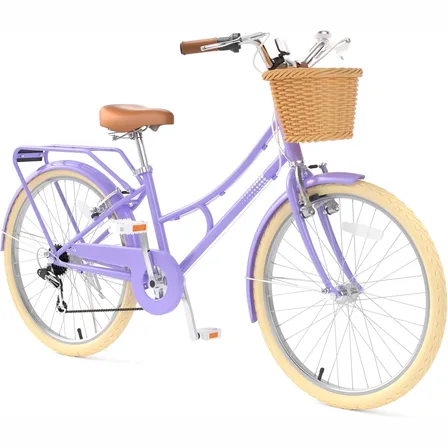
24-Inch Purple XJD Beach Cruiser Bike with U-Brake
The XJD 24-Inch Purple Beach Cruiser is built for girls and young women roughly …$159.99
-

XJD Pink Beach Cruiser for Girls – Rear Rack & V-Brake
The XJD Pink Beach Cruiser for girls is the step-up bike for riders who've outgr…$179.99
$209.99