

Why a balanexe bike is better for toddler
A balance bike can be better for a toddler because it lets the child practise balancing, steering and stopping with feet available for support. It is better only when the bike fits now and the toddler can control it confidently; a pedal bike with training wheels serves a different learning approach.
Why balance-first learning can help
A balance bike removes pedalling from the first stage of learning. The toddler can concentrate on looking ahead, steering and keeping the bike upright while moving at a comfortable pace. Because the rider’s feet are used to propel and steady the bike, the child can explore balance without also coordinating pedals.
That does not make a balance bike universally better. Some children prefer the supported feel of training wheels, while others are not yet comfortable walking or gliding on a bike. The useful question is whether the child can sit naturally, reach the ground, steer without strain and stop under control.
Measure the toddler before comparing bikes
Measure the child’s standing height and inseam while the child is wearing the shoes normally used for riding. For inseam, measure from the floor to the crotch with the child standing straight. Compare those measurements with the bicycle’s stated fit information, then have the child try the actual bike.
During the fit check, look for four things:
- Stand-over: the child must be able to manage the frame without being trapped or forced onto tiptoes.
- Ground contact: on a balance bike, the child needs useful foot contact for propulsion and controlled stopping.
- Reach: the handlebars should be reachable without stretching, locked elbows or an awkward forward lean.
- Controls: if the bicycle has hand brakes, the child must be able to reach and operate them reliably.
Do not buy an oversized bicycle merely to allow room for growth. Age is only a starting point; measured height, inseam, reach, brake control and present confidence decide whether a bike fits.
Use wheel size only as a starting point
The relevant XBikes starting points begin with 12-inch wheels. They are not a substitute for an individual fit check.
| Wheel size | Starting age | Rider height |
|---|---|---|
| 12 Inch | Ages 3–4 | 34–40 in / 86–102 cm |
| 14 Inch | Ages 3–6 | 37–45 in / 94–114 cm |
| 16 Inch | Ages 4–7 | 40–48 in / 102–122 cm |
If the toddler falls below a listed height range, do not assume that the wheel size will work. Look for a balance bike whose manufacturer provides fit information matching the child’s measurements, and confirm the fit in person. If the child overlaps two ranges, compare actual stand-over, reach and control rather than automatically choosing the larger wheel.
How the supplied training-wheel bike compares
The Girls 12/14/16 Inch Kids Bike by XJD with Training Wheels – Peach is a training-wheel bicycle offered with 12 Inch, 14 Inch and 16 Inch SKU labels. It helps answer the title by showing the supported pedal-bike alternative across the three smallest supplied XBikes wheel-size starting points. It is not identified in the catalog facts as a balance bike, so it should not be treated as an equivalent substitute.
These particular catalog options are useful when a parent wants to compare balance-first learning with a training-wheel approach while checking 12-, 14- or 16-inch starting ranges.

Consider this product only if the child’s measured height falls within the relevant starting range and an individual trial confirms suitable stand-over, reach, brake access and control. Choose among its size labels from fit evidence, not from age alone. Consult the exact product manual or a qualified bicycle mechanic for assembly, maintenance, load limits, compatibility and torque information.
Make safety part of the fit decision
A properly fitting bicycle helmet is required for every ride. It should sit level and its straps should be adjusted according to the helmet manufacturer’s instructions. A helmet cannot correct a bicycle that is too large or difficult for the child to control.
Begin in a level area away from traffic and other hazards, with close adult supervision. Let the child show that they can start, steer, slow and stop before moving to a more demanding setting. If the child repeatedly stretches for the ground, cannot steer predictably or cannot use the available braking method, pause and reassess the fit.
Decide which approach fits this toddler now
Choose a balance bike when the toddler fits it properly and is ready to learn steering and balance through foot-powered movement. Consider the supplied XJD training-wheel bike when a supported pedal-bike approach is preferred and one of its 12-, 14- or 16-inch options passes the child’s individual fit check. Measure first, try the bike, and select the approach the toddler can control today—not the size they may grow into later.
Bikes for your next adventure
-
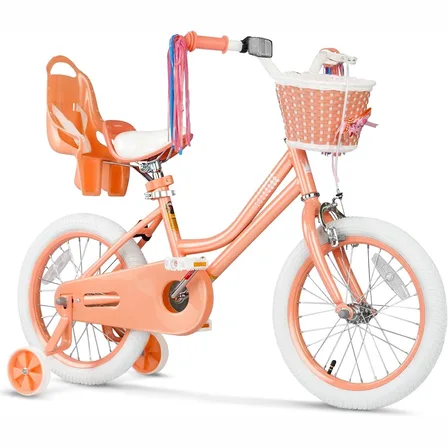
Girls 12/14/16 Inch Kids Bike by XJD with Training Wheels – Peach
The XJD Girls Bike in Peach is a training-wheel bike built for girls roughly 3 t…$149
$169 -
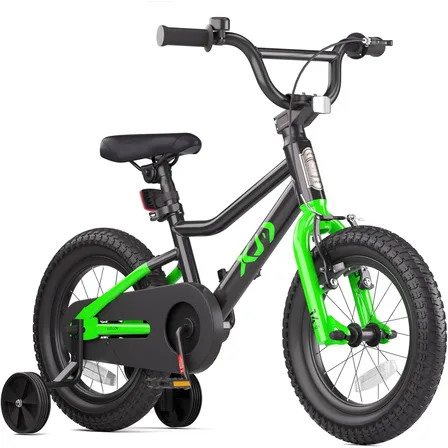
Black XJD Kids' BMX Bicycle with Training Wheels
The XJD Kids' BMX Bicycle with Training Wheels is built for children roughly 3 t…$99.99
$119.99 -

Black XJD Toddler Bike Helmet, Adjustable – Kids' Protective Helmet
The XJD Toddler Bike Helmet in black is an adjustable protective helmet for kids…$20.39