

Why can't my 7 year old ride a bike
A 7-year-old may be unable to ride because the bike does not fit, the controls are hard to use, or balance and confidence need more practice. Measure your child and check the bike before assuming they are unwilling or incapable.
Check fit before working on technique
Measure your child’s height and inseam while they are wearing the shoes they will ride in. Then have them try the actual bicycle. Age is only a starting point: compare their measurements, reach, brake control and confidence with the bike in front of you.
With the child standing over the bicycle, check that they can manage the bike without being trapped or forced onto tiptoes. When seated, they should be able to reach the handlebar comfortably, steer without stretching and operate the brakes with control. If they cannot do those things, practice alone will not correct the mismatch.
Do not buy an oversized bicycle for future growth. A bike that feels tall, long or heavy to control can make starting, stopping and turning unnecessarily difficult.
Compare the wheel-size starting points
Use measured height first. These XBikes ranges help narrow the comparison, but the child still needs an individual fit check.
| Wheel size | Starting age | Rider height |
|---|---|---|
| 12 Inch | 3–4 | 34–40 in / 86–102 cm |
| 14 Inch | 3–6 | 37–45 in / 94–114 cm |
| 16 Inch | 4–7 | 40–48 in / 102–122 cm |
| 18 Inch | 5–9 | 43–52 in / 109–132 cm |
| 20 Inch | 7–12 | 48–60 in / 122–152 cm |
| 24 Inch | 10–14 | 54–64 in / 137–163 cm |
| 26 Inch | Youth and adults | Over 60 in / 153 cm |
A 7-year-old could therefore fall near the upper end of a 16 Inch range, within the 18 Inch range, or at the beginning of the 20 Inch range. Overlap is normal. Height does not settle the decision by itself; inseam, stand-over room, reach, braking and present confidence can make two children of equal height need different fits.
Identify what is stopping your child
Watch one short attempt in a flat, open area and look for the specific failure point:
- The bike leans immediately: the child may need balance practice or may be unable to place their feet confidently.
- Starting is the problem: the starting position may feel unstable, or the bike may be too large to control.
- They wobble while looking down: practice gliding and looking ahead before adding more tasks.
- Stopping causes panic: confirm that their hands reach and operate the brakes comfortably before continuing.
- They refuse after a fall: reduce the task to short, predictable attempts rather than pushing through fear.
If the handlebar, wheels, brakes or other parts seem loose, damaged or incorrectly assembled, stop riding. Follow the exact product manual or ask a qualified bicycle mechanic; do not guess at compatibility, adjustment procedures or torque.
Use a simpler practice sequence
- Choose a level, traffic-free practice space with plenty of room.
- Have the child walk the bike and practice controlled stops.
- Let them push and glide briefly, looking ahead rather than at their feet.
- Practice starting separately: one foot ready to push while the other stabilizes.
- Add pedaling only when gliding, steering and stopping no longer compete for attention.
Keep sessions short enough that control does not deteriorate through fatigue or frustration. Give one instruction at a time. Progress may mean a calmer stop or a longer glide, not necessarily independent riding that day.
When the supplied catalog option is relevant
The XJD Girls Bike for Kids Ages 3-8, 12/14/16 Inch with Training Wheels – Purple is offered in the Training Wheel Bikes category with 12 Inch, 14 Inch and 16 Inch SKU labels. The “Ages 3-8” wording is part of its catalog title, not proof that it fits a particular 7-year-old. Its sizes are useful comparison points when the measured rider falls within the supplied 12, 14 or 16 Inch height ranges and can pass the hands-on fit checks.
These particular options help answer the question by showing whether a smaller training-wheel configuration is worth comparing when fit or confidence is the barrier. They are not substitutes for an 18 Inch or 20 Inch bike if the child’s measurements and control indicate one of those sizes.
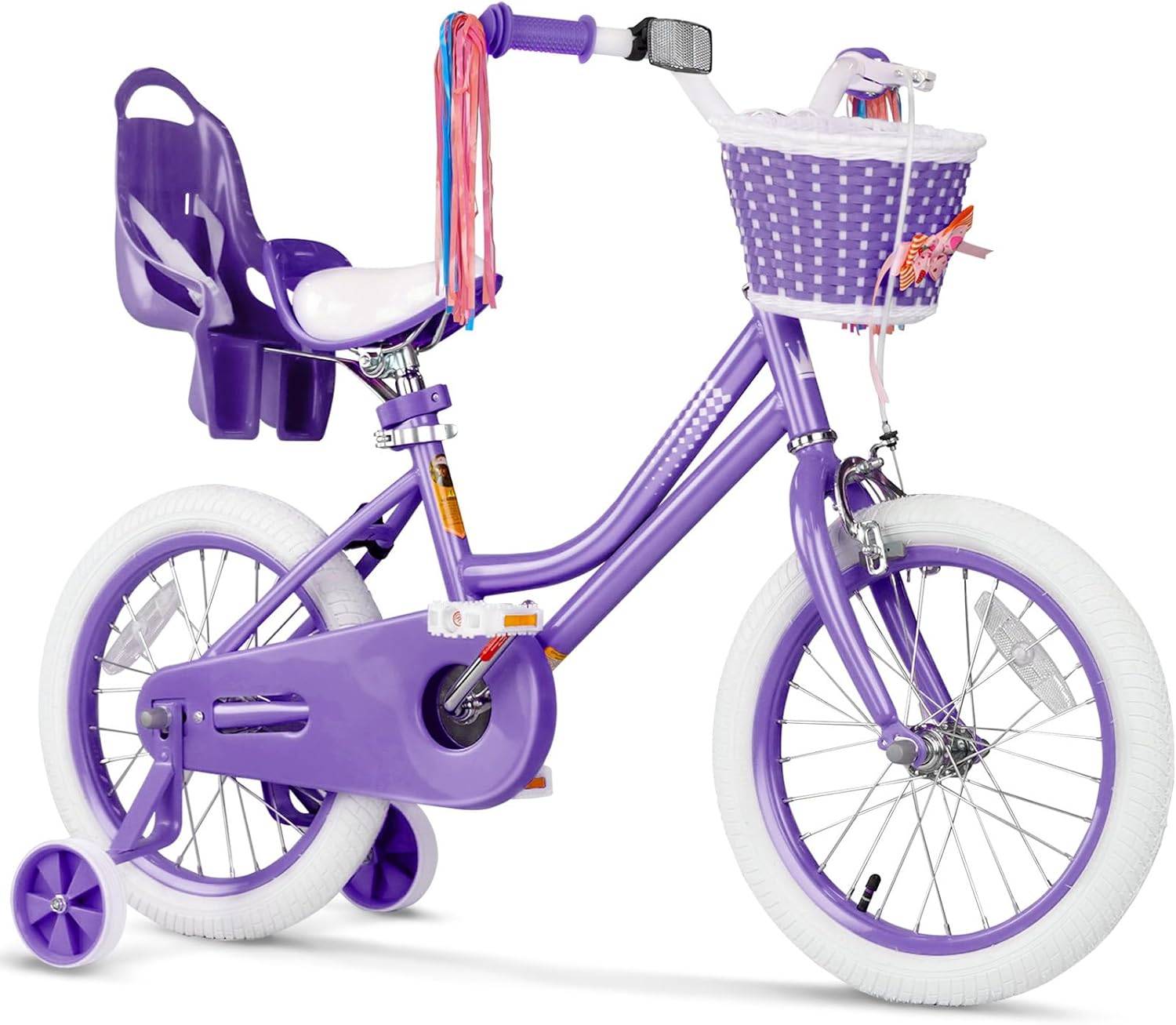
Training wheels may be relevant when the immediate goal is supported pedaling, but the category label does not establish fit or guarantee that it addresses the child’s actual difficulty. If balance is the missing skill, supported riding and balance practice solve different problems; choose according to what you observed.
Decide what to do next
First record height and inseam. Next compare the current bike with the table, then check stand-over position, handlebar reach and brake operation on the actual bicycle. If fit is poor, change the fit or bicycle before asking for more practice. If fit is sound, return to walking, stopping, gliding and starting in that order.
Before every attempt, use a bicycle helmet that fits properly, sits level and has straps adjusted according to its manufacturer’s instructions. For this 7-year-old, the next decision should follow the observed obstacle: correct a fit or mechanical problem first; otherwise practice the single skill that breaks down.
Bikes for your next adventure
-

Green XJD Toddler Bike Helmet with Adjustable Fit, XS (46–51 cm)
The XJD toddler bike helmet in Green is built for the youngest riders — the size…$20.39
$23.99 -

Kids Bike Helmet by XJD for Boys & Girls – Black, Blue, Green, Pink, Purple
The XJD Kids Bike Helmet covers a wide 2-to-8-year age range thanks to two head-…$59.99
-

Kids Bike Helmet by XJD for Girls – Pink
The XJD Kids Bike Helmet in Pink is a lightweight multi-sport helmet for girls r…$59.99
$99