

Is there a difference between boys and girls bikes
No—boys’ and girls’ bikes do not require different sizing. Choose by the child’s body measurements, control and confidence, not the label.
What can actually differ?
“Boys” and “girls” may appear in a product name, but that wording alone does not establish a meaningful fit difference. Colors, graphics and naming can vary. Frame shape, handlebar position, saddle adjustment, brake controls and other equipment may also vary between individual models, but those details must be compared model by model rather than inferred from gender.
Let the rider choose an appearance they like, then judge whether the specific bicycle fits. If two bikes have the same wheel size, do not assume they offer identical stand-over clearance, reach or controls. Check the listed specifications, have the child try each bike and consult the exact product manual for details not provided.
Measure the rider before comparing labels
Measure the child’s height without shoes. Then measure inseam from the floor to the crotch while the child stands naturally. Height provides a wheel-size starting point; inseam helps you assess whether the child can stand over the bicycle comfortably.
During a fit check, confirm that the rider can mount and dismount without struggling, reach the handlebar without stretching, steer while remaining balanced and operate the brakes confidently. The American Academy of Pediatrics advises having the child try the bicycle, checking stand-over and brake reach, and avoiding an oversized bike bought only for future growth.
Use wheel size only as a starting point
| Wheel size | Starting age | Rider height |
|---|---|---|
| 12 Inch | 3–4 | 34–40 in / 86–102 cm |
| 14 Inch | 3–6 | 37–45 in / 94–114 cm |
| 16 Inch | 4–7 | 40–48 in / 102–122 cm |
| 18 Inch | 5–9 | 43–52 in / 109–132 cm |
| 20 Inch | 7–12 | 48–60 in / 122–152 cm |
| 24 Inch | 10–14 | 54–64 in / 137–163 cm |
| 26 Inch | Youth and adults | Over 60 in / 153 cm |
Overlapping ranges are normal, so age cannot settle the choice. Prioritize measured height, inseam, reach, brake control and current riding confidence. A child near a boundary should try the relevant sizes instead of automatically moving up.
How to compare a “boys” bike with a “girls” bike
- Start with fit: shortlist wheel sizes from measured height, then verify stand-over clearance and usable saddle adjustment on the actual bicycle.
- Check the riding position: the child should reach the grips and turn the handlebar without leaning or stretching excessively.
- Check control: ask the child to start, stop, steer and place a foot down in a controlled way. Confirm that the brake controls are within comfortable reach.
- Compare model details: inspect each bicycle’s specifications and exact manual instead of treating a gender label as evidence about geometry, equipment, assembly or compatibility.
- Include the rider: once fit and control are established, let personal preference decide between suitable colors, graphics or names.
Where the supplied XBikes options are relevant
The catalog includes two explicitly unisex-labeled comparison options in 12, 14 and 16 Inch sizes. They help show that a child can consider the same listed model regardless of whether a shopper initially searches for a boys’ or girls’ bike; final selection still depends on an individual fit check.
XJD Kids' Training Wheel Bike for Boys & Girls, 12/14/16 Inch – White is categorized as a Training Wheel Bike and is offered with 12 Inch, 14 Inch and 16 Inch SKU labels. XJD Boys & Girls BMX Bike with Training Wheels, 12/14/16" – Blue is categorized as a Kids' BMX Bike and has the same three listed size labels. The catalog facts do not establish that their geometry, components or fit are identical, so compare the exact size and manual for each.
These particular options are relevant when the measured rider falls within the 12, 14 or 16 Inch starting ranges and training wheels are wanted. For a rider who needs 18, 20, 24 or 26 Inch wheels, they are nearest-size comparison points only—not substitutes for the required size.
 XJD Kids' Training Wheel Bike for Boys & Girls, 12/14/16 Inch – White
A unisex-labeled Training Wheel Bike offered in 12 Inch, 14 Inch and 16 Inch SKU labels; relevant for comparing a measured child’s fit within those wheel-size starting ranges.
 XJD Boys & Girls BMX Bike with Training Wheels, 12/14/16" – Blue
A boys-and-girls Kids' BMX Bike with training wheels, offered in 12 Inch, 14 Inch and 16 Inch labels; compare its exact fit and manual rather than relying on the gender wording.
Make the final decision
Ignore the gender label first. Record the child’s height and inseam, shortlist the matching wheel size, and have the child try the exact bike. Choose only when stand-over, reach, steering, braking and confidence all work together; otherwise compare another model or size.
Follow the exact product manual or use a qualified bicycle mechanic for assembly, maintenance, torque, load limits and compatibility questions. Add a properly fitting bicycle helmet that sits level and has straps adjusted according to its manufacturer’s instructions. The right “boys” or “girls” bike is simply the suitable bicycle the child can control and wants to ride.
Bikes for your next adventure
-
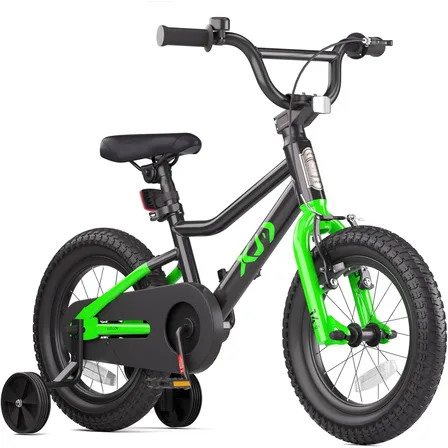
Black XJD Kids' BMX Bicycle with Training Wheels
The XJD Kids' BMX Bicycle with Training Wheels is built for children roughly 3 t…$99.99
$119.99 -
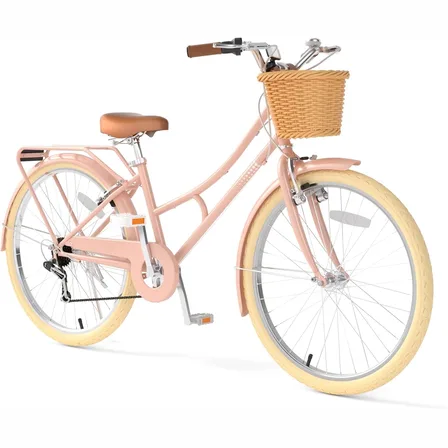
Pink XJD Beach Cruiser Bike, 24"/26", U-Brake
The XJD Pink Beach Cruiser Bike is a single-speed cruiser built for older kids a…$159.99
-

XJD Boys & Girls BMX Bike with Training Wheels, 12/14/16" – Blue
The XJD Boys & Girls BMX Bike in Blue is a first pedal bike for kids roughly age…$99.99
$119.99