

What Height Is a 24-Inch Girls' Bike For?
A 24-inch girls' bike is a starting point for riders 54–64 inches (137–163 cm) tall, usually ages 10–14, but the child must pass an individual fit check.
Start with measured height, not age
Measure the rider barefoot, standing straight against a wall. Compare that measurement with the XBikes 24-inch starting range of 54–64 inches (137–163 cm). Age can help narrow the search, but it cannot confirm that a particular bicycle frame will fit.
A child near either end of the range may fit a neighboring wheel size or a differently shaped frame better. The relevant XBikes starting points are:
| Wheel size | Rider height | Typical age |
|---|---|---|
| 20 Inch | 48–60 in / 122–152 cm | 7–12 |
| 24 Inch | 54–64 in / 137–163 cm | 10–14 |
| 26 Inch | Over 60 in / 153 cm | Youth and adults |
These ranges overlap because wheel diameter does not determine the complete fit. Frame shape, saddle position, handlebar reach and the rider's proportions all matter.
Measure inseam for the stand-over check
Measure inseam with the child barefoot. Have the rider stand with feet slightly apart and measure from the floor to the crotch. Use that measurement when checking the bicycle's stand-over clearance and the manufacturer's sizing information.
At a real fit check, the child should be able to straddle the bicycle without the frame pressing into the body. Do not assume that being tall enough to reach the pedals makes the bike suitable. If stand-over clearance is inadequate, the bike is too large for that rider even when the height chart points toward 24 inches.
Check reach, brakes and control
Have the child sit in a normal riding position and hold the grips. The rider should not need to stretch, lock the elbows or slide forward simply to reach the handlebar. Steering should feel controlled rather than heavy or awkward.
Next, confirm that the rider can reach and operate both brake controls confidently while keeping a secure grip. The child should also be able to start, stop, turn and dismount without panic or assistance. Current confidence matters: a hesitant rider may need a more manageable fit even if height and age fall within the 24-inch starting range.
Follow the exact product manual for assembly, adjustment, maintenance and torque instructions. If the setup or fit cannot be confirmed, use a qualified bicycle mechanic.
Do not size up just for growth
An oversized bicycle can make mounting, stopping, steering and brake operation harder. Do not choose a 26-inch model merely because the child may grow into it. Likewise, do not keep a 20-inch bike solely because it feels familiar if the rider is cramped and cannot use it comfortably.
When measurements overlap two wheel-size ranges, compare both bicycles in person if possible. Choose according to stand-over clearance, natural reach, brake access and demonstrated control—not the larger number or the longest predicted period of use.
How the supplied bikes help with comparison
The supplied catalog choices include 20-, 24- and 26-inch SKU labels, so they can help a parent compare the requested 24-inch size with adjacent options. The 24-inch variants are directly relevant; the 20- and 26-inch variants are comparison sizes, not equivalent substitutes.
 26-Inch XJD Beach Cruiser Bike for Girls – Purple, V-Brake
Includes Mint Green and Pink 24 Inch SKU labels relevant to the question, alongside 20- and 26-inch comparison sizes. The supplied Purple SKU is 26 Inch, not 24 Inch.
 XJD Pink Beach Cruiser for Girls – Rear Rack & V-Brake
Offers 20 Inch, 24 Inch and 26 Inch SKU labels. The 24 Inch variant is directly relevant, while the adjacent sizes can support an individual fit comparison.
26-Inch XJD Beach Cruiser Bike for Girls – Purple, V-Brake has Mint Green and Pink SKU labels in 20-, 24- and 26-inch sizes, plus Purple / 26 Inch. Despite the exact product title beginning with “26-Inch,” its supplied variants include 24-inch options in Mint Green and Pink. The Purple option supplied here is 26 inches, so it should not be treated as a 24-inch bike.
XJD Pink Beach Cruiser for Girls – Rear Rack & V-Brake has 20 Inch, 24 Inch and 26 Inch SKU labels. Its 24 Inch variant is relevant to the title, while the other two sizes provide neighboring comparison points. Select the exact size variant deliberately; the shared product name does not make the sizes interchangeable.
Make the final 24-inch decision
- Measure the child's standing height and barefoot inseam.
- Use 54–64 inches (137–163 cm) only as the initial 24-inch screening range.
- Have the child straddle and sit on the exact bicycle and size variant.
- Confirm comfortable stand-over clearance, reach, brake operation, starting, turning, stopping and dismounting.
- Reject the bike if the child must stretch, cannot control the brakes or appears overwhelmed; do not accept an oversized fit for future growth.
Before riding, provide a bicycle helmet that fits properly, sits level and has straps adjusted according to its manufacturer's instructions. Choose the 24-inch girls' bike only when the measured rider can control that exact bike confidently now.
Bikes for your next adventure
-
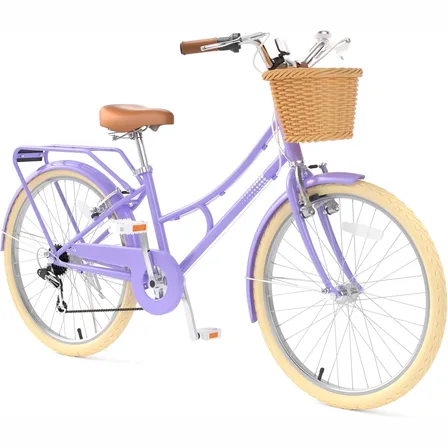
24-Inch Purple XJD Beach Cruiser Bike with U-Brake
The XJD 24-Inch Purple Beach Cruiser is built for girls and young women roughly …$159.99
-

26-Inch XJD Beach Cruiser Bike for Girls – Purple, V-Brake
This XJD 26-inch purple beach cruiser is sized for big kids and teens — suggeste…$218.49
$229.99 -

XJD Pink Beach Cruiser for Girls – Rear Rack & V-Brake
The XJD Pink Beach Cruiser for girls is the step-up bike for riders who've outgr…$179.99
$209.99