

What is the difference between boys and girls bikes
Boys’ and girls’ bikes are not separate fit categories: the meaningful differences may be styling, frame shape or accessories, while the correct choice depends on the child’s body measurements, reach, brake control and confidence.
What actually differs between boys’ and girls’ bikes?
Labels such as “boys” and “girls” often describe appearance or design traditions rather than who can ride the bicycle. A so-called girls’ model may have different colors, graphics, accessories or frame shaping; a boys’ model may use another visual theme. None of those labels proves that the bike will fit a particular child.
Compare the actual bicycles, not the gender words. Look at whether the rider can get on and off comfortably, stand over the bike with appropriate clearance, reach the handlebars without stretching, operate the brakes confidently and control the bicycle at low speed. Let the child choose the appearance they like after confirming those essentials.
Measure before comparing labels
Measure the child’s height without shoes. Then measure inseam from the floor to the crotch while the child stands straight with feet slightly apart. Height provides a wheel-size starting point; inseam helps assess stand-over clearance and whether the child can start, stop and put a foot down comfortably.
Age is only a rough guide because children of the same age can have different proportions and skill levels. Use the XBikes ranges below only to identify sizes worth trying:
| Wheel size | Starting age | Rider height |
|---|---|---|
| 12 Inch | 3–4 | 34–40 in / 86–102 cm |
| 14 Inch | 3–6 | 37–45 in / 94–114 cm |
| 16 Inch | 4–7 | 40–48 in / 102–122 cm |
| 18 Inch | 5–9 | 43–52 in / 109–132 cm |
| 20 Inch | 7–12 | 48–60 in / 122–152 cm |
| 24 Inch | 10–14 | 54–64 in / 137–163 cm |
| 26 Inch | Youth and adults | Over 60 in / 153 cm |
Overlapping ranges are a reason to try both nearby sizes, not permission to guess. Never move up merely because a larger bike offers more growing room.
Use a hands-on fit check
HealthyChildren guidance from the American Academy of Pediatrics supports having the child try the bicycle and avoiding an oversized purchase for growth. During the trial, check these points:
- Stand-over: The child can straddle the bike comfortably rather than being pressed against the frame.
- Reach: Hands reach the bars without locked arms, leaning excessively forward or losing a stable seated position.
- Brakes: The child can reach and operate the fitted brake controls while maintaining a secure grip.
- Control: The child can mount, steer, stop and put a foot down without the bicycle feeling intimidating or unwieldy.
Current confidence matters alongside dimensions. A size that falls inside a height range can still be unsuitable if the child cannot control it. Conversely, a gender label should not rule out a bike that fits, functions appropriately and appeals to the rider.
How the supplied bike helps with the comparison
The supplied catalog option is useful precisely because it is presented for both boys and girls and offers three wheel-size labels. The XJD Kids' Training Wheel Bike for Boys & Girls, 12/14/16 Inch – White is categorized as a training wheel bike and is available in 12 Inch, 14 Inch and 16 Inch labels. It lets parents compare relevant size starting points without treating gender as the deciding specification.

This product is relevant only when a 12, 14 or 16 Inch starting point matches the rider’s measured height and the exact bicycle passes an individual fit check. It is not evidence that all three sizes fit the same child. If measurements point toward 18, 20, 24 or 26 Inch, this catalog option is not a substitute; those sizes are distinct.
What to compare after size
Once likely wheel sizes are identified, compare the exact frame’s stand-over, handlebar reach, brake reach and ease of control. Then consider styling and whether the child wants a design marketed toward girls, boys or everyone. Training wheels are also a separate choice from gender: consider the rider’s present balance and confidence rather than assuming every girl or boy needs the same setup.
For assembly, adjustments, maintenance, load limits, compatibility and torque requirements, follow the exact product manual or use a qualified bicycle mechanic. Do not transfer instructions from another model simply because its wheel size looks similar.
Make the final choice
Have the child wear a properly fitting bicycle helmet that sits level, with straps used according to the helmet manufacturer’s instructions. Recheck control in a suitable low-risk area before regular riding.
The decision is straightforward: measure height and inseam, shortlist the indicated wheel sizes, try each candidate, and reject any bike the child cannot stand over, reach, brake and control comfortably. Between two bikes that pass those checks, “boys” or “girls” can simply be a style preference chosen by the child.
Bikes for your next adventure
-

Black XJD Toddler Bike Helmet, Adjustable – Kids' Protective Helmet
The XJD Toddler Bike Helmet in black is an adjustable protective helmet for kids…$20.39
-

Light Pink XJD Girls' Bicycle with Basket & Training Wheels
The Light Pink XJD Girls' Bicycle with Basket & Training Wheels is a retro-style…$109.99
$129.99 -
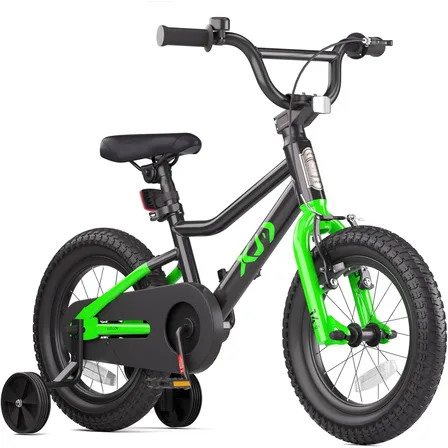
Black XJD Kids' BMX Bicycle with Training Wheels
The XJD Kids' BMX Bicycle with Training Wheels is built for children roughly 3 t…$99.99
$119.99