

What's the difference between a boys and girls bike
The main difference between a boys’ and girls’ bike is usually presentation, not fit. Choose by body measurements, control and confidence—not gender.
What actually differs?
Labels such as “boys” and “girls” often describe color, graphics or marketing. Some models may also use different frame shapes or components, but a label alone does not tell you whether a child can stand over, reach or control that particular bicycle.
There is no need to match the label to the rider. A girl can ride a bike marketed to boys, and a boy can ride one marketed to girls. The meaningful comparison is between the dimensions and controls of the actual models in front of you.
Measure the rider before comparing bikes
Measure the child’s height without shoes. Then measure inseam from the floor to the crotch while the child stands upright with feet slightly apart. Use height to identify a starting wheel size and inseam to assess clearance when the child tries the bike.
During the fit check, have the child stand over the frame and sit on the saddle. Check whether they can comfortably reach the handlebar, turn it without stretching, and operate the brakes with control. They should be able to start, stop and put a foot down without the bicycle feeling intimidating or unwieldy.
Current confidence matters too. Two children of equal height may need different setups because one is still learning to balance or brake. Do not buy an oversized bicycle merely to leave room for growth.
Use wheel size only as a starting point
| Wheel size | Starting age | Rider height |
|---|---|---|
| 12 Inch | 3–4 | 34–40 in / 86–102 cm |
| 14 Inch | 3–6 | 37–45 in / 94–114 cm |
| 16 Inch | 4–7 | 40–48 in / 102–122 cm |
| 18 Inch | 5–9 | 43–52 in / 109–132 cm |
| 20 Inch | 7–12 | 48–60 in / 122–152 cm |
| 24 Inch | 10–14 | 54–64 in / 137–163 cm |
| 26 Inch | Youth and adults | Over 60 in / 153 cm |
Overlapping ranges are normal. If the rider falls into two rows, compare both sizes in person rather than deciding by age. Prioritize measured height, inseam, reach, brake control and confidence. Wheel diameter does not reveal every frame dimension, so two bikes with the same wheel label may still feel different.
How the supplied boys-and-girls bikes help
The supplied catalog options make the central point clearly: both are explicitly presented for boys and girls. The XJD Kids' Training Wheel Bike for Boys & Girls, 12/14/16 Inch – White is categorized as a training wheel bike and is offered in 12 Inch, 14 Inch and 16 Inch labels. The XJD Boys & Girls BMX Bike with Training Wheels, 12/14/16" – Blue is categorized as a kids’ BMX bike and has the same three available size labels.
These particular options are relevant when the child’s measurements place them near the 12-, 14- or 16-inch starting ranges and a training-wheel model is being considered. They also show why white, blue, “boys,” “girls” or BMX wording should not replace an individual fit check.
 XJD Kids' Training Wheel Bike for Boys & Girls, 12/14/16 Inch – White
A boys-and-girls training wheel bike offered in 12 Inch, 14 Inch and 16 Inch labels, relevant for comparing fit when the rider’s measurements fall within those starting ranges.
 XJD Boys & Girls BMX Bike with Training Wheels, 12/14/16" – Blue
A boys-and-girls kids’ BMX bike with training wheels, available in 12 Inch, 14 Inch and 16 Inch labels for measurement-led comparison with the other supplied option.
Neither supplied title provides frame dimensions, brake type, weight, load limit or detailed adjustment information. Compare those points only through the exact product manual or with help from a qualified bicycle mechanic. Do not assume the two models fit identically simply because their listed wheel-size choices match.
Make an in-person comparison
- Shortlist by measured height: use the XBikes ranges to identify likely wheel sizes, not to guarantee a fit.
- Check stand-over clearance: the child should be able to straddle the bicycle without the frame obstructing comfortable control.
- Check reach: reject a model that requires locked arms, excessive leaning or awkward steering.
- Check braking: confirm the child can reach and operate the controls reliably while maintaining their grip.
- Observe confidence: ask the child to start, steer, stop and place a foot down. Hesitation caused by excessive size is a reason to reconsider.
If assembly, adjustment, compatibility or torque information is needed, follow the manual for the exact model or consult a qualified bicycle mechanic rather than applying a generic procedure.
What to do next
Measure height and inseam, shortlist the matching wheel-size rows, and have the child try the actual bikes. Compare stand-over, reach, brake control and confidence side by side. Choose the model the rider can control now, regardless of whether its styling is called boys’, girls’ or unisex, and finish the setup with a properly fitting bicycle helmet worn level with its straps adjusted according to the helmet manufacturer’s instructions.
Bikes for your next adventure
-

Black XJD Toddler Bike Helmet, Adjustable – Kids' Protective Helmet
The XJD Toddler Bike Helmet in black is an adjustable protective helmet for kids…$20.39
-

Light Pink XJD Girls' Bicycle with Basket & Training Wheels
The Light Pink XJD Girls' Bicycle with Basket & Training Wheels is a retro-style…$109.99
$129.99 -
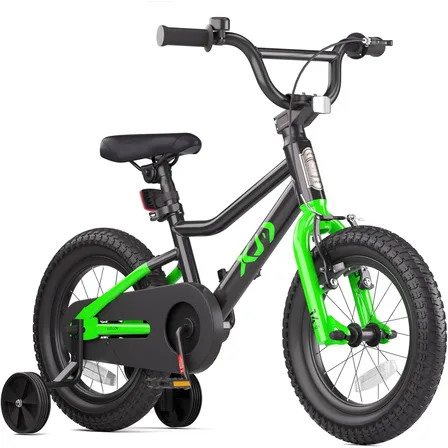
Black XJD Kids' BMX Bicycle with Training Wheels
The XJD Kids' BMX Bicycle with Training Wheels is built for children roughly 3 t…$99.99
$119.99