

How to fit a toddler helmet
Measure around your toddler’s head, compare that number with the helmet’s stated size range, then confirm a level, snug fit on the child.
Measure the head before choosing a size
Use a flexible tape measure around the widest part of the head, passing above the eyebrows and ears and around the fullest point at the back. Keep the tape level and comfortably close to the skin without pulling it tight. Measure with the child’s hair arranged as it will normally be under the helmet.
Record the result in centimetres because the supplied helmet sizes use centimetre ranges. Repeat the measurement to catch a slipped or tilted tape. Head circumference—not the child’s age, bicycle wheel size or a size name such as XS—is the useful starting point.
Compare the measurement with the listed range
A helmet is relevant only when the measured circumference falls within one of its available size ranges. The Black XJD Toddler Bike Helmet, Adjustable – Kids' Protective Helmet has listed options of XS (46–51 cm), XS (48–50 cm), S (51–54 cm) and S (52–56 cm). Some ranges overlap, so the letters alone do not identify the correct option; compare the complete SKU label.
The White Astronaut Bike Helmet for Kids by XJD – Toddler to Youth Sizes lists S:18.11"-20.08" / 46-51 cm and M:20.47"-22.05" / 52-56 cm. Its age-related title wording is a catalog label, not evidence that it fits a particular toddler. These two catalog options help with the fitting decision because their supplied size labels provide specific circumference ranges to compare with the child’s measurement; neither can replace an on-head check.
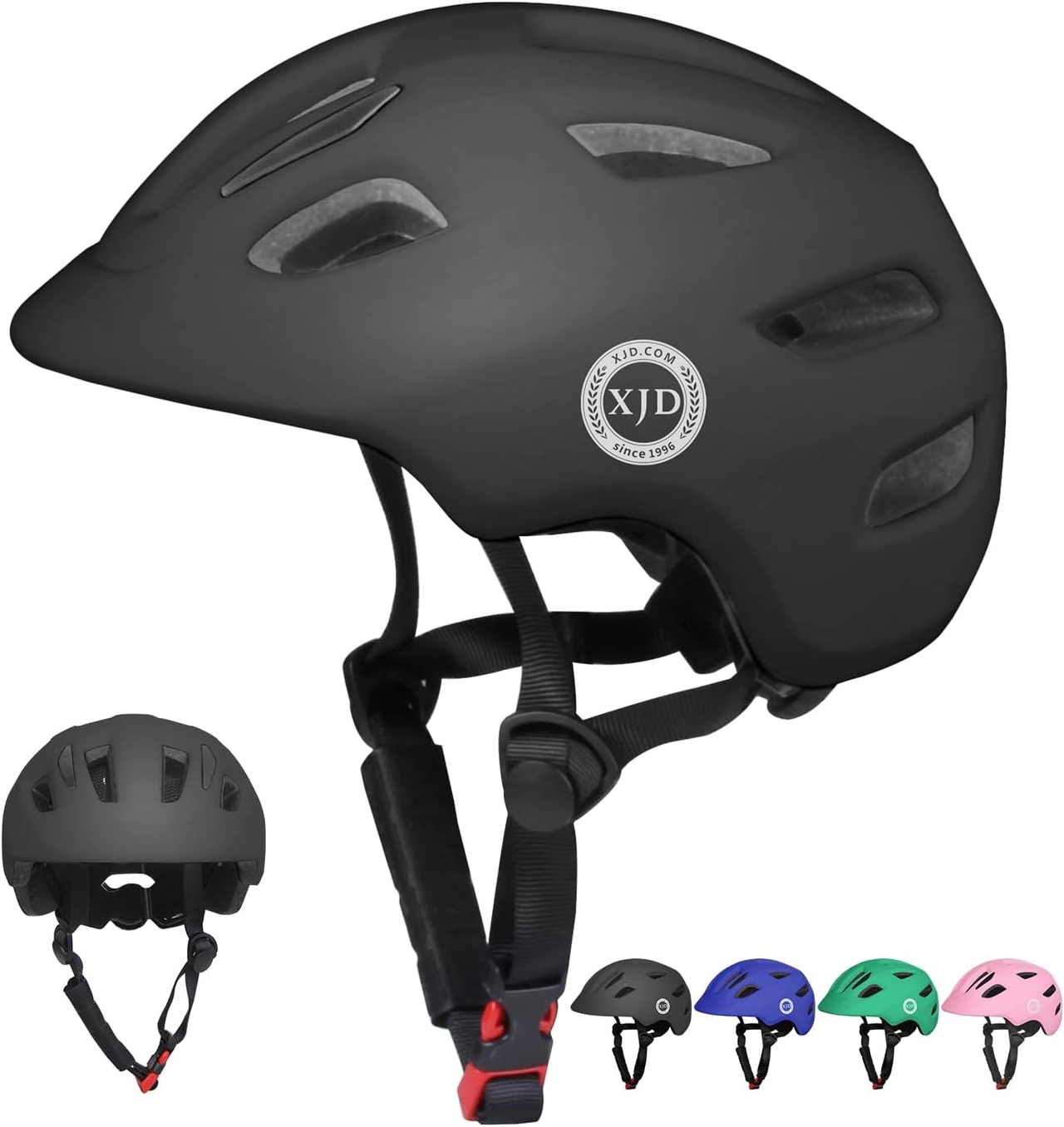 Black XJD Toddler Bike Helmet, Adjustable – Kids' Protective Helmet
Relevant when the measured head circumference falls within one of its listed XS or S ranges, spanning supplied options from 46–51 cm through 52–56 cm. Compare the full SKU label because its XS and S ranges differ.
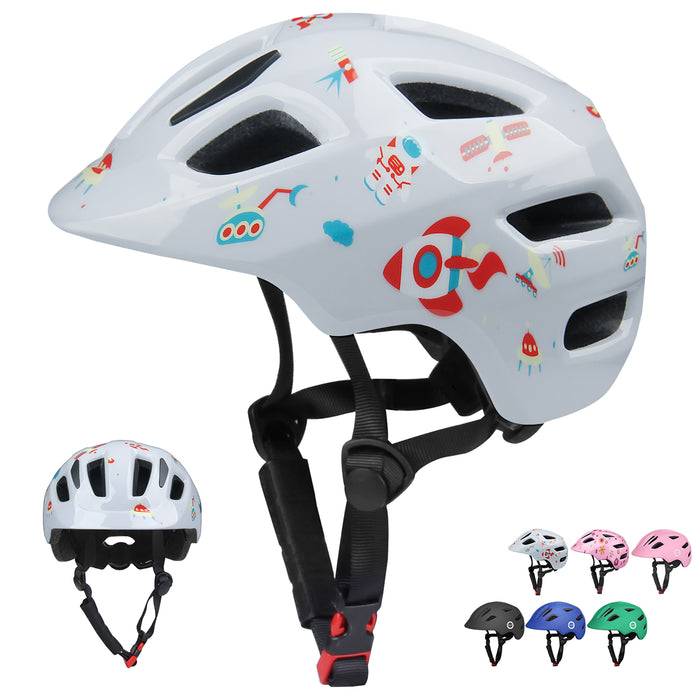 White Astronaut Bike Helmet for Kids by XJD – Toddler to Youth Sizes
Provides supplied S 46–51 cm and M 52–56 cm comparison ranges. The toddler-to-youth wording is only part of the catalog title; select it by measured circumference and a successful on-head fit check.
Put the helmet on level
Place the helmet squarely on the child’s head so it sits level rather than tipped back or pushed down over the eyes. It should cover the forehead appropriately while leaving the child able to see clearly. Follow the exact helmet manufacturer’s instructions for positioning any internal adjustment system.
Adjust the fit system until the helmet feels evenly snug around the head, without creating pressure points. Do not use thick hats, added padding or improvised inserts to make an oversized helmet seem to fit unless the manufacturer’s instructions specifically allow them.
Set the straps and test stability
- Arrange the side straps according to the manufacturer’s instructions so they lie flat and do not twist.
- Fasten and adjust the chin strap so it is secure and comfortable, without loose webbing that allows the helmet to shift.
- Ask the child to look up, down and from side to side. The helmet should remain level and stable.
- Gently try to move the helmet forward, backward and sideways. Reject the fit if it slides substantially, exposes the forehead, obstructs vision or can be pushed out of position.
- Check for pinching, painful pressure, distress or strap contact that makes the child unwilling to keep the helmet on.
A circumference inside the printed range does not guarantee a suitable fit because head shapes differ. If the shell or straps cannot be adjusted to stay level and secure, try another listed size or helmet shape rather than forcing the fit.
Know when these products are not relevant
Neither supplied helmet should be selected when the child’s measurement is outside all of that product’s available ranges. There is also a gap between 51 cm and 52 cm in the listed White Astronaut options: do not round a measurement into a range or assume the M option fits below its stated 52 cm lower limit.
If a measurement sits at an endpoint shared by two Black XJD ranges, both labels may be comparison candidates, but the successful choice is the one that passes the complete on-head fit check. Do not buy a larger helmet merely to leave growth room. An oversized helmet that moves or cannot be secured is not an acceptable current fit.
Recheck before every ride
Confirm that the helmet is level, the adjustments have not loosened and the straps are correctly fastened each time. Re-measure after noticeable growth and reassess whenever the helmet begins to feel tight or unstable. For replacement after damage, cleaning, adjustment limits, component compatibility or any procedure not stated here, follow the exact product manual or ask a qualified bicycle mechanic.
The next step is simple: measure twice, shortlist only SKU ranges containing that measurement, and keep a helmet only if it stays level, snug and stable on your toddler.
Bikes for your next adventure
-

Kids Bike Helmet by XJD for Boys & Girls – Black, Blue, Green, Pink, Purple
The XJD Kids Bike Helmet covers a wide 2-to-8-year age range thanks to two head-…$59.99
-
White Astronaut Bike Helmet for Kids by XJD – Toddler to Youth Sizes
4 reviews
The XJD White Astronaut kids' bike helmet is made for toddlers through younger e…$59.99
-
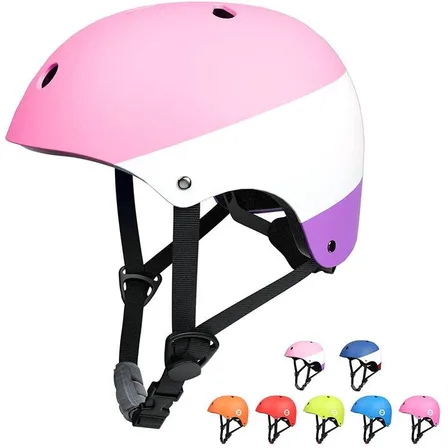
XJD Kids Bike Helmet for Boys & Girls, B White / Pink White
The XJD Kids Bike Helmet covers a wide age range — suggested for ages 2 through …$59.99